

A short definition
An option gives the holder the right to buy (a call) or sell (a put) the underlying at the strike price. American-style options, which include most US equity and ETF options, can be exercised on any business day up to expiration. European-style options, which include most cash-settled index options such as SPX, can only be exercised at expiration.
An option's price has two parts. Intrinsic value is what it would be worth if exercised now. Extrinsic value, or time value, is everything above that: the value of keeping the choice open. Exercising early collects the intrinsic value and gives up the extrinsic value. That is why, most of the time, selling the option is better than exercising it. Option moneyness and the option Greeks cover the pieces in more detail.
Quick reference
| Situation | Early exercise worth considering? | Why |
|---|---|---|
| Call, no dividend before expiry | Almost never | Time value is lost and nothing is gained |
| In-the-money call, dividend tomorrow, dividend larger than time value | Often | Exercise captures the dividend |
| In-the-money call, dividend smaller than time value | No | Selling the call keeps more value |
| Deep in-the-money put, high interest rates | Sometimes | Cash from the strike earns interest |
| Put, stock about to pay a dividend | Usually wait | The stock should fall by the dividend on the ex-date, helping the put |
| European-style index option | Not possible | Exercise only at expiration |
| Option facing a special dividend | Check for adjustment | Large special dividends usually trigger contract adjustments |
Why dividends drive early exercise of calls
Option holders do not get dividends. Shareholders of record do. When a stock goes ex-dividend, its price usually drops by about the dividend amount, so an in-the-money call loses roughly that much intrinsic value overnight.
A call holder has two choices on the day before the ex-date:
- Hold the call, keep its time value, and absorb the price drop.
- Exercise, give up the time value, own the stock, and receive the dividend.
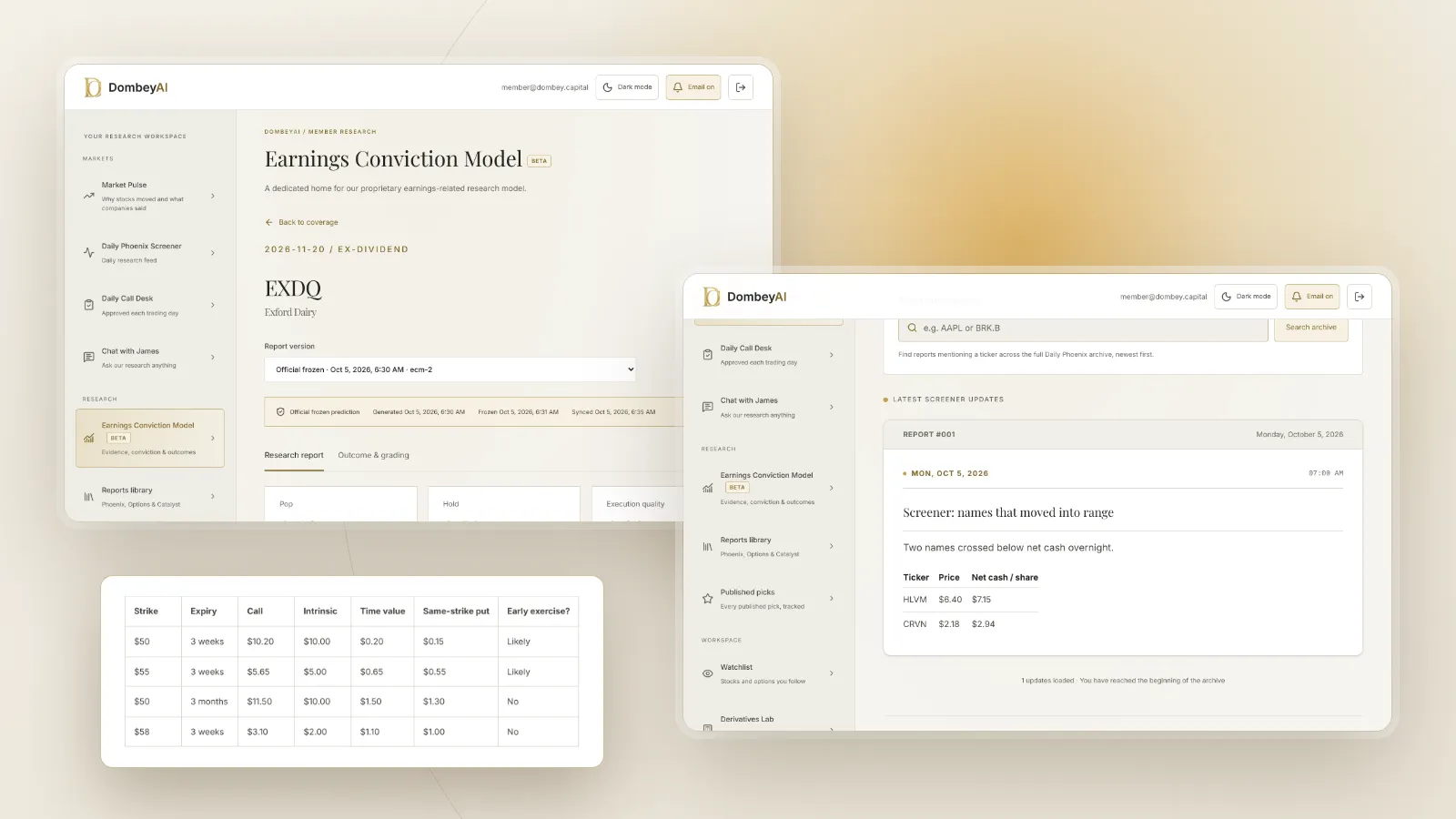
Exercise wins when the dividend is larger than the call's extrinsic value. For a call that is in the money, that extrinsic value is close to the price of the put at the same strike and expiry, a result of put-call parity. A simple check: if the same-strike put is trading for less than the dividend, early exercise of the call is likely to be worth it.
Since US stocks moved to one-day settlement in May 2024, the ex-dividend date and the record date generally fall on the same day. To be a holder of record, the shares must be owned by the end of the business day before the ex-date, so the call must be exercised by then. Brokers often set an earlier cutoff for exercise instructions.
If the same call had three months left and traded at $11.50, extrinsic value would be $1.50, larger than the dividend. Then holding, or selling the call, would keep more value.
Early exercise of puts
Puts face a different trade-off. Exercising a put means selling the stock at the strike and receiving cash. A deep in-the-money put has very little time value left, so the holder gives up little. The cash can then earn interest until the original expiry.
When interest rates are near zero, that benefit is small and early exercise of puts is rare. When rates are higher, a deep in-the-money put with months left can be worth exercising, because the interest on the strike over the remaining time exceeds the small time value. A coming dividend pushes the other way: the put gains when the stock drops on the ex-date, so put holders usually wait until after it.
Assignment risk for option sellers
Every early exercise is matched by an early assignment. The Options Clearing Corporation assigns exercise notices at random to clearing firms that have customers short that option, and each firm allocates them to its customers by a random or first-in, first-out method.
The highest-risk moments for an option seller are predictable:
- If you are short an in-the-money call and the stock goes ex-dividend tomorrow, check whether the dividend exceeds the call's time value. If it does, assignment is likely.
- If you are short a deep in-the-money put with little time value, assignment can come at any time, especially when rates are high.
- If you hold a spread with a short in-the-money call, such as a vertical spread or a covered call, early assignment of the short leg leaves you short the stock overnight and owing the dividend.
- If you are short options near expiration, see pin risk and what happens when options expire for the separate risks of the final day.
Being assigned on a short call before the ex-date means delivering shares. If you did not own them, you are now short the stock as of the ex-date and owe the dividend to the lender. In a spread, the long leg still exists, but the position has changed shape, and margin requirements can jump.
Event-driven cases
Early exercise and assignment come up more often around corporate events.
Special dividends. The OCC generally adjusts option contracts for special dividends that meet its size threshold, reducing the strike or changing the deliverable. When that happens, holders have no reason to exercise early. Ordinary and some smaller cash payments are not adjusted. Adjusted options explains how to read the new terms.
Cash takeovers. When a cash deal closes, options on the target are converted to a right to the cash price, and remaining time value collapses. Holders of deep in-the-money calls sometimes exercise before closing for practical reasons. What happens to options when a company is acquired covers the conversion.
Tender offers and spin-offs. A call holder cannot tender shares they do not own, so exercising before a tender deadline can be the only way to take part. Spin-offs usually lead to adjusted contracts.
For how recent corporate events have moved specific stocks, see the market coverage. Dombey's published research notes dividend and event dates in its options work; see the research archive.
Where this goes wrong
- Exercising when you could sell. If the option has meaningful time value, selling it and buying the stock separately usually beats exercise. Check the bid side of the option first.
- Forgetting the broker's cutoff. An exercise instruction after the broker's deadline on the day before the ex-date misses the dividend.
- Assuming you will not be assigned. Option sellers often assume assignment comes only at expiry. With American-style options, it can come any business day.
- Ignoring wide spreads. In thinly traded options, the bid can be far below fair value. Options liquidity explains why the quote can mislead the exercise decision.
- Missing a contract adjustment. If a special dividend or corporate action has adjusted the contract, the old rules of thumb may not apply.
The bottom line
Early exercise is the right to use an American-style option before expiry, and it usually costs the holder time value. The main exception is an in-the-money call the day before an ex-dividend date, when the dividend is larger than the call's time value; deep in-the-money puts can also be worth exercising when rates are high. Option sellers should treat those same moments as the times assignment is most likely. Check the dividend, the time value and the broker's cutoff before every ex-date on any position with a short in-the-money call.