

Who makes the adjustment and why
Standard US equity options are issued and cleared by OCC. Article VI, Section 11A of its by-laws sets out how contracts are adjusted after corporate events. Adjustment panels of OCC's Securities Committee decide each case, using the company's description of the event as an input but not as a binding one. The aim is fairness to both sides: a corporate action should not hand a windfall to call holders at the expense of call writers, or the reverse.
For each event, OCC publishes an information memo. It states the effective date, the new deliverable, the new symbol, any change to strikes or contract counts, and how fractional shares are handled. Exchanges republish the same terms in their own corporate action alerts. The memo governs the contract from the effective date onward.
Not every event is adjusted. Ordinary cash dividends are not, because option prices already reflect them. A regular increase in a quarterly dividend changes nothing in the contract.
How to spot an adjusted series
Three signs mark an adjusted contract:
- A changed symbol. OCC usually adds a number to the root, so options on XYZ become XYZ1 after the event, and new standard series are listed under the original root.
- A non-standard deliverable. The contract delivers something other than 100 shares: 150 shares, 100 shares plus shares of another company, or shares plus cash.
- A multiplier that does not match the deliverable. Premiums and strikes are usually still multiplied by 100 to get dollar amounts, even when the contract delivers 150 shares or a basket.
If option chains are new to you, how to read an option chain covers strikes, premiums and deliverables before the adjusted cases.
Stock splits and reverse splits
Splits are the simplest case, but the method depends on the ratio.
For whole-number splits, such as 2-for-1 or 5-for-1, OCC usually multiplies the number of contracts and divides the strike. A holder of one $60 call before a 2-for-1 split holds two $30 calls afterwards, each still for 100 shares. These are standard contracts, and no adjusted symbol is needed.
For other ratios, the deliverable usually changes instead. In a 3-for-2 split, a contract that delivered 100 shares delivers 150. The SEC order approving OCC's revised method in 2007 described keeping the strike unchanged in cases like this to avoid rounding windfalls, while noting that the older method of also reducing the strike would continue to apply where strikes are stated in decimals. The memo for each split states which applies, so read it rather than assuming.
Reverse splits always produce a non-standard contract. In a 1-for-10 reverse split, a contract that delivered 100 shares delivers 10 new shares, and the strike stays where it was. Any fraction is usually settled in cash. The explainer on reverse stock splits covers why companies do them and what else changes for shareholders.
Spin-offs
In a spin-off, each parent share receives shares of the new company. OCC adjusts the parent's options so that the deliverable includes both. If holders receive one new share for every four parent shares, a contract that delivered 100 parent shares now delivers 100 parent shares plus 25 shares of the new company. The strike stays the same, and the adjustment usually takes effect on the ex-distribution date.
This is where adjusted options are most often misread. On the ex-date the parent's price drops by roughly the value of the distribution, so the parent's chain makes old calls look further out of the money than they are. The value of the contract is now the value of the whole basket compared with the strike.
The adjusted series keeps its expiration date. New standard options on the parent are listed, and the new company may get its own options later once it meets listing standards. Spin-off investing covers why spun-off shares often trade poorly in the first weeks, which matters here because those shares are now part of the deliverable. The Form 10 guide shows where the distribution ratio and dates appear.
Special dividends
OCC adjusts for cash dividends that are not paid under a regular policy, subject to a minimum. Under the rule approved in 2007 and applied to dividends announced on or after February 1, 2009, a special cash dividend generally triggers an adjustment when it is worth at least $12.50 per contract, which is $0.125 a share on a 100-share contract. Dividends paid under a policy of regular quarterly or other periodic payments are treated as ordinary regardless of size.
The usual method is to cut every strike by the dividend amount. After a $5.00 special dividend, a $100 strike becomes a $95 strike, and the contract still delivers 100 shares. In some cases the cash is added to the deliverable instead. The memo states which. Because the strike moves with the stock on the ex-date, a call holder keeps the value of the dividend without having to exercise early. The explainer on special dividends covers the tax and price effects for shareholders.
Quick reference
| Event | Typical adjustment | Strike | Deliverable per contract | New symbol |
|---|---|---|---|---|
| 2-for-1 split | Contracts doubled | Halved | 100 shares | No |
| 3-for-2 split | Deliverable increased | Per the memo | 150 shares | Usually |
| 1-for-10 reverse split | Deliverable reduced | Unchanged | 10 shares | Yes |
| Spin-off, 1 for 4 | New shares added | Unchanged | 100 parent + 25 new company | Yes |
| Special dividend of $12.50 or more per contract | Strike cut by dividend | Reduced | 100 shares | Sometimes |
| Regular dividend | None | Unchanged | 100 shares | No |
| Merger | Deliverable becomes deal consideration | Usually unchanged | Cash, shares or both | Yes |
Worked example: a spin-off
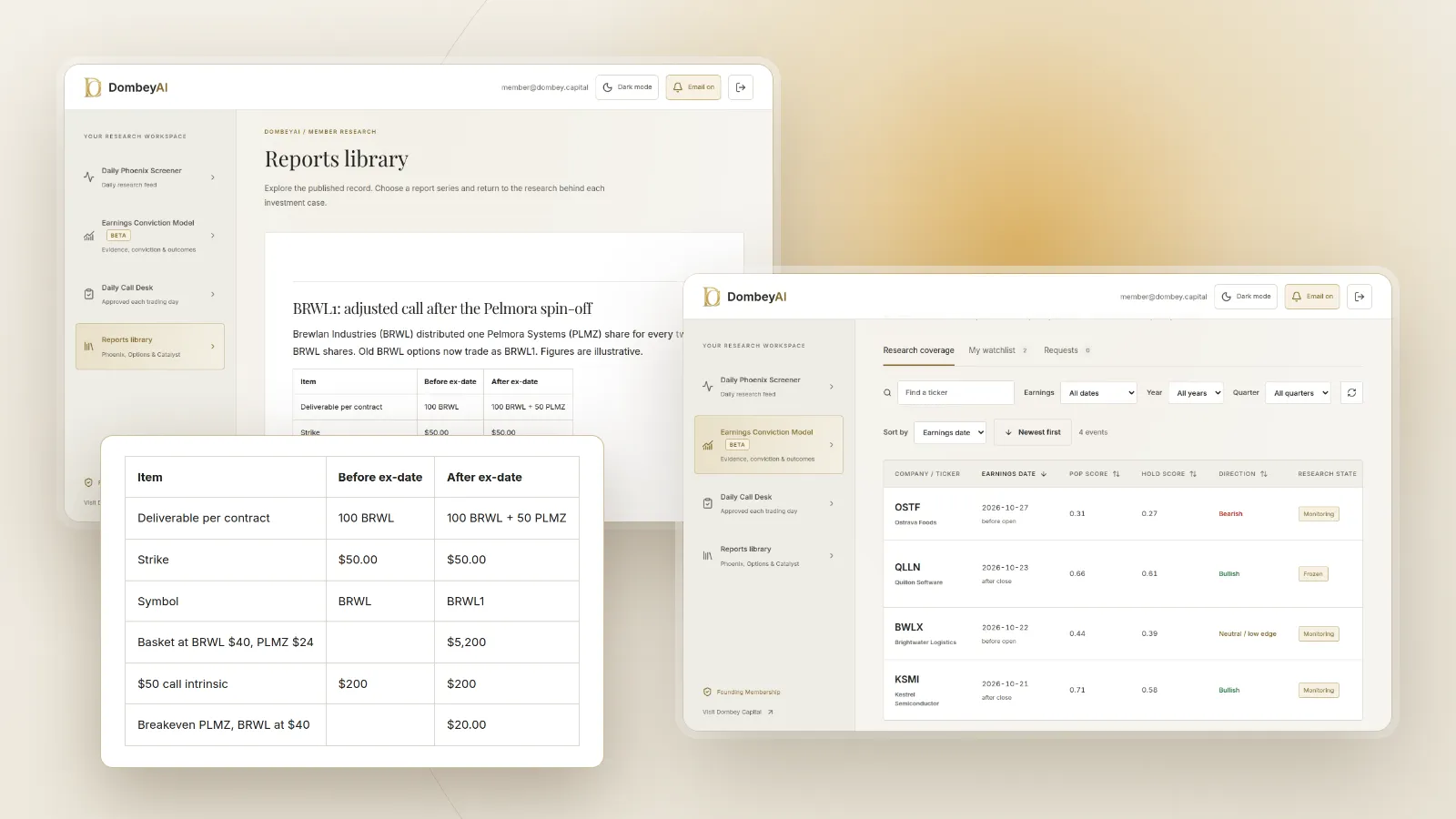
The adjusted contract now delivers 100 Company B shares and 50 Company C shares. The basket is worth $4,000 plus $1,200, or $5,200. The total exercise price is unchanged at $5,000, so the call has $200 of intrinsic value.
A chain that shows Company B at $40 next to a $50 strike suggests a call $10 out of the money. It is in fact $2 a share in the money on the basket. The breakeven also depends on two stocks: if Company C falls to $20, the basket is worth $5,000 and the intrinsic value is zero, even with Company B unchanged.
How adjusted options trade
Adjusted series are real contracts with the same clearing guarantee, but they behave differently after the event.
- Liquidity falls. New trading moves to the standard series listed after the event. Open interest in the adjusted series mostly shrinks as positions close. Market makers still quote them, but spreads are often wide, and the cautions in why wide spreads distort options signals apply with extra force.
- Quotes and Greeks can mislead. Some platforms compute implied volatility and delta as if the contract delivered 100 shares of one stock. On a basket, those figures can be wrong. Implied volatility only means something when the model prices the right deliverable.
- Open interest data mixes series. Comparing open interest before and after an adjustment needs both the old and new symbols, as the explainer on open interest before a catalyst explains.
- Covered positions can break. A covered call writer on a spin-off parent must hold both the parent shares and the new company's shares to stay fully covered. The explainer on covered calls around catalysts covers related assignment risks.
Where this goes wrong
The common failure is reading the contract as standard. A call on a basket priced against the parent alone looks cheap or worthless when it is not, and an order placed on that basis can fill at a poor price in a thin market.
Fractional shares and cash in lieu add small differences that are easy to miss. Over many contracts they add up, and they affect exercise and assignment amounts.
Exercise decisions also change. A spun-off company's shares may be thinly traded or subject to a when-issued period, so the cash value of the basket at exercise can differ from the screen value. Check how the broker handles automatic exercise of adjusted series at expiration.
Finally, memos can arrive late. When a company finalizes a ratio or a dividend shortly before the event, the adjusted terms may not be confirmed until close to the effective date. For live examples of how far stocks can move around corporate events, see today's biggest stock moves.
The bottom line
Adjusted options are listed contracts whose terms OCC changed after a split, spin-off, special dividend or merger, so that neither side gains or loses from the event. Whole-number splits usually leave standard contracts, while other splits, reverse splits and spin-offs leave non-standard deliverables under new symbols. Special dividends of at least $12.50 per contract are generally adjusted, usually by cutting the strike. Before acting on any adjusted series, read the OCC information memo and value the contract on its actual deliverable.