

A short definition
Pick two strikes, a lower strike K1 and a higher strike K2. A long box holds:
- A long call at K1 and a short call at K2 (a bull call spread)
- A long put at K2 and a short put at K1 (a bear put spread)
At expiration, the call spread pays something when the price is above K1, and the put spread pays something when it is below K2. Added together, they always pay K2 minus K1. The vertical spread explainer covers each half. The fixed payoff follows from put-call parity: the box is the difference between two synthetic forward positions.
Real examples: where boxes are built
| Product | Exercise style | Settlement | Early assignment risk | Suits a box? |
|---|---|---|---|---|
| SPX (S&P 500 index options) | European | Cash | None | Yes, the usual choice |
| XSP (Mini-SPX options) | European | Cash | None | Yes, smaller size |
| SPY (ETF options) | American | Shares | Yes | Risky |
| Single-stock options | American | Shares | Yes, especially before dividends | Risky |
Cboe's SPX specifications confirm the European exercise and cash settlement. The difference between styles is covered in European vs American options. SPX contracts are also about ten times the notional size of SPY contracts, which suits larger boxes, while XSP is sized closer to SPY.
The payoff, step by step
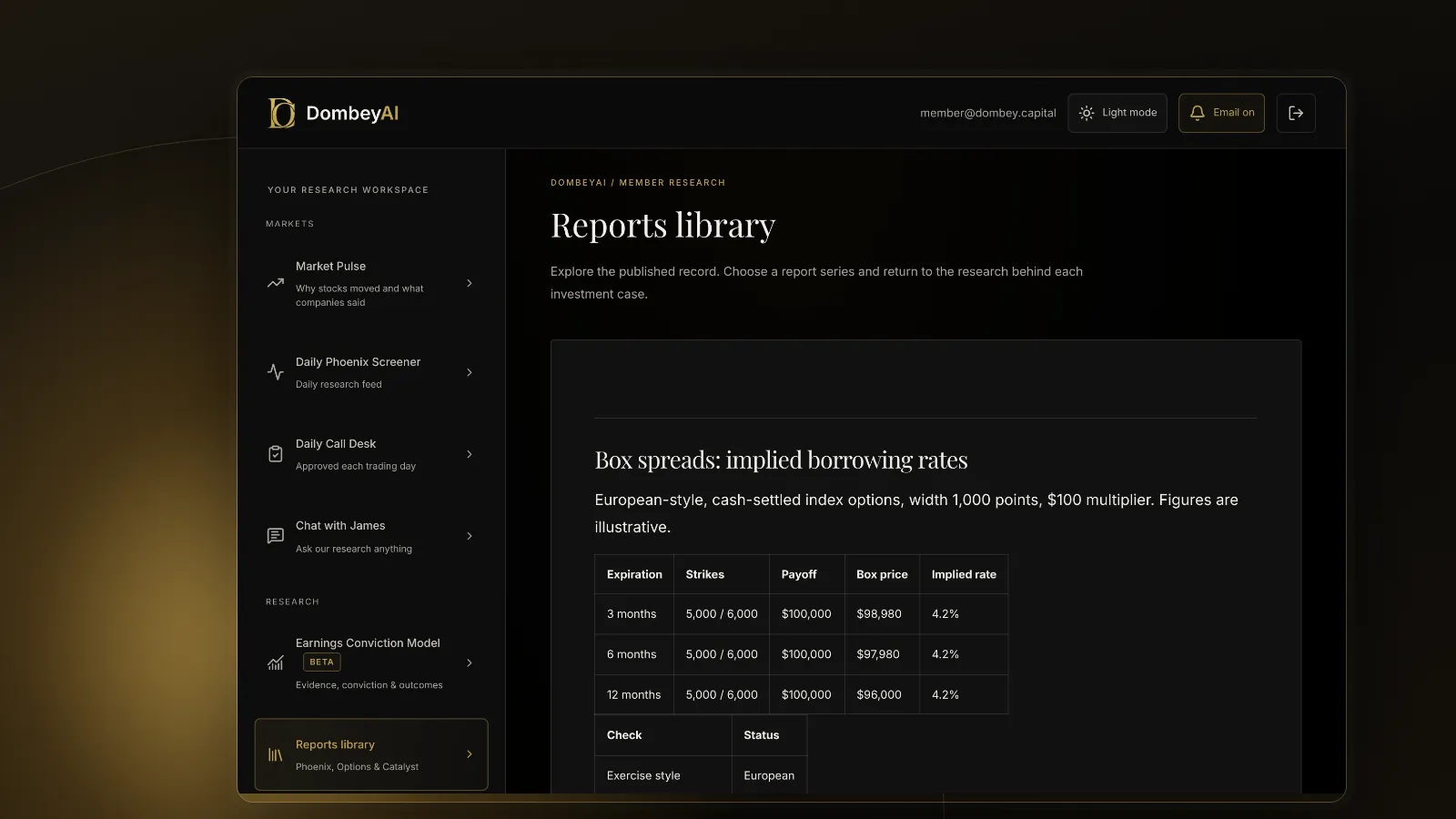
Take an SPX box with strikes 5,000 and 6,000. The width is 1,000 points, and each SPX option has a $100 multiplier, so the box pays $100,000 at expiration.
| Index at expiration | Call spread value | Put spread value | Box value |
|---|---|---|---|
| 4,500 | $0 | $100,000 | $100,000 |
| 5,500 | $50,000 | $50,000 | $100,000 |
| 6,500 | $100,000 | $0 | $100,000 |
The index level does not matter. What matters is what you pay for the box today.
Turning the price into a rate
The formula is: rate = (width times multiplier divided by price) minus one, annualized for the time to expiration. For a box six months out, square the ratio rather than doubling the rate if you want a compound annual figure.
Market makers price boxes close to the rates on short-term Treasury bills and other funding benchmarks, plus or minus a small spread. That is why a short box can be cheaper than a broker's margin loan rate, and a long box can earn close to a T-bill yield.
Who uses box spreads
- Individual investors with low trading costs, selling boxes as a source of borrowing against a portfolio, often in accounts with portfolio margin, where the box's limited risk is recognized in the margin requirement.
- Funds that use boxes in cash management or to finance positions.
- Market makers who use boxes to manage interest rate exposure across the option chain.
Boxes are also a check on option prices: if a box traded far from prevailing rates, arbitrage would push it back.
What breaks a box
Early assignment. With American-style options, the holder of a short leg's counterpart can exercise before expiration. If one of your short options is assigned, you suddenly hold stock or a short stock position and three remaining legs. Early assignment is most likely for deep in-the-money options and before dividends; early exercise of options explains why. In a widely reported 2019 case, a retail account built boxes on a single stock's American-style options, was assigned early and lost far more than the box could have earned. Brokers then restricted the strategy.
Execution. Four legs mean four bid-ask spreads. Most users enter boxes as a single order with a limit price, but wide quotes can still cost more than the rate advantage.
Margin and broker rules. Some brokers treat each leg separately for margin, or do not allow short boxes at all. A margin call at the wrong time can force you to close early at a poor price.
Tax. Index options such as SPX are generally Section 1256 contracts, with 60% long-term and 40% short-term treatment and year-end marking to market. How the borrowing cost on a short box is treated for tax purposes is not simple, and advisers disagree on details. Check with a tax adviser before using boxes as financing.
Pin and settlement details. For American-style options that settle in shares, a price near a strike at expiration creates pin risk: you may not know until after the close whether a leg is exercised.
A box as a check on implied rates
Even if you never trade a box, its price is useful. The implied rate from an index box gives you the market's financing rate for options, which feeds into how calls and puts are priced against each other. When you see a stock's options imply an unusual rate, it can point to hard-to-borrow shares, an expected dividend or a corporate event. For single-stock events such as a deal or a special dividend, those signals sometimes appear in the options before the news; our market pages cover stocks where that happens.
Long box vs short box
The same four legs can be held either way round, and the two sides suit different users.
| Long box | Short box | |
|---|---|---|
| Legs | Long K1 call, short K2 call, long K2 put, short K1 put | The reverse of each leg |
| Cash today | You pay the price | You receive the price |
| At expiration | You receive the width | You pay the width |
| Works like | Buying a zero-coupon bill | Taking a fixed-rate loan |
| Main use | Parking cash at a rate near T-bills | Borrowing against a portfolio |
| Main risk | Counterparty and execution costs | Margin calls, rolling at higher future rates |
A long box ties up cash until expiration, though it can be sold before then at the market price, which moves with interest rates like a short-dated bond. A short box gives cash now, but the obligation is fixed: if rates rise and you want to roll the loan at expiration, the next box will cost more. Choosing an expiration is choosing the term of the loan, so match it to how long you need the money, and leave room in the account for the margin the broker requires on the short legs.
Where this goes wrong
- Using American-style options. Early assignment can turn a fixed payoff into an open position.
- Ignoring costs. A few cents per leg on four legs can wipe out the rate advantage on a small box.
- Assuming the broker allows it. Many retail accounts cannot sell boxes, and margin treatment varies.
- Borrowing too much. A short box is still a loan; it must be repaid at expiration, and rolling it later depends on future rates and access.
- Overlooking tax. The treatment of gains and losses can differ from what you expect for a loan.
The bottom line
A box spread pairs a call spread and a put spread with the same strikes so the payoff at expiration is fixed, which turns its price into an interest rate. Buying a box lends; selling one borrows, usually at rates near Treasury bills. Build it only with European-style, cash-settled options such as SPX, enter it as one order, and check your broker's margin rules and the tax treatment first. Used carelessly, a box can lose far more than it was ever meant to earn.