

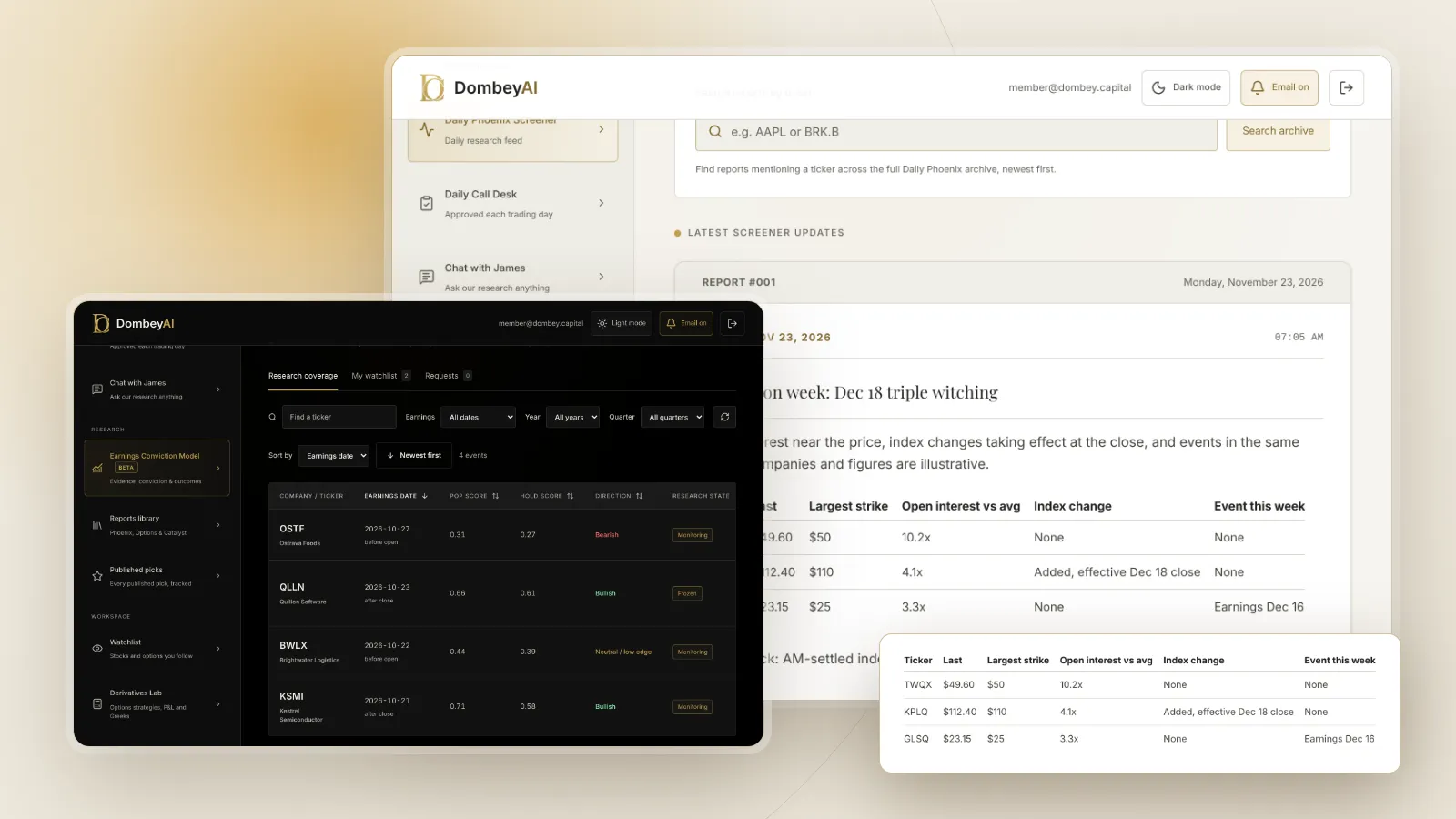
A short definition
Options and futures expire on fixed calendars. Standard monthly stock options expire on the third Friday of every month. Stock index futures, such as the E-mini S&P 500, expire quarterly, on the third Friday of the contract month. Index options have both monthly and quarterly cycles. Four times a year all three line up, and that day is triple witching.
The name is market slang, from the "witching hour" of the final hour of trading. The older term "quadruple witching" also counted single-stock futures, which no longer trade in the United States.
Real examples: the next triple witching dates
| Date | What expires | What else usually takes effect at the close |
|---|---|---|
| December 18, 2026 | Monthly stock and ETF options, quarterly index options, December index futures | S&P 500 quarterly rebalance; Nasdaq-100 annual reconstitution |
| March 19, 2027 | Monthly stock and ETF options, quarterly index options, March index futures | S&P 500 quarterly rebalance |
| June 18, 2027 | Monthly stock and ETF options, quarterly index options, June index futures | S&P 500 quarterly rebalance |
| September 17, 2027 | Monthly stock and ETF options, quarterly index options, September index futures | S&P 500 quarterly rebalance |
| December 17, 2027 | Monthly stock and ETF options, quarterly index options, December index futures | S&P 500 quarterly rebalance; Nasdaq-100 annual reconstitution |
Index providers announce each rebalance in advance and set the effective dates. Check their notices for any date that matters to a position, because schedules can change. Our list of index change trackers covers where to find them.
What actually happens on the day
Three kinds of activity overlap.
Expiring options. Holders of in-the-money stock options either close them or let them be exercised into shares; what happens when options expire walks through the rules. Dealers who sold those options unwind the stock they held as a hedge.
Index futures and index options settlement. Many index products are AM-settled: trading stops on Thursday, and the final value is the special opening quotation, calculated from the first trades of each component stock on Friday morning. That makes the Friday open important for index traders. PM-settled contracts, including many weekly index options, settle on the Friday close instead.
Index rebalancing. Index funds trade in the closing auction to match quarterly index changes. Adding stocks, removing stocks and changing share counts all happen at once. See how index deletions create forced selling for what that does to the names involved.
The result is a large spike in volume at the open and at the close, with the closing auction often the busiest few minutes of the quarter.
Why prices can move near strikes
When a large amount of open interest sits at one strike, dealer hedging can pull the stock toward it in the final hours, a pattern often called pinning. The gamma exposure explainer covers the mechanism: dealers who are long gamma sell into rallies and buy dips, which dampens moves, while dealers who are short gamma do the opposite.
Pinning is a tendency, not a rule. News, index trades and large orders regularly overwhelm it. Max pain is a related idea, and it has the same limits.
What to check for a stock you own
| Check | Where to find it | Why it matters |
|---|---|---|
| Open interest by strike | The option chain for the expiring month | Large strikes near the price can pin or release it |
| Index changes taking effect | Index provider announcements | Closing auction buying or selling |
| Earnings or events near the date | Company calendar; 8-Ks | Event risk stacked on top of expiration |
| Your own expiring options | Brokerage account | Exercise and assignment decisions |
| Liquidity at the close | Closing auction imbalance data | Wide prints and fast moves |
The open interest explainer shows how to read the chain before a dated event. Event-driven coverage on our market pages flags names where expiration overlaps with a catalyst.
Triple witching and the index calendar
The overlap with index changes is what turns an expiration day into one of the year's busiest sessions. The S&P 500 and the other S&P indexes rebalance quarterly, with share count and float changes effective after the close on the third Friday of March, June, September and December. The Nasdaq-100 reconstitutes annually in December, on the same schedule. Other providers have their own calendars, and some of their dates also fall near quarterly expiration.
Index funds that track these benchmarks must own the new weights at the close, so they trade in the closing auction. When a stock is added, funds buy; when it is removed, they sell. Those orders arrive on the same afternoon that options and futures positions are being closed and hedges unwound.
| Week or date | Event | What to check |
|---|---|---|
| About two weeks before | Index provider announces quarterly changes | Additions, deletions and share count changes |
| Monday to Thursday of expiration week | Positioning and rolls in futures and options | Open interest and roll activity |
| Thursday close | Last trading for AM-settled index options and futures | Positions that settle on Friday's open |
| Friday open | Special opening quotation calculated | Opening prices of index components |
| Friday close | Monthly options expire; index changes take effect in the closing auction | Closing imbalances; assignment notices |
| The following Monday | New index weights in force; new front-month contracts | Whether price moves held or reversed |
For stocks with their own catalyst in expiration week, such as earnings or a merger vote, the effects stack. The options implied move will reflect the event, and expiration flows add noise around it. Keep the two apart when you read the price action.
Where this goes wrong
- Treating the date as a signal. There is no reliable pattern for whether stocks rise or fall on or after triple witching. Volume rises; direction does not follow.
- Forgetting AM settlement. An index option position held through Thursday's close settles on Friday's opening prices, which can differ sharply from Thursday's close.
- Ignoring assignment. Short options in the money at expiration are likely to be assigned. Early assignment risk also rises before dividends, as covered in early exercise of options.
- Trading in the closing minutes. Market orders near the close can fill at prices far from where the stock traded a few minutes earlier.
- Reading one day's move. A stock that moves on triple witching because of index trades may reverse the next week. Look for news before assuming the market learned something.
The bottom line
Triple witching is the quarterly day when stock options, index options and index futures expire together, usually alongside index rebalances. It brings heavy volume at the open and the close, and sometimes pinning near large strikes. It does not predict direction. If you hold options or a stock with large open interest or an index change, check the chain, the settlement method and the closing auction before the day.