

How a vertical spread works
The name comes from the option chain, where strikes for one expiration are listed in a column. A vertical spread picks two strikes from the same column. Our guide on how to read an option chain shows the layout.
Three numbers define the trade:
- The long strike, the option you buy.
- The short strike, the option you sell.
- The net premium, a debit if the bought option costs more than the sold one, a credit if it costs less.
At expiration the spread is worth something between zero and the strike width. Everything else, the maximum gain, the maximum loss and the breakeven, follows from those three numbers.
The four vertical spreads
| Spread | Legs | Net premium | View | Max gain | Max loss |
|---|---|---|---|---|---|
| Bull call spread | Buy lower-strike call, sell higher-strike call | Debit | Stock rises | Width minus debit | Debit |
| Bear put spread | Buy higher-strike put, sell lower-strike put | Debit | Stock falls | Width minus debit | Debit |
| Bull put spread | Sell higher-strike put, buy lower-strike put | Credit | Stock stays above the short strike | Credit | Width minus credit |
| Bear call spread | Sell lower-strike call, buy higher-strike call | Credit | Stock stays below the short strike | Credit | Width minus credit |
Each figure is per share; a standard equity option contract covers 100 shares.
Debit spreads
A debit spread is a bought option with part of its cost paid for by selling a further out-of-the-money option. You give up gains beyond the short strike in exchange for a lower cost and a nearer breakeven.
The bear put spread works the same way in the other direction: buy a put at or near the money and sell a lower-strike put.
Credit spreads
A credit spread sells the option nearer the money and buys a further one as protection. You keep the credit if the stock stays on the right side of the short strike at expiration.
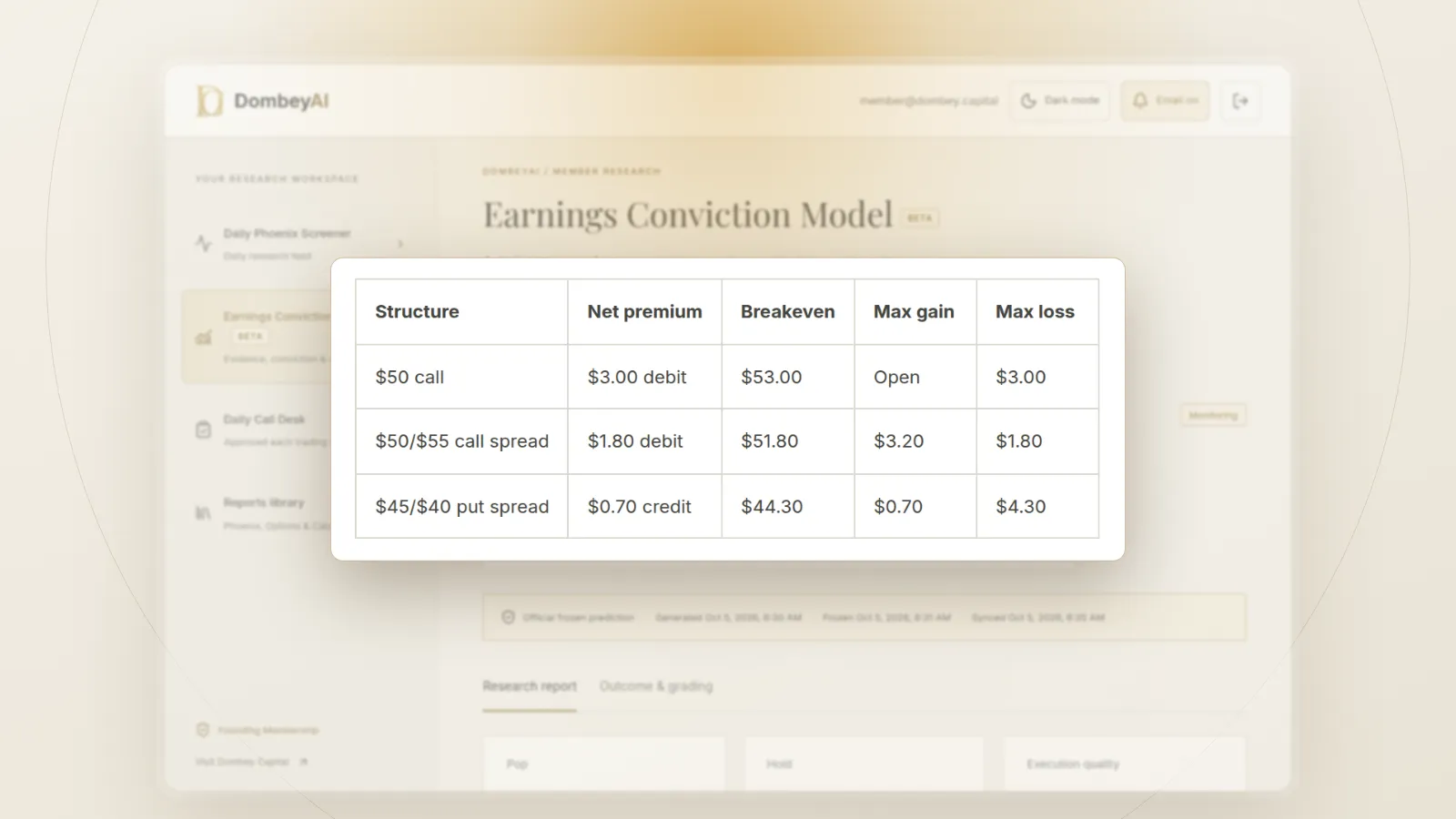
Using the same illustrative chain, selling a $45 put for $1.10 and buying a $40 put for $0.40 brings in $0.70. The position keeps the full $0.70 if Company A closes above $45 at expiration, loses money below $44.30 and loses at most $4.30 below $40.
Credit spreads have a high chance of a small gain and a low chance of a larger loss. In option prices the two tend to offset, so a credit spread is not a way to collect income for free. The option greeks show how the position's value changes with the stock, time and volatility.
Using vertical spreads around a catalyst
Catalysts such as earnings, drug decisions or court rulings push implied volatility up before the event and down afterward. A single bought option pays that inflated volatility and loses value when it collapses, the effect known as IV crush. In a vertical spread, the sold option carries similar inflated volatility, so much of the effect cancels.
That changes how the trade is planned:
- If you expect a move about the size the market implies, compare the spread's breakeven with the implied move from options.
- If you expect a large move, a single option keeps the upside that a vertical caps.
- If you expect the stock to stay in a range, credit spreads on both sides form an iron condor.
- If you expect the stock to finish near a specific price, a butterfly spread targets that price more directly.
Strike width sets the risk. A wider spread costs more, pays more and behaves more like a single option. A narrow spread is cheap, but bid-ask costs on two legs take a larger share of its value.
Managing the position before expiration
Most vertical spreads are closed before expiration rather than held to the last day. Closing both legs together, as one spread order, avoids leaving one leg open by accident and lets you set a single net price.
Time works differently on the two families. A debit spread loses value as time passes if the stock does not move, though more slowly than a single bought option because the short leg decays too. A credit spread gains value as time passes if the stock stays on the right side of the short strike. Near expiration, the spread's value moves quickly toward either zero or the full width as the stock crosses the strikes, which is why many traders close well before the final days.
Choose the expiration with the catalyst in mind. An expiration just after the event captures the move with the least time value, while a later one gives the thesis more time at a higher cost.
Vertical spreads vs a single option
Pros
- The maximum loss is known before the trade.
- Lower cost and a nearer breakeven than a single bought option.
- Less exposure to the fall in implied volatility after an event.
Cons
- The gain is capped at the strike width.
- Two legs mean two bid-ask spreads and two commissions.
- The short leg can be assigned early.
Where this goes wrong
- Early assignment. American-style equity options can be exercised at any time. A deep in-the-money short call is often assigned the day before an ex-dividend date, leaving a short stock position and a dividend owed.
- Pin risk. If the stock closes near the short strike at expiration, you may not know whether the short option will be exercised, and the long option may expire worthless. The result can be an unwanted stock position over a weekend.
- Liquidity. Wide markets on either leg can make the spread expensive to open and close. Our explainer on options liquidity covers how to read the quotes.
- Corporate actions. Mergers, special dividends and spin-offs can adjust the contract terms of both legs, which changes what the spread delivers.
For daily coverage of stocks moving on earnings and other catalysts, see Dombey's market coverage. Dombey's published research includes options analysis around dated events; see the research archive.
The bottom line
A vertical spread buys one option and sells another of the same type and expiration at a different strike, which fixes the maximum gain and loss from the strike width and the net premium. Debit spreads need the stock to move; credit spreads need it to stay on one side of a strike. Around a catalyst, the sold leg reduces the cost and the exposure to falling volatility, at the price of a capped gain. Work out the breakeven, the worst case and the assignment risk before the trade, not after.