

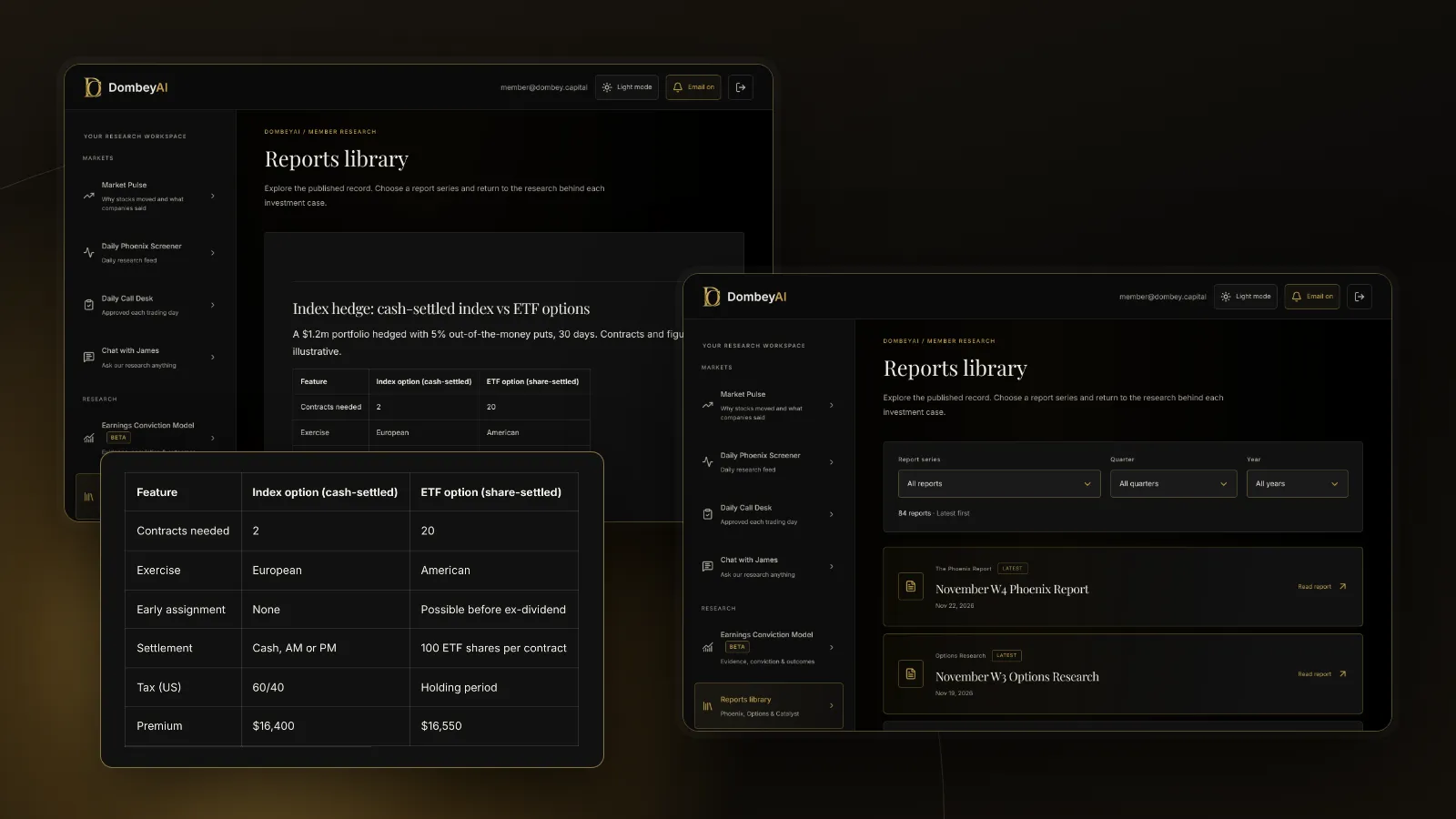
The core differences
| Feature | SPX | SPY |
|---|---|---|
| Underlying | S&P 500 index | SPDR S&P 500 ETF Trust |
| Exercise style | European (at expiration only) | American (any time before expiration) |
| Settlement | Cash | Delivery of 100 ETF shares per contract |
| Notional size | About 10 times SPY | About one tenth of SPX |
| Early assignment risk | None | Yes, especially before ex-dividend dates |
| Dividends | No effect on assignment | Quarterly distributions affect pricing and early exercise |
| US tax treatment | Generally Section 1256 (60/40) | Ordinary equity option rules |
| Settlement value | AM (monthly) or PM (weekly and daily SPXW) | Closing ETF price, then shares |
| Smaller alternative | XSP, one tenth of SPX | Not needed |
Both contracts use a multiplier of 100. The size difference comes from the underlying: the S&P 500 index trades at roughly ten times SPY's share price, because the ETF was set up to track about one tenth of the index.
Settlement: cash versus shares
SPX settles in cash. At expiration, an in-the-money SPX option pays the difference between the strike and the settlement value, times 100. Nothing is delivered. A long call that finishes 20 points in the money pays $2,000, and the position is gone.
SPY settles in shares. An in-the-money SPY call that is exercised delivers 100 ETF shares per contract at the strike price, and a short call that is assigned requires the writer to deliver them. Most brokers automatically exercise options that finish in the money by a small amount, which can leave a trader holding a large ETF position on Monday morning that they never intended to own. Our article on what happens when options expire covers the mechanics.
Exercise style and early assignment
SPX options are European-style. They can only be exercised at expiration, so a short SPX position cannot be assigned early. SPY options are American-style. Any holder can exercise at any time, and short positions can be assigned without warning.
Early assignment on SPY is most likely in two cases. The first is a deep in-the-money call just before the ETF goes ex-dividend, when the call holder exercises to capture the distribution. The second is a deep in-the-money put with little time value left. For a spread trader, an early assignment on one leg can turn a defined-risk position into a stock position overnight. Our comparison of European and American options and the guide to early exercise explain when it is rational.
AM and PM settlement
This is the detail that catches SPX traders most often.
- Standard monthly SPX options stop trading at the close on the day before expiration, usually Thursday. They settle on a special opening quotation of the S&P 500 calculated from the opening prices of its component stocks on expiration morning. This is AM settlement.
- Weekly and daily SPX options, traded under the symbol SPXW, settle on the index closing value on the expiration day. This is PM settlement. Cboe lists SPXW expirations for every weekday.
An AM-settled position carries overnight risk from Thursday's close to Friday's open, and the settlement value can differ noticeably from both Thursday's close and Friday's opening index print. SPY options, like other ETF options, settle on the closing price on expiration day.
Taxes
For US taxpayers, broad-based index options such as SPX are generally treated as Section 1256 contracts. Gains and losses are taxed 60% as long-term and 40% as short-term capital gains, whatever the holding period, and open positions are marked to market at the end of the year. For an active trader who would otherwise realize mostly short-term gains, the blended rate is lower.
SPY options are options on an ETF, which the tax rules generally treat like equity options. Gains and losses are short-term or long-term depending on how long the position was held, and most options trades are short-term. Exercise and assignment also roll into the cost basis of the ETF shares.
The rules have details, such as how wash sales and straddle rules apply, and they differ by country. IRS Publication 550 covers Section 1256 contracts, and a tax adviser should confirm how they apply to you.
Size, cost and liquidity
Size is the practical difference for most individual investors. One SPX contract controls about ten times the value of one SPY contract, so a position that would take ten SPY contracts takes one SPX contract.
| Consideration | SPX | SPY |
|---|---|---|
| Notional per contract | About 10 times SPY | Smaller, easier to scale in small steps |
| Commissions per dollar of exposure | Lower for large positions, since there are fewer contracts | Higher for large positions |
| Bid-ask spread in dollars | Wider per contract | Narrower per contract |
| Spread as a share of notional | Comparable for liquid strikes | Comparable for liquid strikes |
| Fees | Cboe charges index option fees | Standard equity option fees |
| Smaller cash-settled alternative | XSP (one tenth of SPX) | Not applicable |

Both are among the most liquid options in the world. Liquidity thins in far out-of-the-money strikes and long-dated expirations, where the guidance in our article on options liquidity applies.
Which to use around market events
Index options matter for event-driven investors mainly as hedges and as a read on market-wide expectations. Before a Federal Reserve decision, a jobs report or an inflation release, the implied move in SPX or SPY options shows how much the market is pricing for the day. The VIX is calculated from SPX option prices.
- If you want to hedge a large portfolio against a market drop, SPX puts do it with fewer contracts and no assignment risk.
- If you hold a small account or want to adjust in small increments, SPY or XSP fits better.
- If the hedge must cover an overnight event before a monthly expiration, be clear whether the contract is AM- or PM-settled.
- If you trade spreads near ex-dividend dates, SPX avoids the early assignment problem that SPY spreads can face.
For our coverage of dated market and company events, see the market section. Dombey's published research covers event-driven options on single stocks rather than index trading; see the research archive.
Where this goes wrong
- Forgetting AM settlement. Holding a monthly SPX position into Thursday's close leaves you exposed to the next morning's opening print, with no way to trade out.
- Ignoring early assignment on SPY. Short calls before an ex-dividend date and deep in-the-money short puts can be assigned at any time.
- Underestimating size. One SPX contract is large. A trader used to SPY can take on ten times the intended exposure by switching symbols without adjusting the count.
- Assuming the tax benefit applies. Section 1256 treatment depends on the product and on your tax situation. It does not apply in tax-advantaged accounts in the same way and varies outside the US.
- Treating SPX and SPY prices as identical. The ETF tracks the index closely but not perfectly, and it pays dividends, so strikes do not line up exactly at ten to one.
The bottom line
SPX and SPY options both give exposure to the S&P 500, but they are different contracts. SPX is cash-settled, European-style, about ten times larger and generally taxed under the 60/40 rule in the US. SPY settles in shares, can be assigned early and follows the normal equity option tax rules. SPY and XSP suit smaller positions; SPX suits larger ones and removes assignment and delivery. Whichever you use, check whether the contract settles on the open or the close before holding it into expiration.