

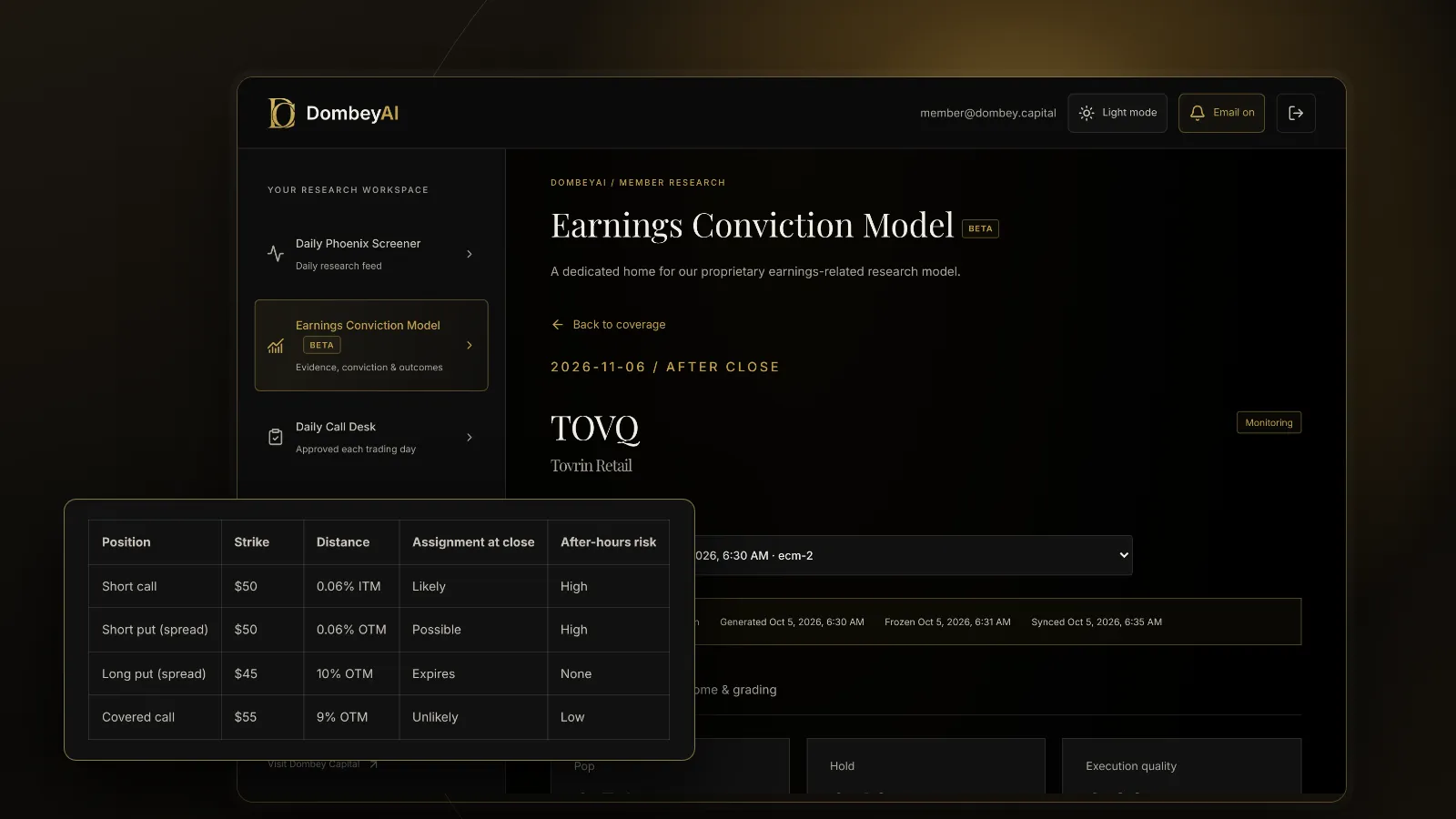
How option expiration creates pin risk
At expiration, a stock option either becomes a stock trade or disappears. A call that is exercised turns into a purchase of shares at the strike; a put that is exercised turns into a sale. For the seller, exercise means assignment: they must deliver or take the shares.
When the stock closes well away from the strike, the outcome is obvious. A $50 call with the stock at $56 will be exercised; with the stock at $44, it will expire. The problem is the narrow band around the strike. A close of $50.03 or $49.97 leaves the result to the decisions of holders the seller never sees.
Three features of the system make that band uncertain:
- Automatic exercise has a threshold. Under the Options Clearing Corporation's exercise-by-exception process, equity options in the money by $0.01 or more at expiration are exercised automatically unless the holder instructs otherwise.
- Holders can override it. A holder can decline to exercise an option that is slightly in the money, or choose to exercise one that is at or slightly out of the money. Transaction costs, a view on after-hours news or a hedge elsewhere can all drive that choice.
- The cut-off is after the close. Trading stops at 4:00 p.m. Eastern, but holders can submit exercise instructions after that, up to a deadline set by industry rules and earlier deadlines set by each broker. News released in that window can change their decision.
Assignment itself is allocated: the OCC assigns exercises to clearing firms at random, and each broker allocates them among its customers by a method it discloses. A seller with ten contracts may be assigned on some, all or none.
Quick reference
| Situation at expiration | Default outcome | What the seller faces |
|---|---|---|
| Deep in the money | Exercised automatically | Assignment is near certain; plan for it |
| In the money by a few cents | Exercised automatically unless holder declines | Likely assignment, not certain |
| Exactly at the strike | Not exercised automatically | Holder may still exercise |
| Out of the money by a few cents | Expires unless holder chooses to exercise | Possible assignment, especially after news |
| Far out of the money | Expires worthless | Minimal assignment risk |
| Cash-settled index option | Settled in cash | No shares delivered, so little pin risk |
Worked example: a pinned covered call
The calls are in the money by $0.02, so they are exercised automatically unless their holders decline. You expect to be assigned and to deliver your 1,000 shares at $50. That is the outcome a covered call is built for.
Now change one detail. At 4:45 p.m. the company announces that a large customer contract has been renewed, and the stock trades at $51.20 after hours. Every call holder now exercises. You are assigned, as expected, but you have given up the after-hours gain. That is a known feature of covered calls, not pin risk.
The pin risk case is the reverse:
You now hold 400 shares instead of 1,000, and the call you planned to sell on Monday covers the wrong amount. If you had sold calls against shares you did not own, the same after-hours exercise would leave you short 600 shares over the weekend, with no limit on the loss if the stock gaps higher.
Pin risk in spreads
Spreads are where pin risk most often surprises traders, because the position looks hedged.
Take a bull put spread: short a $50 put and long a $45 put. If the stock closes at $50.01, the short put expires out of the money by a cent. If some holders exercise it anyway, you are assigned and buy shares at $50. Your long $45 put expires worthless because it is far out of the money. The spread is gone, and you own stock with no hedge.
The same thing happens with an iron condor when the stock finishes near one of the short strikes, and with any vertical spread where only the short leg is near the money. The defined-risk profile you paid for only holds while both legs exist.
Why stocks sometimes close near a strike
Traders talk about stocks being "pinned" when they close very near a strike with large open interest on expiration day. One explanation is hedging: dealers who are long options at that strike hedge by selling stock as it rises above the strike and buying as it falls below, which can damp moves near the strike in the final hours.
Whether that effect is large for a given stock is uncertain, and it is not a forecast tool. The related idea of max pain tries to predict a closing price from open interest. Pin risk does not depend on any such forecast. It matters whenever the stock happens to finish near your strike, for whatever reason. For background on how dealer hedging is estimated, see gamma exposure, and for reading where open interest sits, see open interest before a catalyst.
Pin risk around catalysts
Pin risk is worst when news can arrive between the close and the exercise deadline, or over the weekend before the next open. Many companies release earnings, deal news and regulatory updates after the close. A short option that expires on the same day as a scheduled after-hours report carries pin risk and event risk at once.
Some situations to watch:
- Earnings after the close on expiration day. The stock may finish near the strike, then move several percent in after-hours trading before exercise decisions are final.
- A pending deal. If a target trades near a strike as a vote or regulatory decision approaches, assignment can leave you with stock exposed to a deal break. Our explainer on what happens to options when a company is acquired covers how terms adjust once a deal closes.
- Ex-dividend dates. A short call that is in the money just before an ex-dividend date may be exercised early by a holder who wants the dividend. That is early assignment rather than pin risk, but it often hits the same positions. See covered calls around catalysts.
How traders manage pin risk
The controls are simple, and most cost a little to use.
- Close near-the-money short options before the final close. Buying back a short option worth a few cents removes the uncertainty for that price.
- Close spreads as a unit. Exit both legs together rather than letting either expire.
- Roll early. If you want to keep the position, roll the short option to a later expiry before the last session, not after.
- Know the broker's rules. Brokers publish expiration procedures, exercise cut-offs and how they allocate assignments. Some close customer positions on their own near the deadline.
- Check the calendar. Before selling an option, look for company events between the expiry date and the next trading day. A catalyst calendar makes this a routine check.
- Price the exit, not the mid. Near-expiry options on smaller stocks can have wide bid-ask spreads; see options liquidity.
Where this goes wrong
Assuming out of the money means safe. An option a few cents out of the money at 4:00 p.m. can still be exercised. After-hours news is the usual reason.
Relying on the long leg. A long option that expires worthless gives no protection against stock acquired through assignment on the short leg.
Ignoring the weekend. Assignment notices for Friday expirations often arrive before Monday's open, but you cannot trade the resulting position until the market opens. A weekend of news can move the stock a long way.
Forgetting account limits. An unexpected assignment can create a position larger than the account can carry, leading to a margin call or a forced liquidation at a poor price.
The bottom line
Pin risk is the uncertainty over assignment when a stock closes near a short option's strike at expiration. Exercise-by-exception rules, holder discretion and the gap between the close and the exercise deadline mean a seller cannot know the outcome until it is too late to trade. The risk grows when news can arrive after the close and when a spread relies on a long leg that may expire worthless. Closing or rolling near-the-money short options before the final session is the plain answer. For the events moving options prices now, see the market coverage.