

A short definition
Margin is the equity an investor must keep in an account that borrows from the broker or holds positions with open-ended risk, such as short options. In the United States there are two main ways to calculate it:
- Strategy-based margin (Regulation T). Each position or recognized strategy has a fixed requirement. Buying stock on margin requires 50% initial margin under Regulation T, FINRA sets a maintenance minimum of 25% for long stock, and options strategies have their own formulas.
- Portfolio margin. The broker models the gain or loss of every position in the account under a set of price moves and uses the worst result as the requirement. It is permitted under FINRA Rule 4210(g) and the matching exchange rules.
The idea is simple: margin should reflect how much the account could lose, not how many positions it holds.
Real examples of the rules
| Rule | What it says | Where it comes from |
|---|---|---|
| Stress range for stocks | Revalue each stock and its options at ten points across a move of 15% up and down | FINRA Rule 4210(g) |
| High-cap broad-based indexes | Up 6% and down 8% | FINRA Rule 4210(g) |
| Other broad-based indexes | Up and down 10% | FINRA Rule 4210(g) |
| Minimum charge | $0.375 per contract times the multiplier, so a fully offset position still carries some margin | FINRA Rule 4210(g) |
| Unlisted derivatives | At least $5 million of account equity | FINRA Rule 4210(g) |
| House requirements | Brokers may add charges for concentration, volatility or low liquidity | Broker policy, allowed under FINRA rules |
| Reg T comparison | 50% initial margin on stock purchases; 25% FINRA maintenance minimum | Regulation T and FINRA Rule 4210 |

The theoretical values in the model come from an options pricing model, so implied volatility affects the requirement as well as price. Many brokers use the Theoretical Intermarket Margining System run by the Options Clearing Corporation, or their own version of it.
How the calculation works
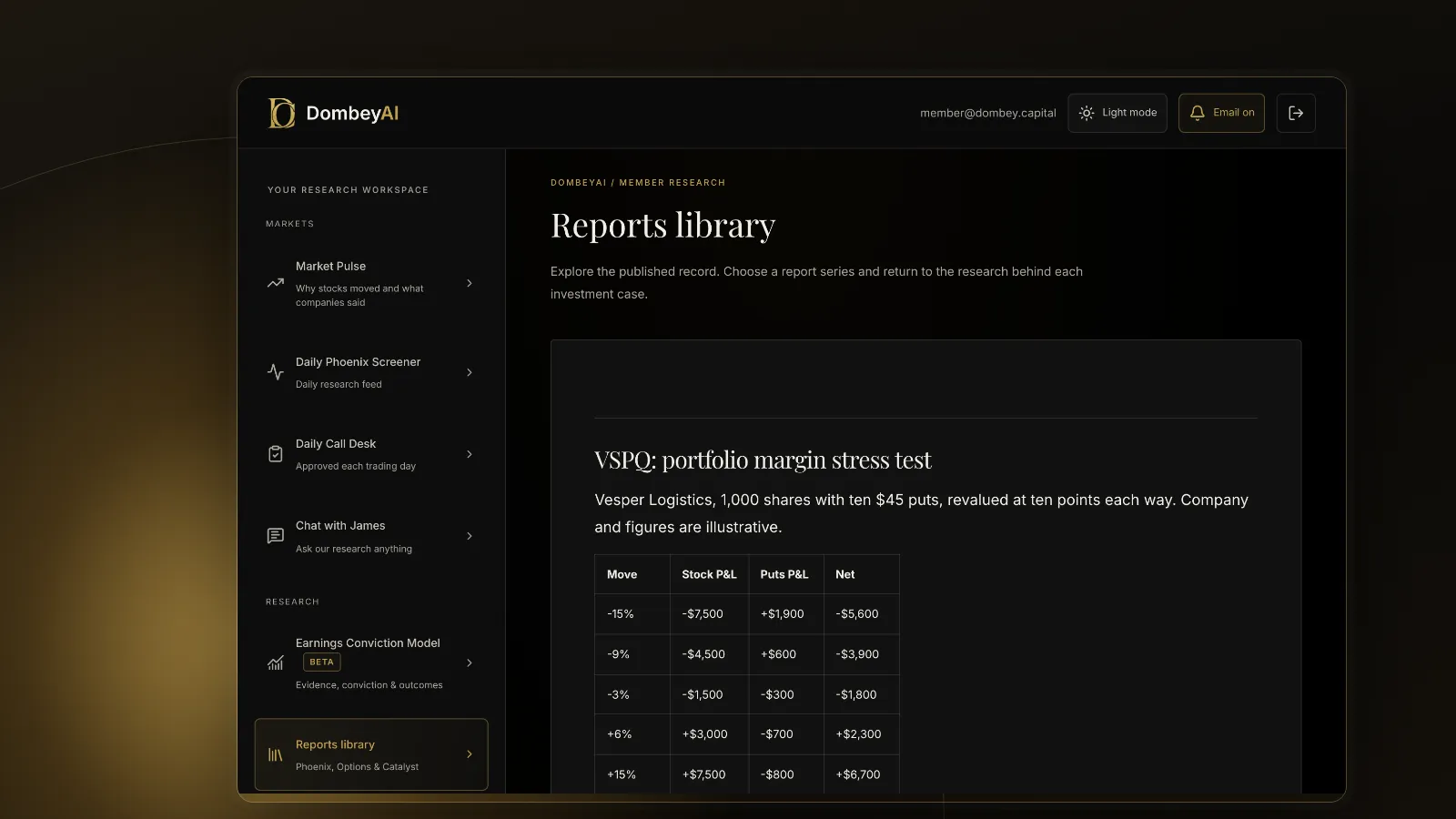
The broker takes each underlying stock or index in the account, moves its price to ten equally spaced points on each side within the stress range and revalues every position on that underlying at each point. The loss at the worst point is the requirement for that group. The groups are then added up, with some offsets allowed between closely related index products. The requirement is the larger of that worst loss and the minimum charge per contract.
Two details matter in practice. First, the theoretical values use implied volatility, so a rise in volatility can raise the requirement even when prices do not move. Second, the calculation runs on the positions you hold at that moment, and brokers also monitor intraday risk, so opening a large unhedged position during the day can produce a call before the close.
The same logic works in reverse. A short put with no hedge has a modeled loss at the bottom of the stress range that may be close to, or higher than, the Reg T requirement. Portfolio margin rewards hedging; it does not reward taking risk.
Who uses portfolio margin
| Account type | Effect of portfolio margin |
|---|---|
| Hedged stock plus protective puts or collars | Requirement usually falls sharply |
| Defined-risk spreads, such as iron condors and verticals | Requirement often falls to near the spread's maximum loss, sometimes less |
| Box spreads and conversions | Very low requirement, since the risk is mostly financing |
| Unhedged short options | Little benefit, sometimes a higher requirement |
| A few concentrated stock positions | Broker concentration charges can erase the benefit |
Spreads are a common reason to apply. Our explainers on vertical spreads, iron condors and box spreads show why their risk is limited and why a risk-based method treats them more favorably. Hedged positions, such as stock with protective puts, benefit for the same reason.
Why portfolio margin matters around catalysts
Event-driven positions are where the model and reality can diverge most. The stress range assumes moves of up to 15% for a single stock. Earnings reports, trial readouts, deal votes and court rulings can move a stock far more than that overnight. A position that looks safe within the model can lose much more than the requirement when a binary event resolves.
Implied volatility adds a second problem. Before an event, implied volatility is high, which raises the theoretical value of options and affects the requirement. After the event, IV crush can change the requirement sharply in a single session, even if the stock barely moves.
Brokers know this. Many add extra charges for positions in stocks with an upcoming event, low liquidity or a history of large moves, and they can raise requirements with little notice. For how we track dated events on specific stocks, see the market coverage.
Getting approved
The process varies by broker, but usually includes:
- Account equity above the broker's minimum, which is commonly in six figures.
- Options approval at a high level, since the account is likely to hold uncovered or complex positions.
- A portfolio margin agreement and risk disclosure acknowledging the different rules and the broker's right to change requirements or liquidate positions.
- An eligibility test or questionnaire at some brokers, covering experience with options and margin.
If equity falls below the minimum, the broker may stop new positions or move the account back to Reg T margin, which can trigger a margin call on positions that were within requirements a day earlier.
Where this goes wrong
- Gaps beyond the range. The model tests moves of up to 15% for a stock. A takeover bid, a failed trial or a fraud allegation can move a stock 40% or more. The requirement says nothing about losses past the range.
- Volatility shocks. A jump in implied volatility raises the value of short options and the requirement with it, often at the worst time.
- Concentration. A few large positions in correlated names behave like one large position. Brokers add charges for this, but the investor's own sizing matters more. Our guide to sizing a position before a binary event covers the math.
- Liquidity. Wide spreads in thinly traded options make the model's values hard to realize in a fast market.
- House changes. Brokers can raise requirements without notice. An account using most of its capacity can face a large call overnight.
The bottom line
Portfolio margin sets an account's margin by stress-testing all its positions together, so hedged accounts need much less margin than under Regulation T. Brokers set minimum equity levels and add their own rules on top of FINRA's. The lower requirement is real for balanced options books, but it is also more leverage, and the model does not capture gaps beyond its stress range, volatility shocks or concentration well. Around catalysts, size positions on the loss you could actually take, not on the requirement the model shows.