

What counts as a preannouncement
Preannouncements come in three main forms:
- Preliminary results. After a quarter ends but before the report, the company gives revenue, earnings or a key metric, often as a range.
- Intra-quarter guidance changes. During the quarter, the company says the current period or the year will come in above or below the outlook it gave.
- Disclosure in an offering. A company raising debt or equity includes recent results in a "recent developments" section, because investors in the offering need current information.
A guidance change made at the scheduled report is not a preannouncement. That is covered in guidance changes. The difference is timing: a preannouncement arrives when no one is expecting news.
Why companies preannounce
Companies are not required to preannounce. They do it for practical reasons.
To avoid a larger surprise. If results will miss badly, management may prefer to reset expectations early and let the scheduled call focus on the fix.
To keep disclosure fair. Under Regulation FD, a company that shares material nonpublic information with analysts or investors must disclose it publicly at the same time, or promptly if the disclosure was unintentional. Once management knows a quarter is far off plan, staying silent at conferences and in investor meetings gets harder. A public release removes the risk of selective disclosure.
Because of an offering. A company about to sell bonds or shares discloses recent performance in the offering documents. That often surfaces as a preannouncement.
Because of an event. A lost customer, a plant outage, a recall or a sudden change in demand can be large enough to require disclosure before the report.
Negative preannouncements outnumber positive ones. Good news tends to wait for the scheduled date; bad news has reasons to come out early.
Where to read it
When a company releases results for a completed period, it generally furnishes the release on Form 8-K under Item 2.02. Guidance updates without completed-period results often go under Item 7.01. The guide on how to read an 8-K for catalysts shows where the exhibits sit.
Read three things in order:
| What to read | What it tells you | What to check |
|---|---|---|
| The numbers | Size of the shortfall or beat | Compare with prior guidance and the consensus, not just last year |
| The stated cause | Whether the problem is one-off or structural | Specific and verifiable, or vague ("macro headwinds") |
| The outlook | Whether the next quarter or year is also cut | Whether the full-year range moved as much as the quarter implies |
If the release includes non-GAAP figures, check the reconciliation, as in how to read an earnings release.
Reading the cause
The same 10% revenue shortfall can mean very different things.
- Timing. A large order slipped into the next quarter. The revenue is delayed, not lost. Check whether the full-year outlook is unchanged.
- One-off disruption. A plant outage, a weather event or a supplier problem. Ask whether it is insured, fixed and isolated.
- Pricing or mix. Lower prices or a shift toward cheaper products. Often more persistent than it is described.
- Demand. Customers buying less. The most serious, especially if management did not see it coming a few weeks earlier.
- Accounting. A change in estimates, a reserve or a restatement. Read the language carefully; see what a financial restatement is.
The quality of the explanation is itself a signal. A specific cause with a number attached is more credible than a list of general pressures.
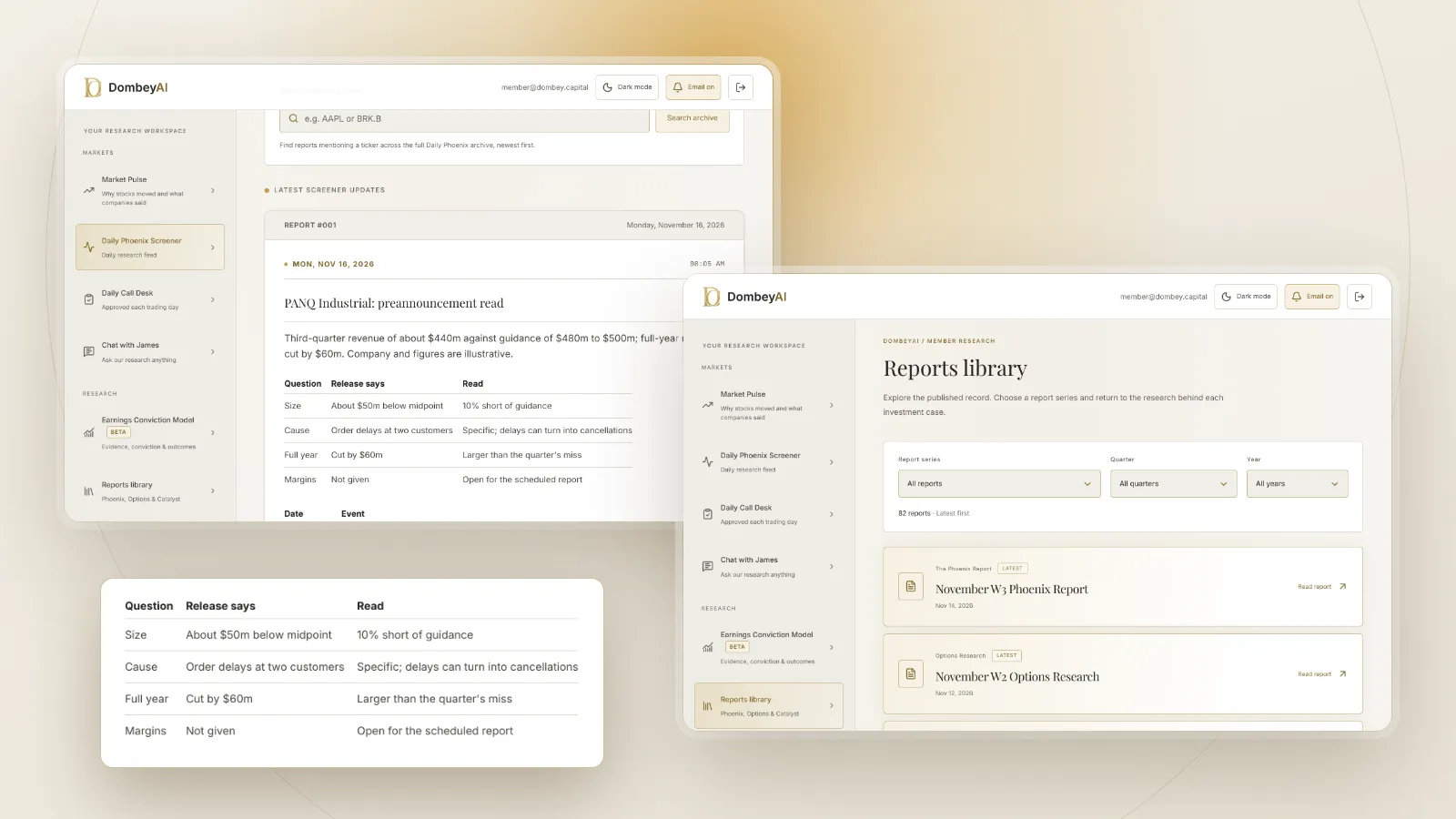
Worked example
| Question | What the release says | Read |
|---|---|---|
| Size | About $50 million below the midpoint | Roughly 10% below guidance |
| Cause | Order delays at two named customer types | Specific, but delays can become cancellations |
| Full year | Cut by $60 million | Larger than the quarter's miss, so management expects the fourth quarter to be weaker too |
| Margins | Not given | The scheduled report will have to answer this |
The full-year cut is larger than the third-quarter miss. That says the problem is not only timing. When the scheduled report arrives, the questions are whether the delayed orders were booked, whether margins fell with revenue and whether the new full-year range already assumes the worst.
What happens after a preannouncement
A preannouncement splits one event into two.
- The preannouncement day. The stock reacts to the numbers and the cause. Analysts cut estimates, often over the following days. The pattern is covered in earnings estimate revisions.
- The scheduled report. Revenue is now largely known. The focus moves to margins, cash flow, the outlook and management's explanation on the call.
Implied volatility before the scheduled report is often lower after a preannouncement, because some of the uncertainty is already resolved. A catalyst calendar should keep both dates, because the second event can still move the stock.
Watch for related signals too. A company that moves its report date later or files late may be working through more than a shortfall; see earnings date changes. Our market coverage follows real stocks through moves like these, with the dated filings behind them.
A timeline to track
A preannouncement starts a sequence of dated checks. Putting them on one page keeps the questions in order, and it stops the scheduled report from arriving as if nothing had happened. The same structure works for a positive preannouncement: the questions change from how bad to how durable, but the dates are the same.
| Date | Event | What to check |
|---|---|---|
| Day 0 | Preannouncement and 8-K | Size of the miss, stated cause, change to full-year outlook |
| Days 1 to 5 | Analyst notes and estimate cuts | Whether estimates now sit below the new range or at it |
| Days 1 to 10 | Bond prices and any lender or rating agency comment | Whether the shortfall touches covenants or refinancing |
| Scheduled report | Full results and call | Margins, cash flow, whether the cause is resolved |
| Next quarter | Following report | Whether the reset held or a second cut followed |
Some companies also hold an investor call on the day of the preannouncement. If they do, the questions analysts ask often show which part of the explanation the market doubts. How to analyze an earnings call transcript covers what to listen for.
Where this goes wrong
The common mistakes in reading preannouncements:
- Assuming the reset is final. Companies that preannounce once sometimes cut again at the report or the next quarter.
- Assuming it is the worst case. The opposite error. Some companies reset deliberately low.
- Reading the headline, not the outlook. A small quarterly miss with a large full-year cut is worse than it looks.
- Ignoring the cause. Size alone does not tell you whether the problem is temporary.
- Treating an offering disclosure as routine. Preliminary results in a debt offering can include detail the company would not otherwise give, such as liquidity and covenant headroom.
The bottom line
An earnings preannouncement is an off-schedule release of results or a revised outlook, usually a warning. Companies make them to reset expectations, keep disclosure fair under Regulation FD, or because an offering requires current numbers. Read the numbers against guidance, judge the cause and check whether the outlook moved more than the quarter. Then treat the scheduled report as a second event, where margins, cash and the credibility of the explanation are tested.