

What you need
- The 8-K announcing the merger agreement, with the agreement and investor presentation attached.
- The registration statement on Form S-4 or F-4, or the merger proxy if the SPAC is not registering shares. The S-4 explainer shows how these documents are laid out.
- The SPAC's latest 10-Q for the trust balance and share counts.
- The PIPE subscription agreements and any non-redemption agreements, usually filed as 8-K exhibits.
- A spreadsheet with three redemption scenarios and room for warrants and earnouts.
All of it is free on EDGAR. Our guide on how to search SEC EDGAR filings shows how to pull every filing for both the SPAC and, once it files, the combined company.
Step 1: Read the deal terms
Start with what the target's owners receive and what conditions sit between signing and closing. The merger agreement and its summary in the proxy give you:
- Consideration. The number of new shares issued to target holders, usually set by dividing an agreed equity value by $10.00.
- Earnouts. Extra shares that target holders, and sometimes the sponsor, receive only if the stock trades above set prices.
- Minimum cash condition. The cash the target requires at closing, after redemptions. If redemptions breach it, the target can walk or waive it.
- Termination date. The date after which either side can walk away, which must fit inside the SPAC's own deadline.
The headline "pro forma enterprise value" in the press release is built on these terms and an assumed redemption level. Note which level it uses, because the answer changes with it.
Step 2: Map sources and uses
Every de-SPAC has a sources and uses table in the proxy. Rebuild it yourself at three redemption levels, for example 0%, 50% and a high case near what recent deals have seen. Sources are cash left in trust, PIPE proceeds and any new debt. Uses are redemptions, cash paid to selling holders, deal costs and debt repayment. What remains is net cash added to the balance sheet.
Two things deserve attention. Deal costs, including underwriting fees deferred from the SPAC IPO, are often fixed in dollars, so they eat a larger share of the cash when redemptions are high. And some deals pay cash to the target's existing owners at closing, which takes money out of the business before public holders own any of it.
Step 3: Build the pro forma share count
Next, list every share that will exist at closing, by holder. The 2024 SEC rules require a dilution table across a range of redemption levels (Regulation S-K Item 1604(c)), so start from that and check it. Then add what the basic count leaves out.
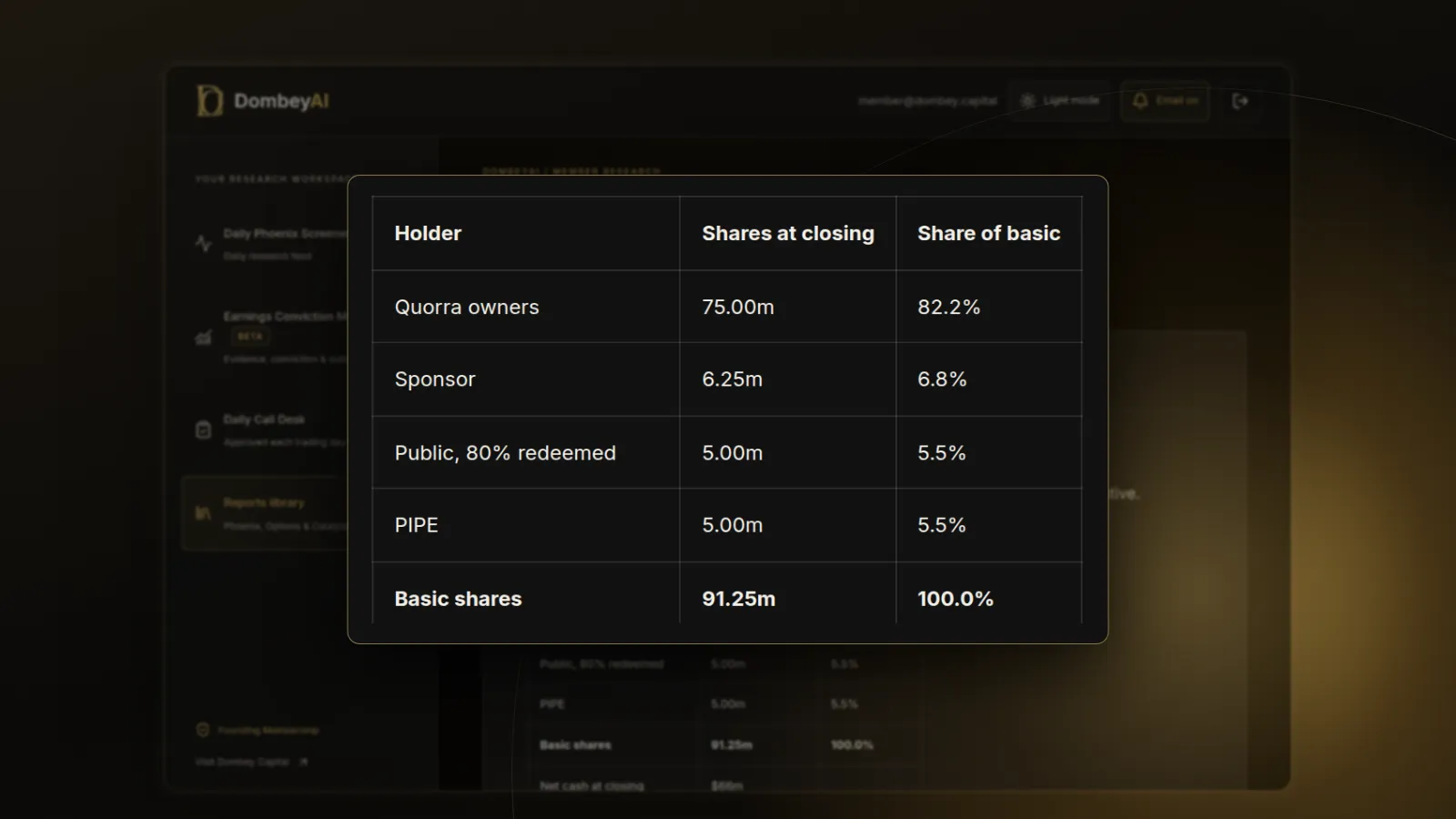
At 80% redemptions, 20.0m public shares take $204m from the trust. Cash at closing is $51m left in trust plus $50m from the PIPE, less $35m of costs: $66m of net cash.
| Holder | Shares at closing | Share of basic count |
|---|---|---|
| Company B owners | 75.00m | 82.2% |
| Sponsor | 6.25m | 6.8% |
| Public holders who stayed | 5.00m | 5.5% |
| PIPE investors | 5.00m | 5.5% |
| Basic shares | 91.25m | 100.0% |
| Earnout shares if $15.00 is reached | 7.50m | |
| Warrants, net shares at $15.00 (treasury method) | 4.55m | |
| Fully diluted at $15.00 | 103.30m |
The public holders who stayed put in $51m and own 5.5%. The sponsor paid a nominal sum and owns 6.8%. That gap is the core of de-SPAC dilution, and our guide to how share count changes dilute holders covers the general mechanics. Warrants and earnouts only dilute at higher prices, so price them at the share price where they matter.
Step 4: Find the breakeven valuation
The breakeven valuation is the business value at which a remaining share is worth exactly its trust value. Compute it as trust value per share times total shares, less net cash at closing.
In the example, at 80% redemptions: $10.20 x 91.25m - $66m = about $865m. At 0% redemptions it is $10.20 x 111.25m - $270m, the same $865m, because each redeeming share takes out exactly $10.20 of cash. Company B's headline value is $750m, so a holder who stays needs the business to be worth about $115m more than the deal price just to get back $10.20. Most of that gap is the sponsor's 6.25m shares, about $64m at $10.20, and the $35m of costs; the rest comes from issuing target and PIPE shares at $10.00 against a $10.20 trust value.
Item 1604(c) also asks the filing to state the company valuation at which non-redeeming holders get back the IPO price at each redemption level. Compare that figure with yours and read the assumptions behind it.
Step 5: Test the projections
De-SPAC filings often include multi-year projections, which a traditional IPO prospectus does not. Since the 2024 rules took effect, the litigation safe harbor for forward-looking statements is not available to SPACs, and Item 1609 requires the filing to explain the purpose of the projections, their material bases and assumptions, and whether they still reflect the view of the board or management. That disclosure is useful. It does not make the forecast accurate.
Test it three ways:
- Against history. Put the last three years of actual revenue and margins beside the projected years. A step change in growth with no signed contracts behind it is a warning.
- Against peers. Find listed companies in the same business and check what growth and margins they have actually achieved at a similar size.
- Against the funding. Check whether the cash at closing in your high-redemption case covers the plan. If it does not, the projections assume more capital raising and more dilution.
Then value the business on what it earns now and in a conservative case. A peer multiple on current revenue or profit is a sounder anchor than a multiple on revenue three years out. Our guide to building a base and worst case gives a structure for the range.
Step 6: Read the sponsor and PIPE terms
The 2024 rules require the de-SPAC filing to describe the sponsor's compensation, its conflicts of interest and any agreements that change its share count (Items 1603 and 1604). Read those sections closely, because the sponsor's incentive differs from yours: it earns its promote if the deal closes, even at a price where public holders lose money.
Look for:
- Promote changes. Forfeited, deferred or price-vested sponsor shares reduce the fixed dilution in Step 3.
- PIPE pricing. A PIPE at $10.00 with no extras is a vote of confidence. A PIPE with extra shares, warrants or a reset price lowers the real entry price for those investors and shifts value away from public holders.
- Non-redemption agreements. Shares handed to holders who agree not to redeem move value toward them and can mask weak demand.
- Fairness opinions. Item 1607 requires disclosure of any outside report, opinion or appraisal the SPAC received about the deal. Note whether one exists and what it covers.
Step 7: Map the dates after closing
Closing is not the end of the dated events. Within four business days, the combined company files a Form 8-K with the full information a Form 10 registration would contain, often called the super 8-K. From there, a run of dates can bring new shares to market:
| Date or trigger | Event | What to check |
|---|---|---|
| Vote date | Shareholder approval and redemption results | 8-K with the vote and the redemption count |
| Closing | New ticker; trust cash released | Super 8-K, final share count, cash at closing |
| About 30 days after closing | Warrants typically become exercisable | Warrant agreement and the resale registration |
| Price trigger | Warrant redemption or earnout vesting | Trigger prices and day counts in the agreements |
| 6 to 12 months | Sponsor and target holder lockups lapse | Lockup terms and any early-release price |
| Effectiveness of resale S-1 | PIPE shares become freely tradable | S-1 filing and SEC effectiveness |
Our explainer on lockup expirations covers how supply events tend to affect thinly traded stocks. Put every date into a catalyst calendar so none of them arrives unnoticed.
Step 8: Decide and write it down
Before the redemption deadline, which the proxy sets and brokers often move earlier, compare three choices on the same date: redeem for trust value, sell in the market, or stay in for the combined company. Write down your breakeven valuation, your own range of business values, the redemption level you assumed and the dates from Step 7. If the stock later falls below your low case or a lockup releases a large block, you have a record to revisit rather than a feeling.
Dombey's published research applies this kind of dated, per-share analysis before each catalyst; see the research archive. For other sources that track SPAC votes and similar events, see our list of the best investing newsletters for special situations.
Common mistakes
- Valuing the deal at $10 a share. The $10 is a unit of account. Value per share depends on sponsor shares, costs and redemptions, which the headline ignores.
- Using the press release's redemption assumption. Announcements often show low redemptions. Run your own high case.
- Ignoring warrants and earnouts. They do not dilute at today's price, but they cap the upside at the prices where you would make money.
- Taking projections at face value. Disclosure rules describe the forecast; they do not test it. Compare it with history and peers.
- Missing the redemption deadline. Once it passes, you hold the combined company's stock whether you meant to or not.
Where this goes wrong
This method assumes the filings are complete and the business can be compared with listed peers. Many de-SPAC targets are early-stage companies with little revenue, so the peer comparison is wide and the valuation range is large. Share counts can change after your analysis through forward purchase agreements, equity lines and convertible notes that are added close to the vote. A thin float after high redemptions can push the price far from any estimate of value in either direction, and the structure resembles the risks in a reverse merger once the trust floor is gone. Treat the output as a range and update it when the closing 8-K gives final numbers.
The bottom line
A de-SPAC is a merger in which the price is quoted at $10 a share but the value per share is set by sponsor shares, deal costs, redemptions, warrants and earnouts. Rebuild sources and uses and the share count yourself, compute the breakeven valuation, and compare it with what the business would be worth next to listed peers. Read the sponsor and PIPE terms to see who carries the dilution, and calendar every post-closing date that can add supply. Make the redeem or stay decision before the deadline, on paper, with your numbers.