

A short definition
Most convertibles give the holder a choice. A convertible bond can be swapped for shares if the stock rises, and is repaid in cash if it does not. A mandatory convertible removes the choice. On the mandatory conversion date, every share converts into common stock, whatever the price.
The issuer sets three numbers when the security is sold:
- The initial price, usually the common stock price at pricing.
- The threshold appreciation price, usually 15% to 25% above the initial price.
- The conversion rates, a maximum number of common shares per mandatory share (the issue price divided by the initial price) and a minimum (the issue price divided by the threshold price).
The dividend is the holder's compensation for the capped upside. It is normally well above the common stock's dividend yield.
Real examples
Mandatory convertibles show up most often when a large company needs equity for a specific purpose and wants to limit how many shares it sells today.
| Issuer | Year | Form | Context |
|---|---|---|---|
| Danaher | 2019 | Series A mandatory convertible preferred | Part of the funding for its acquisition of GE's biopharma business |
| Albemarle | 2024 | Depositary shares in mandatory convertible preferred | Balance sheet support during a lithium price downturn |
| Boeing | 2024 | Series A mandatory convertible preferred, sold with common stock | Part of a large capital raise to repair the balance sheet |
| NextEra Energy | Several years | Equity units with a stock purchase contract | Utility capital programs, a structure with the same economics |
Each issuer filed the terms with the SEC in a prospectus supplement, which you can find with EDGAR full-text search. The terms differ by deal, so the numbers that matter come from the filing, not from a summary.
How the payoff works
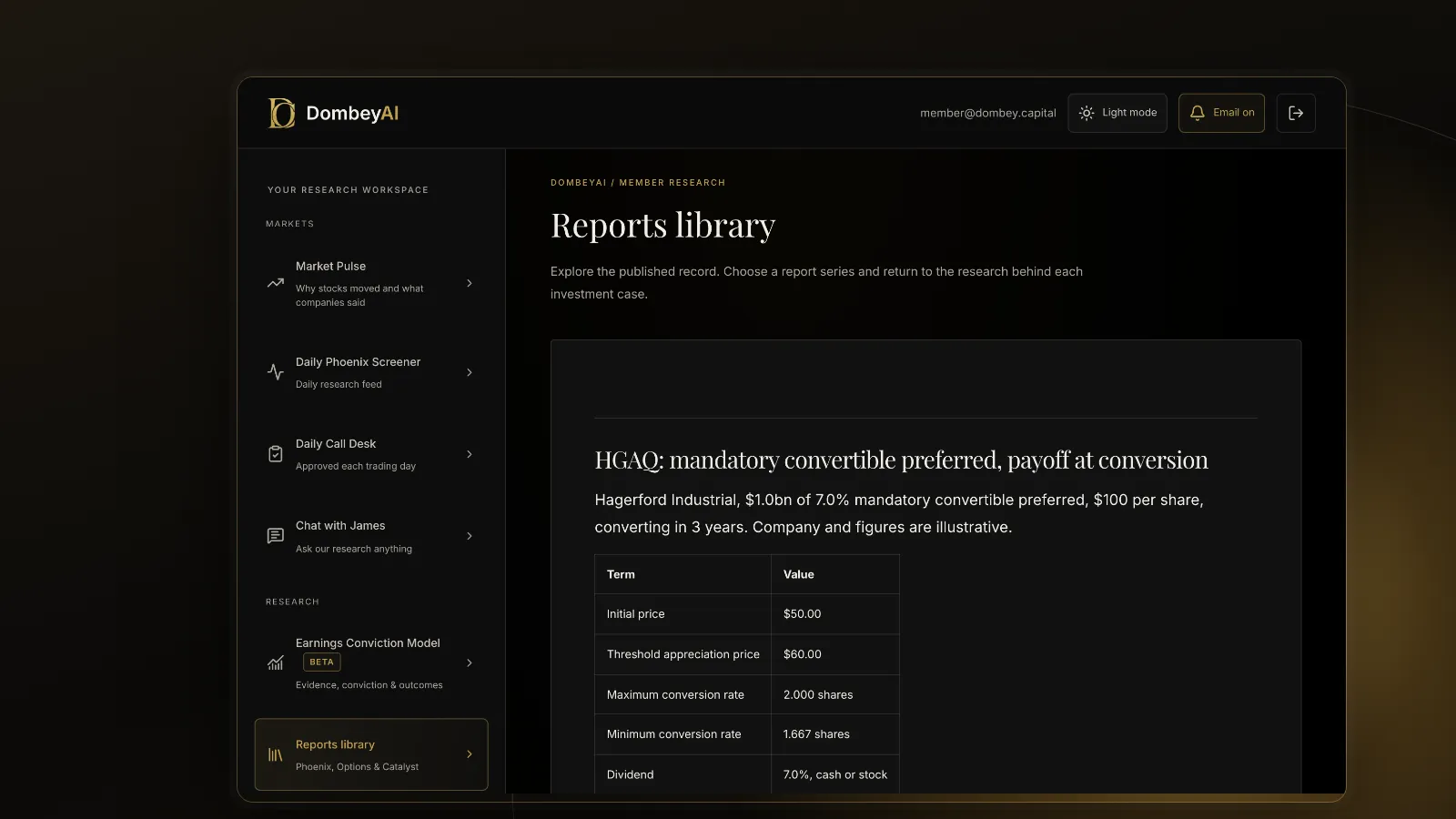
The payoff at conversion has three zones. Take a hypothetical mandatory sold at $100 per share when the common trades at $50, with a threshold appreciation price of $60. The figures are illustrative.
- Maximum conversion rate: $100 divided by $50, or 2.0 common shares per mandatory share.
- Minimum conversion rate: $100 divided by $60, or about 1.667 shares.
| Common price at conversion | Shares delivered | Value per mandatory share | Change vs $100 |
|---|---|---|---|
| $35 | 2.000 | $70.00 | -30% |
| $45 | 2.000 | $90.00 | -10% |
| $50 | 2.000 | $100.00 | 0% |
| $55 | 1.818 | $100.00 | 0% |
| $60 | 1.667 | $100.00 | 0% |
| $70 | 1.667 | $116.67 | +16.7% |
| $80 | 1.667 | $133.33 | +33.3% |
Below $50, the holder gets the maximum shares and loses money one for one with the common. Between $50 and $60, the holder gets exactly $100 of stock, so the value is flat. Above $60, the holder gets the minimum shares and gains again, but at about 83% of the common's rate.
Why companies issue them
The structure solves a few problems at once:
- Fewer shares if the stock rises. If the stock ends above the threshold price, the company delivers the minimum number of shares, so it has effectively sold equity at a premium.
- Equity credit. Rating agencies usually treat mandatories as mostly equity because conversion is certain. That matters for a company funding a large acquisition while trying to keep its rating.
- A different buyer base. Convertible funds and income investors buy mandatories when they might not buy a plain common stock offering.
- Size. Issuers often sell a mandatory alongside common stock to raise more equity than one offering would absorb.
The trade-off for the issuer is a higher cash dividend until conversion and a share count that rises more if the stock falls, which is when the company can least afford it.
What a mandatory means for the common stock
For the common holder, the question is how many shares will exist in three years. Use the maximum conversion rate. If the stock falls, that is the number delivered, and those are the scenarios where dilution hurts most. Our explainer on dilution and share count changes walks through how to build a fully diluted count.
Announcements often push the common lower, for two reasons. The market prices in the new shares, and buyers of the mandatory often hedge by shorting the common, which adds selling around pricing. That is the same mechanism behind why stocks fall on convertible note offerings, with less room for the stock to recover the shares later.
Other features to read in the prospectus:
- Early conversion: holders can usually convert early at the minimum rate; some deals have a fundamental change provision that adjusts the rate after a takeover.
- Dividend payment: many issuers can pay the dividend in cash or in common stock, which adds shares if they choose stock.
- Dividend arrears: a skipped dividend on preferred stock can accrue, and our piece on preferred dividends in arrears covers what that means.
- Ranking: a mandatory preferred ranks ahead of the common and behind all debt.
Mandatory vs ordinary convertible vs common stock
| Feature | Mandatory convertible | Convertible bond | Common stock |
|---|---|---|---|
| Converts | Always, on a set date | At the holder's option | Not applicable |
| Downside protection | None beyond dividends | Bond floor if the issuer can repay | None |
| Upside | Capped between the initial and threshold prices, then about 80% to 87% | Full above the conversion price | Full |
| Income | High fixed dividend | Low coupon | Common dividend, if any |
| Rating agency treatment | Mostly equity | Mostly debt | Equity |
| Dilution | Certain, range set at issue | Only if converted | Not applicable |
If you want the detail on the optional kind, our guide on how to analyze a convertible bond covers the bond floor, conversion premium and call terms.
Where this goes wrong
Treating the minimum share count as the dilution. The minimum applies only if the stock rises. A stressed issuer is more likely to see the maximum delivered.
Reading the dividend as yield on a safe instrument. A mandatory is not a bond. A holder can lose 40% if the common falls 40%, and the dividend only cushions part of that.
Ignoring the hedge flows. Convertible funds that buy the mandatory short the common to hedge. As the conversion date nears, those hedges adjust, which can move the common in ways that have nothing to do with the business.
Ignoring stock-paid dividends. If the issuer can pay dividends in shares and its cash position weakens, the share count can rise before conversion.
Missing the use of proceeds. The same structure can fund a sensible acquisition or plug a hole. The proceeds section of the prospectus and the latest 10-Q for special situations tell you which.
How to read a mandatory convertible deal
When a company announces one, work through the prospectus supplement in order:
- Find the initial price, the threshold appreciation price and both conversion rates.
- Multiply the maximum rate by the number of mandatory shares to get the worst-case new share count.
- Note the dividend rate, whether it can be paid in stock and the conversion date.
- Read the use of proceeds and the capitalization table.
- Check whether a common stock offering was sold at the same time, and add those shares too.
Dombey's published research applies this kind of share count work before each catalyst; see the research archive. For newsletters that cover these situations, see our list of the best investing newsletters for special situations.
The bottom line
A mandatory convertible is equity on a delay. It pays a high dividend for three years or so, then turns into a share count that falls between a minimum and a maximum depending on the stock price. For the holder, the payoff is most of the downside and part of the upside. For the common holder, plan around the maximum share count and read the use of proceeds closely.