

What the research found
Arbel and Strebel grouped stocks by how much attention they received, measured by the number of analysts following them and the share held by institutional investors. They found that the least-followed group earned higher returns than the most-followed group, and that the difference held within groups of companies of similar size. A 1983 paper by Arbel, Steven Carvell and Strebel in the Financial Analysts Journal called the most-followed stocks "giraffes", visible above the crowd, and argued that investors could earn a premium by looking where others were not.
Later work refined the idea. Studies of analyst coverage found that information about uncovered companies is reflected in prices more slowly, so news at a neglected company can take longer to be priced. Other studies found that much of the effect could be explained by size, liquidity and the bid-ask spread, which made the premium harder to capture after trading costs.
| Concept | Measure | What it captures |
|---|---|---|
| Analyst neglect | Number of sell-side analysts publishing estimates | How many professionals model the company |
| Institutional neglect | Share held by institutions, from 13F filings | How many large investors own and watch it |
| Size effect | Market capitalization | Small companies' historical return premium |
| Illiquidity effect | Trading volume, bid-ask spread | Compensation for the cost of trading |
| Information diffusion | Speed at which prices react to news | How quickly filings and events are priced |
The rows overlap. A company with a $150 million market value usually has few analysts, little institutional ownership and thin trading, all at once.
Why neglect can create mispricing
Prices reflect information when enough people read it, model it and trade on it. A large company has dozens of analysts, many institutional holders and constant news flow. A small, uncovered company may have none of those. Three things follow.
Slower reaction to news. A large-cap 8-K is read within minutes. An uncovered micro-cap's 10-Q might not be read carefully by anyone for days. That delay is the core of what makes small caps misprice events more often.
Less scrutiny of the numbers. Without analysts asking questions on calls, unusual items in the accounts can go unremarked. This works in both directions: hidden value, such as real estate carried at historical cost, and hidden problems.
Structural sellers and no natural buyers. Funds that cannot hold small positions, index funds after a deletion, or holders who received shares in a spin-off may sell regardless of price. With no analysts or institutions on the other side, the price can fall further than the fundamentals justify.
Where neglected stocks come from
Some companies are neglected because they are too small for sell-side research to be profitable. Others become neglected because of an event:
- Spin-offs. The new company may have no analysts at first, and many parent shareholders sell. See our guide to spin-off investing.
- Post-bankruptcy equities. New shares are often held by former creditors who do not want them. Our article on post-bankruptcy equities covers why.
- Index deletions. Forced selling removes holders, and coverage often thins. See index deletions.
- Busted IPOs. Analysts drop coverage after a listing fails, and early buyers exit.
- Holding companies and odd structures. Complex companies that are hard to model attract fewer analysts.
- Foreign listings and OTC stocks. Companies outside the main US exchanges often have little US coverage. Our guide to researching an OTC stock covers what to check.
Finding neglected companies
| Screen | Where to find it | What to watch for |
|---|---|---|
| Analysts providing estimates: 0 or 1 | Most stock screeners | Some data sets miss foreign or very small coverage |
| Institutional ownership below 20% | 13F aggregators, screeners | 13F covers only managers above the filing threshold |
| Market value below $300 million | Any screener | Size alone does not mean neglect |
| No earnings call | Company investor relations page | Some good companies simply do not hold calls |
| Recent event: spin-off, emergence, deletion | Filings, event calendars | The event is the reason for the neglect |
How to use the effect in practice
Treat neglect as a place to look, not a reason to own. The research process stays the same; only the competition is thinner.
- Start from the filings. Without analyst models, the 10-K and 10-Q are the primary sources. Read the footnotes and the risk factors.
- Check why it is neglected. Size, a recent event, a complex structure or a poor business. The last one is the most common.
- Look for a catalyst. A neglected stock can stay cheap for years. An event, such as a buyback, sale, listing change or index addition, gives the market a reason to look.
- Size for liquidity. Thin trading means wide spreads and slow exits. Our article on illiquid stocks covers the costs.
- Write down what would prove you wrong. With no analysts to challenge the thesis, you have to do it yourself.
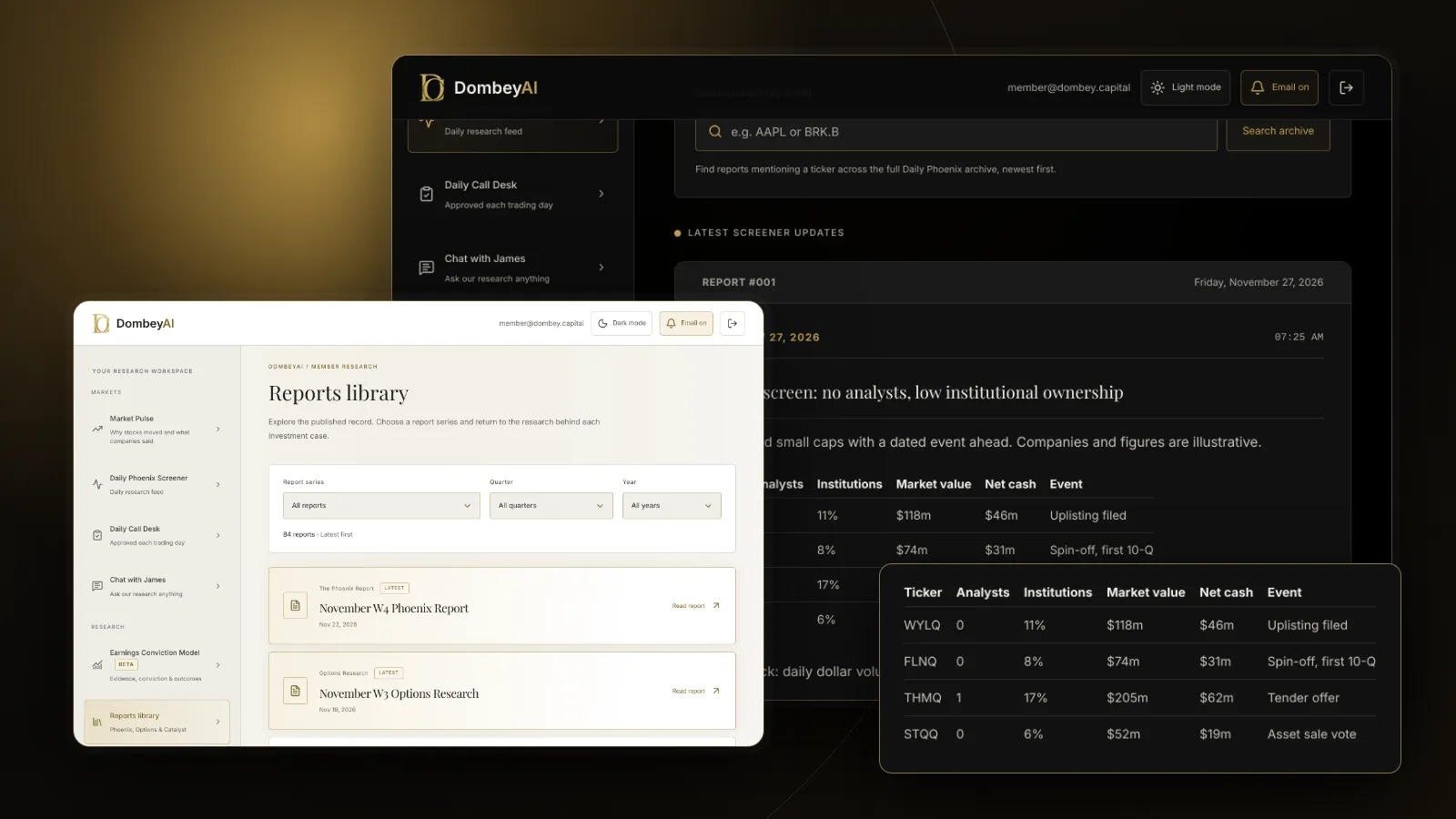
Newsletters that specialize in small and overlooked situations are one way to widen the search; our ranking of investing newsletters for special situations compares them. Dombey's published research often starts from companies with little coverage around a dated event; see the research archive.
What ends the neglect
Neglect is temporary when something gives the market a reason to look. Common triggers are an analyst initiating coverage, often after a capital raise; a move up in market value that brings the company into a small-cap index; a listing on a major exchange after trading over the counter; a buyback or tender offer; and an activist filing a 13D. Each brings new readers to the filings. If the gap between price and value closes, it usually closes around one of these events rather than gradually, which is why the catalyst matters as much as the discount.
Where this goes wrong
- Mistaking neglect for value. Many companies are uncovered because there is nothing to say about them. Low attention does not make a poor business cheap.
- Ignoring trading costs. A 3% bid-ask spread and thin volume can eat much of any mispricing, which is why the academic premium is hard to capture.
- Overrating your information. When no one else is checking, no one checks your work either. Errors in a thinly followed company's numbers can persist as long as mispricings.
- Weak governance. Less scrutiny can mean less discipline on management. Check related-party transactions, compensation and insider ownership.
- No catalyst. Without an event, the gap between price and value can last indefinitely.
- Relying on old research. Anomalies documented decades ago often shrink after publication and as markets change.
The bottom line
The neglected-firm effect describes the historical return premium of stocks with little analyst coverage and institutional ownership, first documented by Arbel and Strebel. Much of it overlaps with the size and illiquidity effects, and the premium is hard to capture after trading costs. Its lasting value is practical: information at uncovered companies is priced more slowly, so investors who read the filings around an event have less competition. Use neglect as a reason to look, then judge the business, the catalyst and the liquidity on their merits.