

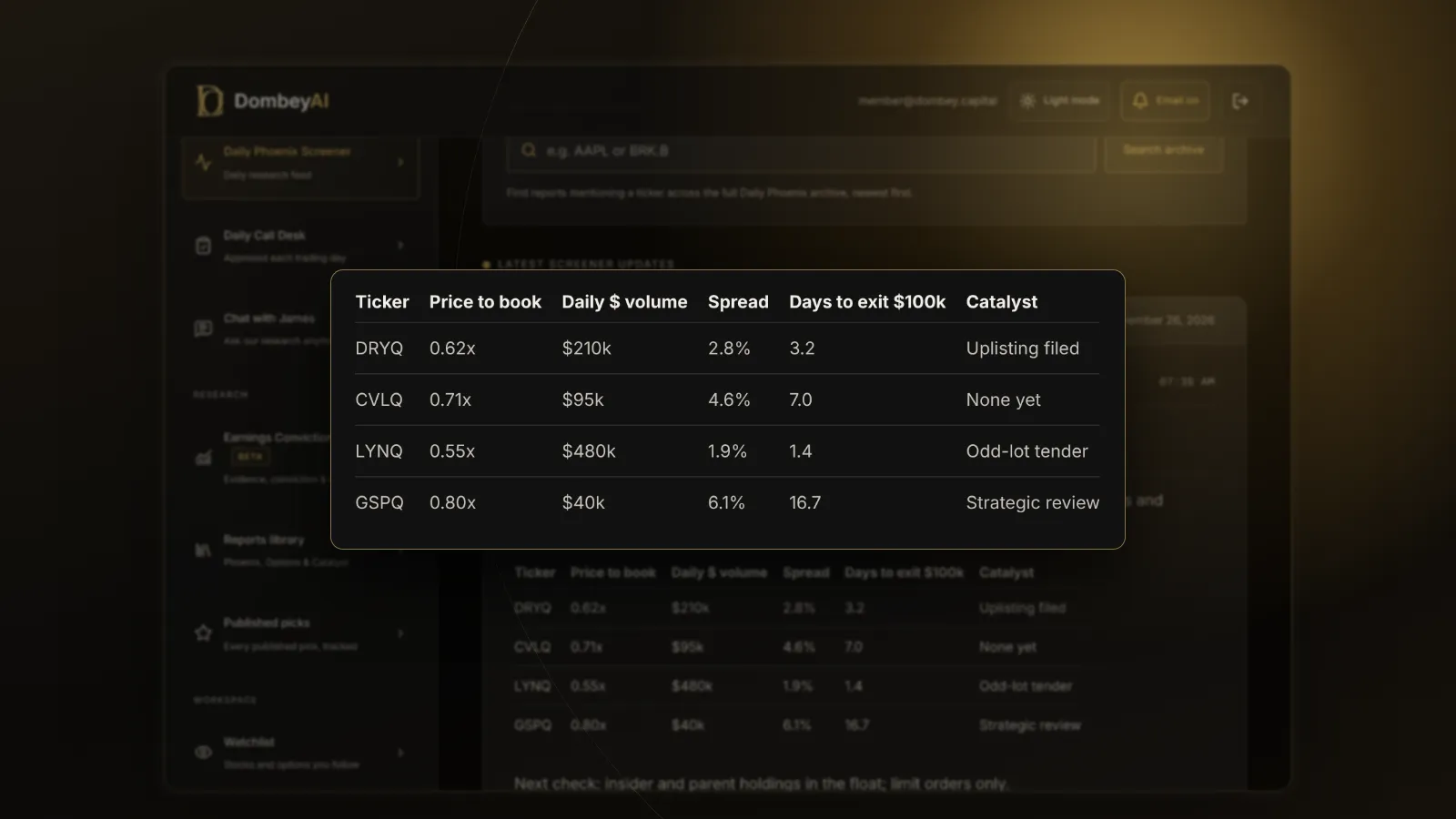
What makes a stock illiquid
Liquidity is the ability to trade a reasonable amount quickly, at a price close to the last trade. A stock can lack it for several reasons, and they often come together:
- A small float. Few shares are available to trade, often because insiders, a parent company or a long-term holder own most of them.
- A small market value. Microcaps and nanocaps trade in small dollar amounts even when share volume looks high.
- A secondary venue. Stocks on over-the-counter markets, or that have been delisted, usually trade less than exchange-listed ones. Our guide to researching an OTC stock covers what changes.
- A high share price with few shares. A stock at several thousand dollars a share can trade a handful of shares a day.
- Little information. Companies that file less, or have gone dark, attract fewer buyers.
How to measure liquidity
| Measure | How to calculate it | What it tells you |
|---|---|---|
| Average daily dollar volume | Average shares traded per day times price, over 20 to 60 days | How much money changes hands on a normal day |
| Bid-ask spread | (Ask minus bid) divided by the midpoint | The round-trip cost of trading a small amount |
| Days to trade a position | Position size divided by 10% to 20% of daily volume | How long it takes to get in or out without dominating the market |
| Amihud illiquidity ratio | Average of the absolute daily return divided by dollar volume | How much the price moves per dollar traded |
| Days with no trades | Count of zero-volume days over a period | Whether trading is regular at all |
| Order book depth | Shares shown near the best bid and ask | How much you can trade before the price moves |
Yakov Amihud's 2002 paper popularized the illiquidity ratio and found that stocks with higher illiquidity had tended to earn higher returns, which many read as a premium for bearing liquidity costs. The finding describes averages across many stocks and periods; it does not make any single illiquid stock cheap.
Why low liquidity creates mispricing
Most investors cannot own it
A fund with billions under management cannot build a meaningful position in a stock that trades $200,000 a day, and it cannot sell one quickly if it needs to. Many funds also have rules setting a minimum market value or daily volume for anything they hold. The stock is left to a smaller group of investors: individuals, small funds and specialists. Fewer potential buyers means less competition to correct a low price. The same logic explains why small caps misprice events more often.
Information travels slowly
Illiquid stocks rarely have sell-side coverage, so there is no analyst to explain a change in the business or publish estimates. A strong quarter can sit in a 10-Q for weeks before anyone acts on it. Investors who read the filings first have a timing edge that rarely exists in widely held stocks.
Motivated sellers set the price
When a stock trades little, the price on any given day can be set by one holder with a reason to sell that has nothing to do with value: a fund closing down, an estate settling, a parent unloading shares after a spin-off, a tax-loss sale in December or an index fund removing the stock. Our piece on index deletions shows how forced selling can push a price well below value for a period. In a liquid stock, other buyers absorb that pressure quickly. In an illiquid one, it can push the price down for days or weeks.
Structural reasons to stay away
Some situations create illiquidity and a discount at the same time. Shares emerging from bankruptcy are often held by former creditors who never wanted equity, which is one reason post-bankruptcy equities often trade cheap. Stocks that move to the expert market after losing current public information can become very hard to trade at all.
The costs of capturing the discount
| Cost | What it looks like | How to limit it |
|---|---|---|
| Spread | Paying the ask and selling at the bid | Limit orders inside the spread; patience |
| Market impact | Your own buying pushes the price up, your selling pushes it down | Trade a small share of daily volume |
| Time | Weeks to build or exit a position | Size the position for the exit, not the entry |
| Exit risk | No buyers when bad news hits | Keep position sizes small enough to hold through a bad period |
| Information risk | Thin disclosure, few independent checks | Read every filing; check insider transactions |
| Opportunity cost | The discount can persist for years | Look for a catalyst that changes liquidity or value |
The last row matters most. An illiquid stock can stay cheap for a long time, because the reasons it is cheap are structural. A position works best when a specific event is likely to bring in new buyers or to pay holders directly.
Events that change liquidity
- Uplisting. A move from over-the-counter trading to a national exchange widens the potential shareholder base. See what an uplisting is.
- Index inclusion. Being added to an index brings index funds and benchmark-aware managers.
- Stock splits. A split in a very high-priced stock can make round lots affordable and lift share volume.
- Buybacks and tender offers. A company buying its own shares gives sellers a ready buyer. An odd-lot tender offer can also clean up a fragmented shareholder base.
- A sale of the company. A takeover at a premium gives every holder liquidity at once and often at a price that reflects value rather than the last small trade.
- New coverage or disclosure. Resuming SEC reporting, adding an investor relations program or hosting earnings calls can bring the stock to a wider audience.
Newsletters that specialize in small and special situations often look for exactly these events; our list of special situations newsletters compares them. Dombey's published research notes liquidity alongside each thesis, since a cheap stock you cannot trade is a different proposition; see the research archive.
Practical rules for trading illiquid stocks
- Use limit orders only. A market order in a thin stock can fill far from the last price.
- Build slowly. Spread purchases over days or weeks, at a small share of daily volume.
- Size for the exit. Ask how long it would take to sell the whole position if the thesis broke, and keep that period short enough to tolerate.
- Avoid the open and the close. Spreads can be wider and prices less reliable at the edges of the session.
- Watch the order book. A single large bid or offer can be the only real interest in the stock.
- Check the float. Count the shares held by insiders and large holders. Only the rest can trade.
Where this goes wrong
- Mistaking illiquidity for value. A low price can reflect a weak business or poor governance, not just few buyers. Do the valuation work first.
- Ignoring the round trip. A 3% spread paid twice and some market impact can absorb a year of expected return.
- Holding too much. A position that takes a month to sell is a position you cannot manage in a crisis.
- Waiting without a catalyst. The discount can last indefinitely. Without an event to close it, the return depends on someone else deciding to pay more.
- Trusting stale prices. The last trade may be days old. Value the position at the bid you could actually sell into.
The bottom line
Illiquid stocks trade rarely and in small size, which keeps most institutions out, slows the spread of information and lets motivated sellers set the price. That combination creates mispricing that patient investors can use. The cost is real: wide spreads, market impact, slow entry and exit and the risk of being stuck. Measure liquidity before you trade, size the position for the exit, use limit orders, and favor situations where an event is likely to bring new buyers.