

A short definition
A scheme is an arrangement between a company and its members, or a class of them, that the court approves. It can be used for many things, including reorganizations and demergers, but its most common use is a takeover. The target's board proposes a scheme under which the bidder acquires all the shares for the agreed price.
The conduct of the takeover is governed by the Takeover Code, which the Panel on Takeovers and Mergers administers. The court approves the scheme itself, and the two run side by side. Our explainer on the plan of arrangement covers Canada's similar process.
Real examples
UK and Jersey-incorporated companies have used schemes for many of the largest recommended takeovers, while contested bids have used contractual offers.
| Deal | Year | Structure | Why it matters |
|---|---|---|---|
| SoftBank's acquisition of ARM Holdings | 2016 | Scheme of arrangement | A large recommended cash takeover completed by scheme |
| Takeda's acquisition of Shire | 2019 | Scheme of arrangement under Jersey law | Shows the same process for a Jersey company listed in London |
| Melrose's bid for GKN | 2018 | Contractual takeover offer | A hostile bid, so it could not use a scheme |
| Comcast's bid for Sky | 2018 | Contractual takeover offer, decided by a Panel-run auction | Competing bids for one target, settled through the Code's auction procedure |
The announcements, scheme documents and court timetables for each are public, which makes them useful reference points for reading a new deal.
How a scheme works, step by step
- Approach and announcement. If an approach leaks or is announced, Rule 2.6 of the Code usually gives the bidder 28 days to announce a firm offer or walk away, the "put up or shut up" deadline.
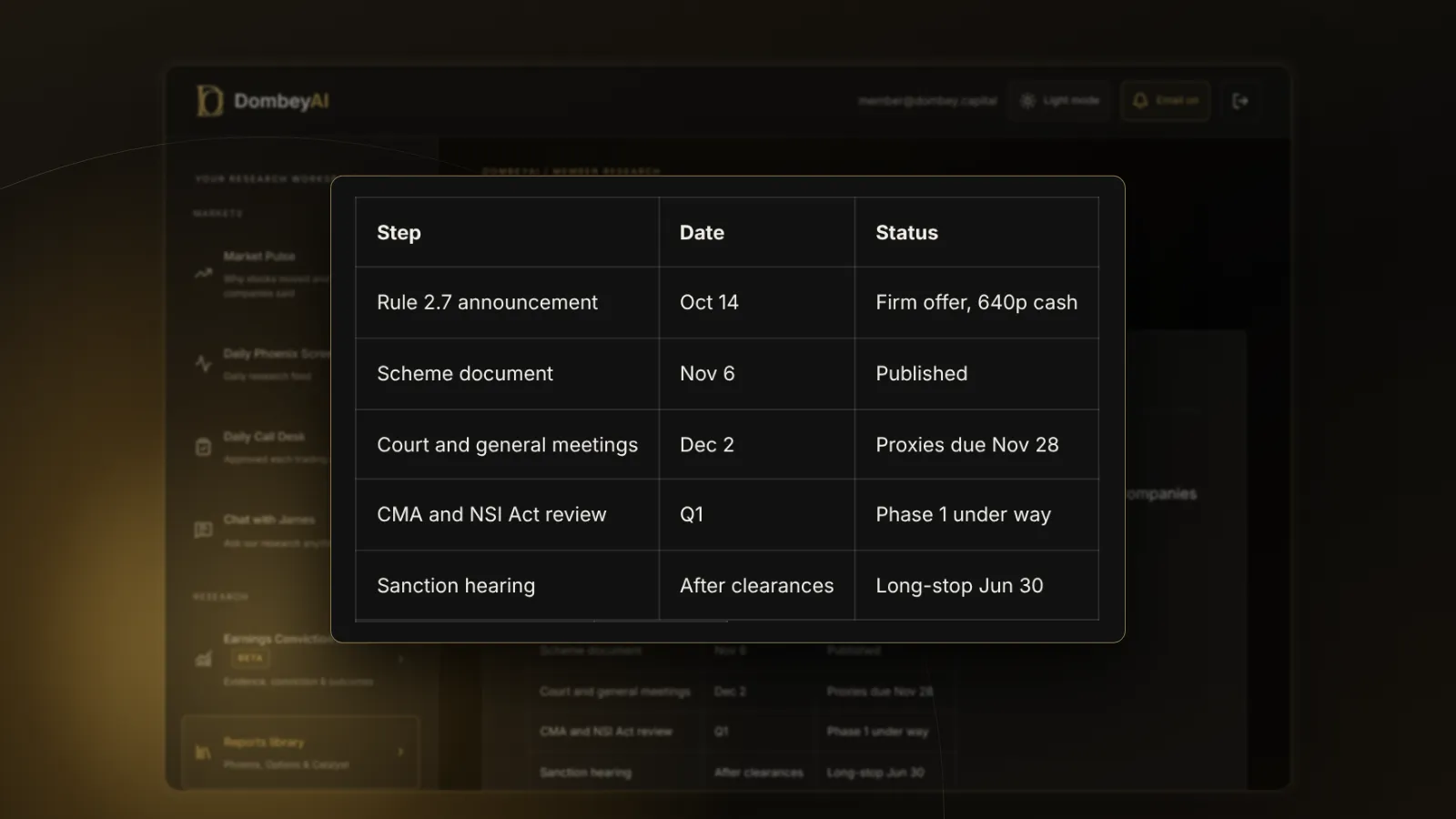
- Firm offer announcement. The bidder and target announce a firm intention to make an offer under Rule 2.7, with the price, conditions and the intention to proceed by scheme.
- Scheme document. The target publishes the scheme document, usually within 28 days of the firm announcement, with the notices of the meetings, the board's recommendation and the independent financial adviser's view.
- Court and general meetings. At least 21 days after the document, shareholders vote at the court meeting and at a general meeting that passes the related special resolution.
- Conditions. Antitrust, foreign investment and sector regulators review the deal. These usually set the timetable.
- Sanction hearing. Once the conditions are met, the court hears the application to sanction the scheme. It checks the process was fair and the vote was representative.
- Effective date. The scheme becomes effective when the court order is delivered to the Registrar of Companies. Shares are transferred, the stock is delisted and consideration is paid, usually within 14 days under the Code.
The vote in detail
The court meeting test has two parts:
- A majority in number of the shareholders who vote, in person or by proxy, and
- At least 75% in value of the shares voted.
Each class of shareholders votes separately if their rights differ. Shares held by the bidder and its concert parties usually do not vote at the court meeting.
Because the test is measured against shares voted, turnout matters. If 60% of the shares are voted, a holder of about 15% of the total can block the scheme, because 15% of all shares is 25% of those voted.
Scheme vs contractual offer
| Feature | Scheme of arrangement | Contractual takeover offer |
|---|---|---|
| Who runs it | Target, with board support | Bidder, directly to shareholders |
| Approval | 75% in value of shares voted, majority in number, court sanction | Acceptances; usually above 50% to become unconditional |
| Getting to 100% | All shares on the effective date | Squeeze-out after 90% of the shares the offer relates to |
| Hostile bids | Not possible | Yes |
| Timetable | Set by the court process and conditions | The Code's offer timetable, with Day 60 as the usual last date for the acceptance condition |
| Switching | Bidder can switch to an offer with Panel consent | Bidder can switch to a scheme if the board agrees |
Bidders prefer schemes for certainty: all or nothing, on a known date. They use offers when the board will not recommend, or when they want flexibility to acquire control at a lower threshold. Our explainer on the hostile takeover covers how unsolicited bids proceed, and the one on the squeeze-out merger covers how minority holders are bought out after control.
What to track in a deal spread
A scheme turns a UK takeover into a set of dated checks. These are the ones that move the spread:
- The court meeting result, including turnout and the percentage against. A narrow pass tells you how close dissenting holders came.
- Regulatory clearances, often the longest step. The UK's Competition and Markets Authority, the National Security and Investment Act regime and foreign authorities can each add months. Our explainer on UK CMA merger review covers the phases.
- The long-stop date in the cooperation agreement, after which either side may be able to walk away.
- The sanction hearing date, which the target announces once conditions are close to satisfied.
Our guide on how to calculate a merger arbitrage spread shows how to annualize the return to each of these dates, and our explainer on merger arbitrage covers the strategy as a whole.
Where this goes wrong
Blocking stakes. Activist or long-term holders can build a stake large enough to block at the expected turnout, and use it to push for a higher price. A rising volume of dealings disclosures under Rule 8 of the Code is often the first sign.
Regulatory delay. Most schemes do not fail at the vote; they slip because a review takes longer than planned. A long delay increases the cost of carry and gives time for the bidder's circumstances to change.
The court's view of fairness. Courts rarely refuse sanction, but they examine whether classes were drawn correctly and whether the vote fairly represented each class.
Competing bids. A second bidder can appear before the court meeting. The Panel's auction procedure decides contested situations, as it did for Sky in 2018.
Currency and stamp duty. Consideration in sterling exposes non-UK investors to currency moves, and a transfer scheme attracts UK stamp duty for the bidder, which can matter in tight negotiations.
For the strategy around tracking UK and other deals, see our list of the best investing newsletters for special situations.
The bottom line
A scheme of arrangement is the court-supervised route most recommended UK takeovers use to acquire 100% of a company at once. It needs a majority in number and 75% in value of the shares voted at the court meeting, then the court's sanction, after which every shareholder is bound. Hostile bidders use a contractual offer instead. For a deal spread, the dated steps are the scheme document, the meetings, clearances and the sanction hearing, and the most common source of delay is regulation, not the vote.