

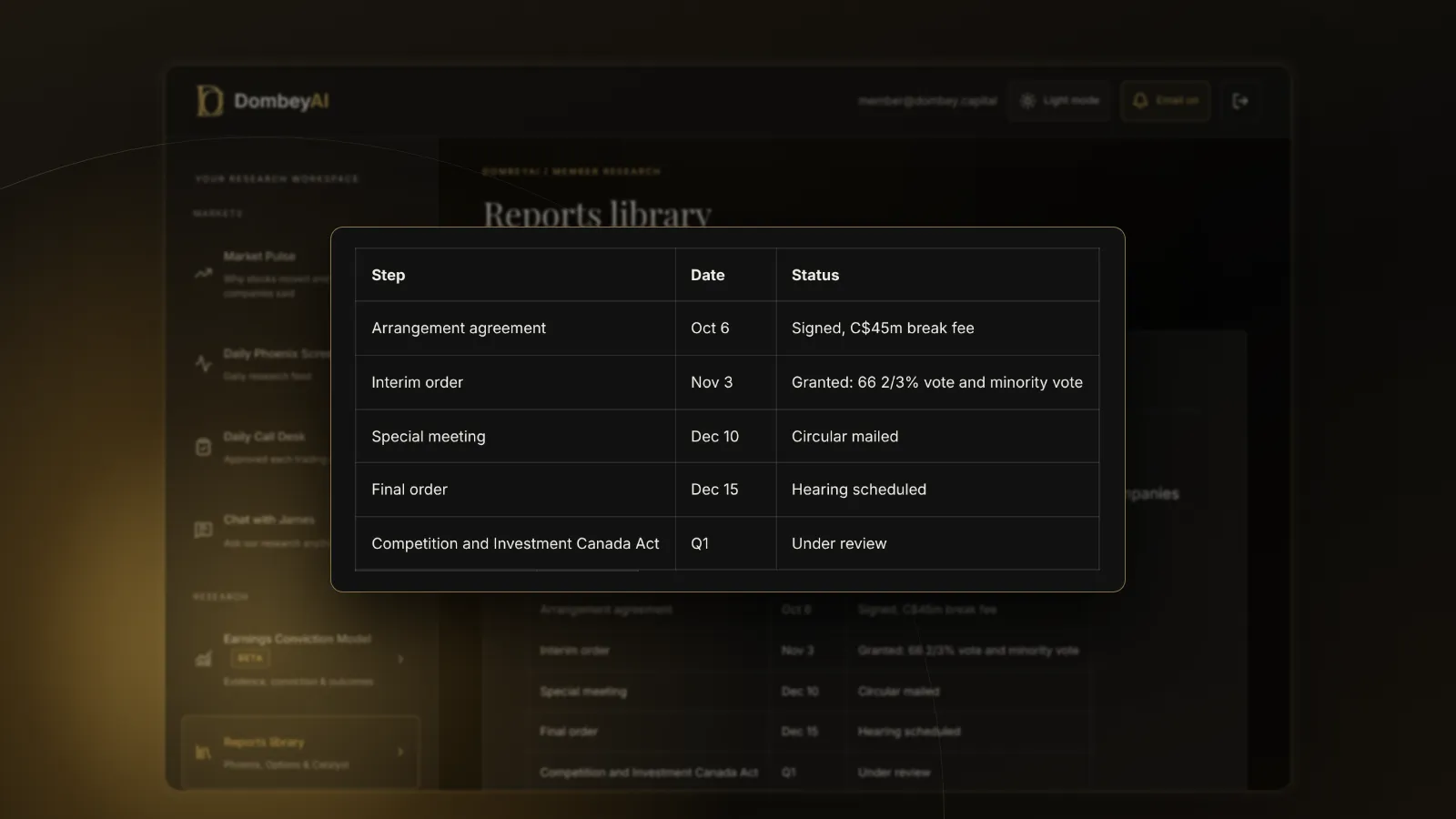
A short definition
Canadian corporate statutes, including section 192 of the Canada Business Corporations Act and similar sections in provincial statutes such as Ontario's and British Columbia's, let a company propose an "arrangement": a fundamental change that can include an amalgamation, a share exchange, a transfer of assets, a reorganization of share capital or a mix of these. The court supervises the process and must approve the result as fair and reasonable.
The appeal is flexibility. An arrangement can combine a cash and share offer, a spin-off of a business, a stock option exchange and tax steps in one plan that closes on one day, with 100% ownership at closing if it is approved.
Real examples
Large Canadian deals have used plans of arrangement for decades. The management information circular for each, filed on SEDAR+ and often on EDGAR, sets out the plan in full.
| Transaction | Year completed | What the arrangement did |
|---|---|---|
| Burger King and Tim Hortons | 2014 | Combined the two under a new Canadian parent, Restaurant Brands International |
| Agrium and Potash Corporation of Saskatchewan | 2018 | Merger of equals forming Nutrien |
| Newmont and Goldcorp | 2019 | Acquisition of Goldcorp for Newmont shares |
| Rogers Communications and Shaw Communications | 2023 | Acquisition of Shaw after a long regulatory review |
These deals differ in size and structure, but each followed the same sequence: an arrangement agreement, an interim order, a shareholder vote, a fairness hearing and a final order, with regulatory approvals running alongside.
How a plan of arrangement works
- Arrangement agreement. The buyer and target sign an agreement setting the consideration, conditions, deal protections such as a break fee, and the outside date. The target files it publicly.
- Interim order. The target applies to court for an interim order that sets the procedure: the record date, who votes, the approval threshold, dissent rights and how notice is given.
- Management information circular. The target mails a circular with the plan, the board's recommendation, the fairness opinion and often a formal valuation.
- Special meeting. Shareholders vote. The usual threshold is two-thirds of the votes cast. Related-party deals may also need majority-of-the-minority approval.
- Final order. After the vote, the court holds a fairness hearing. Affected parties can appear and object. If the court approves, it grants the final order.
- Closing. Once regulatory and other conditions are met, the company files articles of arrangement and the plan takes effect.
Approvals and timing
| Step | Who decides | Typical timing after signing | What to check |
|---|---|---|---|
| Interim order | Court | 2 to 6 weeks | Voting threshold, class votes, dissent procedure |
| Circular mailed | Target | 3 to 8 weeks | Fairness opinion, formal valuation, insider interests |
| Shareholder meeting | Shareholders | 1 to 3 months | Two-thirds threshold and minority vote |
| Final order | Court | Days to weeks after the meeting | Objections filed, the court's reasons |
| Regulatory approvals | Competition Bureau, Investment Canada Act, foreign regulators | Weeks to more than a year | Conditions and the outside date |
The timing ranges are illustrative. The circular and the arrangement agreement state the expected dates for each deal.
Minority protection and dissent rights
Two protections matter for shareholders.
Majority of the minority. Multilateral Instrument 61-101, adopted by securities regulators in Ontario and Quebec, requires minority approval for many related-party transactions and business combinations: a majority of the votes cast excluding shares held by the buyer, its related parties and insiders who receive a collateral benefit. Some deals also need a formal valuation by an independent valuator.
Dissent rights. The interim order usually grants dissent rights. A shareholder who files a notice of dissent before the meeting and follows the procedure can be paid the fair value of their shares as set by the court, instead of the deal price. The procedure is strict, and the outcome can be above or below the deal price. Our explainer on appraisal rights covers the US equivalent.
How US holders are affected
Many Canadian targets have US shareholders. When the buyer issues shares, it would normally need to register them with the SEC. Section 3(a)(10) of the Securities Act exempts securities issued in an exchange the court has approved as fair after a hearing that all recipients can attend. That is why US holders in Canadian arrangements often receive new shares without an S-4 or F-4 registration statement.
The exemption covers the issuance, not every later resale. Holders who are affiliates of the issuer after the deal may face resale limits, which the circular describes. For buyers that are not already SEC registrants, the arrangement may also bring new reporting obligations if they list the shares in the US.
If the arrangement includes a spin-off or a share exchange, tax treatment can differ for US and Canadian holders. The circular has sections on both, and the differences can be material.
Plan of arrangement vs other deal structures
| Feature | Plan of arrangement (Canada) | Takeover bid (Canada) | One-step merger (US) | Scheme of arrangement (UK, Australia) |
|---|---|---|---|---|
| Court role | Interim and final orders | None, unless contested | None, unless litigated | Court sanction after the vote |
| Shareholder approval | Usually two-thirds of votes cast | Tenders, minimum 50% tender condition | Majority of outstanding shares in most states | 75% by value, plus a majority in number in the UK |
| Minimum timeline | Set by the meeting date | Open at least 105 days unless shortened | Set by the proxy process | Set by the meeting and hearing |
| Result at closing | 100% if approved | Second step needed for holdouts | 100% | 100% if approved |
| Dissent or appraisal | Under the interim order | Under the second step | Under state law, often Delaware | Generally no appraisal |
For the US process that runs alongside many cross-border deals, see how to track a merger through approval.
Where this goes wrong
Assuming the court is a formality. Most final orders are granted, but courts can refuse or require changes when a plan treats one group unfairly, such as debtholders or a share class.
Missing the minority vote. If insiders hold a large stake and receive a benefit, the deal may need majority-of-the-minority approval, which can be harder to win than the two-thirds vote.
Ignoring regulatory approvals. The Competition Bureau, the Investment Canada Act net benefit review and foreign regulators can take longer than the vote and court steps. The Rogers and Shaw review ran far beyond the original timeline.
Losing dissent rights through process errors. A notice filed late or a vote cast in favor can forfeit the right.
Ignoring tax differences. A share exchange that is tax-deferred in Canada may be taxable for US holders unless the structure was planned for both.
Arrangements in merger arbitrage
For a deal spread, the arrangement adds two court dates to the usual calendar. Each date is a checkpoint: the interim order confirms the vote mechanics, and the final order removes one of the last conditions before closing. Our explainer on merger arbitrage and our guide on how to calculate a merger arbitrage spread cover how to price the time and the risk, and our piece on deal breaks covers the downside.
Dombey's published research tracks deal spreads against these dates; see the research archive. For newsletters that cover deals, see our list of the best investing newsletters for special situations.
The bottom line
A plan of arrangement is the standard way to combine or reorganize Canadian public companies: a two-thirds shareholder vote, an interim and a final court order, and dissent rights set by the court. It allows many steps in one transaction and reaches full ownership at closing. For investors, the circular holds the dates, the vote thresholds and the minority protections, and the regulatory approvals are usually the longest part of the timeline.