

What you need
- The offering documents. The prospectus or offering memorandum, and the 8-K announcing the pricing. Most convertibles are sold under Rule 144A, so the 8-K and the indenture filed as an exhibit are the public sources.
- The indenture. The legal terms: conversion ratio, adjustments, calls, puts and settlement. How to read a bond indenture covers the structure.
- The latest 10-K and 10-Q. For the debt note, the share count and the cash position.
- Current prices. The stock price and, if available, the bond's quoted price.
- A spreadsheet. The arithmetic is simple, but you will compare several scenarios.
Step 1: Pull the key terms
Start with a one-page term sheet.
| Term | Where to find it | What it sets |
|---|---|---|
| Principal and coupon | Pricing 8-K, indenture | Income and amount owed |
| Maturity | Indenture | When principal is due |
| Conversion ratio | Indenture | Shares per $1,000 bond |
| Conversion price | $1,000 divided by the ratio | Stock price at which conversion breaks even |
| Settlement method | Indenture | Cash, shares or a mix on conversion |
| Issuer call | Indenture | When the issuer can force conversion or redemption |
| Holder put | Indenture | When holders can demand repayment |
| Fundamental change terms | Indenture | Make-whole shares and put rights on a takeover |
| Capped call | Pricing 8-K | Dilution offset and its cap |
Step 2: Compute parity and the premium
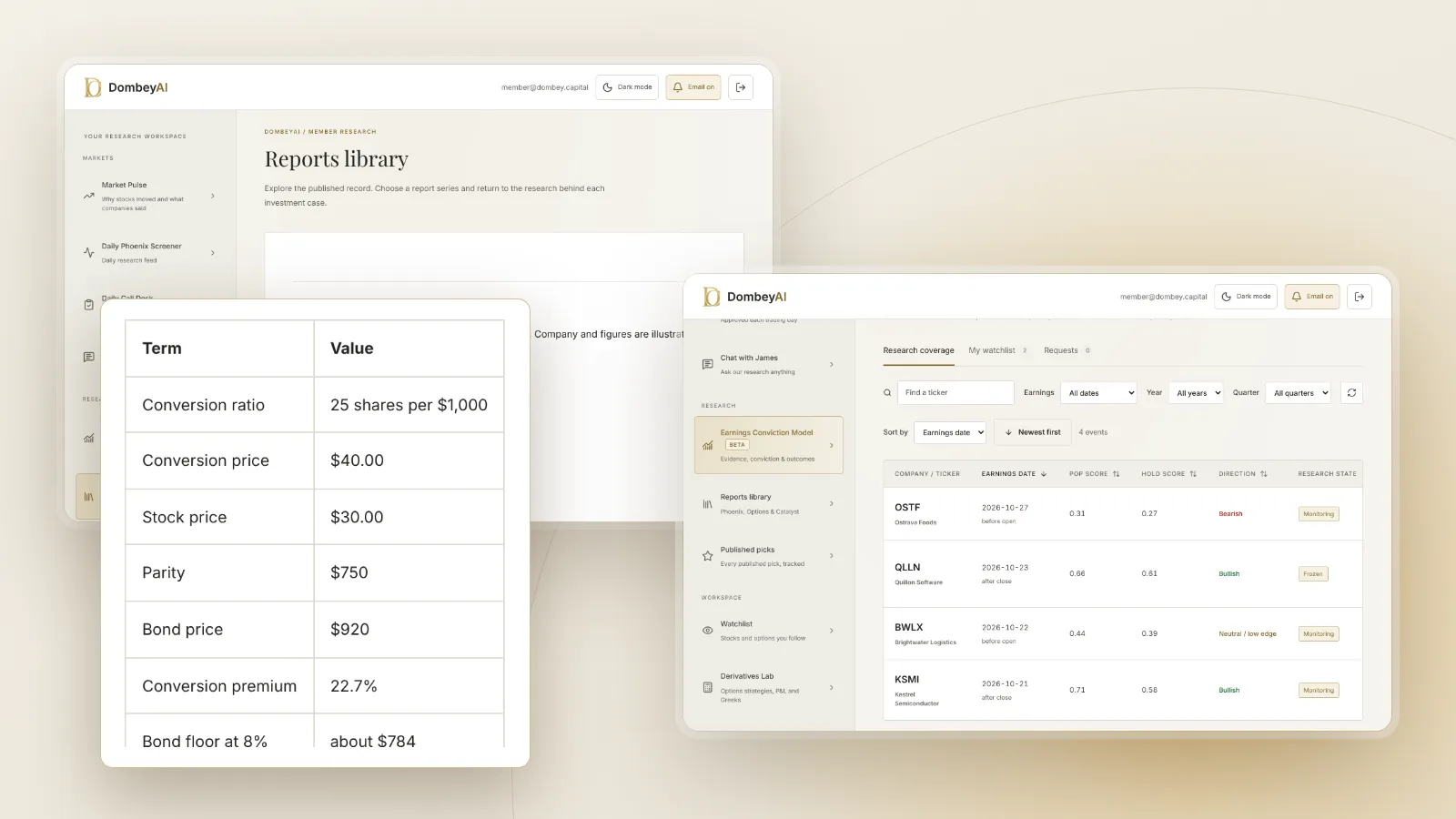
Parity is the conversion ratio times the share price. The conversion premium is the bond price over parity, minus one.
A premium below about 15% usually means the bond behaves mostly like the stock. Above about 50%, it behaves mostly like debt. In between, both parts matter.
Step 3: Value the bond floor
The bond floor is the convertible's value as an ordinary bond. Discount the coupons and principal at the yield the issuer would pay on straight debt of the same maturity.
For Company A, suppose straight debt would yield 8% and the bond has four years left. The floor is roughly $784 per $1,000. The bond trades at $920, so about $136 is being paid for the conversion option. The stock would need to rise about 23%, to roughly $36.80, before parity alone matches the bond's price.
If the issuer has no straight debt to compare with, use yields on similar-rated companies. The floor is an estimate, and a range is more honest than one figure.
Step 4: Assess credit
The floor depends on credit. A strong issuer's convertible falls toward a solid floor when the stock drops. A weak issuer's floor falls with the stock, because the same bad news that hurts the shares raises the risk of default.
Check:
- Liquidity. Cash against debt due before and at the convertible's maturity.
- Seniority. Most convertibles are senior unsecured. Secured debt ranks ahead. Mapping the capital structure shows where the convertible sits.
- Cash burn. For loss-making issuers, quarters of runway.
- Maturity stack. Other debt due around the same time. Debt maturity walls explains why clusters of maturities matter.
When the stock is far below the conversion price and credit is weak, the convertible is a distressed bond. Its value then depends on recovery, not the option.
Step 5: Read calls and puts
Issuer calls let the company redeem the bonds, often only if the stock has traded above a level, such as 130% of the conversion price, for a set number of days. A call forces holders to convert or accept cash and ends the option's time value. It caps the upside of the bond relative to the stock.
Holder puts let investors demand repayment at par on set dates. A put shortens the bond's effective maturity and raises the floor.
Fundamental change provisions apply if the company is acquired. Holders typically receive a put at par and extra shares under a make-whole table that compensates for lost option value.
Step 6: Model settlement and dilution
Settlement decides how many new shares conversion creates.
| Settlement | What holders get | Dilution |
|---|---|---|
| Physical | Shares only | Full conversion shares |
| Cash | Cash only | None, but uses cash |
| Net share | Cash for principal, shares for the excess over principal | Only the in-the-money excess |
| Issuer's choice | Any of the above | Depends on the issuer's decision |
Under current US accounting, convertibles are generally included in diluted share counts using the if-converted method. Read the earnings per share note for the share count used. Dilution and share count changes covers the wider picture.
Then add any capped call. If Company A bought a capped call with a cap at $60, conversions between $40 and $60 are offset by the capped call's payoff, and dilution begins only above $60.
Step 7: Check the hedge flows
When a convertible prices, many buyers are hedge funds that short the stock against the bond. That selling often hits the shares on pricing day. Over time, hedge adjustments add and remove short positions as the stock moves. Convertible arbitrage explains how the hedge works.
Short interest that rises after an issue often reflects these hedges, not a negative view. Read it in that light. Short interest and days to cover explains how to read the figure, and the pricing 8-K sometimes states that the issuer used part of the proceeds to repurchase shares from hedging buyers, which offsets some of the selling.
Step 8: Put it together
Compare the bond's price with your estimate of the floor plus the option's value. Then write down which way it behaves now, debt or equity, and what would change that. For a stockholder, write the dilution at several share prices and the cash needed at maturity or the first put date.
Common mistakes
- Treating the floor as fixed. The floor moves with the issuer's credit, and falls hardest exactly when the stock falls.
- Ignoring settlement. Physical and net share settlement give very different dilution.
- Forgetting the put. A holder put can bring a cash need forward by years.
- Reading short interest at face value. Hedge shorts against convertibles inflate it.
- Missing the capped call. It changes effective dilution and appears in the pricing 8-K, not always in the indenture.
- Skipping the adjustment clauses. Special dividends, spin-offs and some tender offers adjust the conversion ratio. A large special dividend can raise the ratio and add dilution.
- Ignoring the make-whole table. In a takeover, extra conversion shares go to bondholders, which reduces what common holders receive. Read the table before modeling a deal price.
The bottom line
A convertible bond is a bond plus an option, and analysis means valuing both and how they interact. Parity, premium and the bond floor show whether it behaves like stock or debt. Credit, calls, puts and settlement terms decide its value and the dilution it can cause. For stockholders, the same steps show how a convertible affects the share count and the cash the company will need, which is often where special situations begin. The best newsletters for special situations compares services that follow capital structure events like these.