

A short definition
A REIT is a company that owns or finances income-producing real estate and meets the requirements of the US tax code for REIT status. Most REITs are formed that way from the start. A conversion takes an existing corporation, often one that does not look like a property company, and reorganizes it so that the real estate qualifies.
Real examples of REIT conversions
| Company | Asset type | First REIT tax year | Note |
|---|---|---|---|
| Weyerhaeuser | Timberland | 2010 | Timber owner converted from a forest products company |
| American Tower | Cell towers | 2012 | Tower leasing treated as real estate rent |
| Corrections Corporation of America (now CoreCivic) | Prisons | 2013 | Later gave up REIT status |
| Crown Castle | Cell towers and fiber | 2014 | Followed American Tower |
| Iron Mountain | Document storage | 2014 | Storage racking and buildings as real estate |
| Lamar Advertising | Billboards | 2014 | Billboard structures as real estate |
| Equinix | Data centers | 2015 | Colocation space as real estate |
The list shows the point of the label: "real estate" for tax purposes can include towers, billboards and data centers, as long as the income looks like rent from real property. Each of these companies built its case on that definition, in some cases with private letter rulings from the IRS.
Why companies convert
Tax. A C corporation pays corporate income tax, and shareholders pay tax again on dividends. A REIT deducts the dividends it pays, so qualifying income is taxed mostly once, at the shareholder level. For a business with large, steady, rent-like cash flows, the saving can be substantial.
Investor base. REITs are held by income funds, REIT index funds and dividend investors who might not own a tower or billboard company. A conversion can bring new buyers and, at times, a valuation closer to that of other REITs, which are often valued on funds from operations rather than earnings.
Discipline. The payout requirement returns most cash to shareholders. Some investors see that as a check on management.
The trade-off is reinvestment. A REIT must distribute at least 90% of its taxable income, so it retains less to fund growth and relies more on issuing shares and debt. Companies that need to reinvest heavily may find the rule constraining; that tension is one reason some converted companies later gave up the status.
What a conversion requires
| Requirement | What it means |
|---|---|
| Asset test | At least 75% of total assets in real estate, cash and government securities |
| Income tests | At least 75% of gross income from real estate sources, and 95% from those plus dividends and interest |
| Payout | Distribute at least 90% of REIT taxable income each year |
| Ownership | At least 100 shareholders; no more than 50% held by five or fewer individuals in the second half of the year |
| Taxable subsidiaries | Businesses that do not qualify sit in taxable REIT subsidiaries, which may hold no more than 20% of total assets |
| E&P purge | Distribute accumulated C-corporation earnings and profits by the end of the first REIT year |
| Built-in gains | Corporate tax on pre-conversion gains if those assets are sold within five years |
In practice, converting companies split the business. The real estate goes into the REIT, and services that do not qualify, such as installation, management or media sales, go into taxable REIT subsidiaries. The structure resembles an opco and propco split inside one company.
The special distribution
The E&P purge is often the largest single event in a conversion. The company must pay out the earnings and profits it accumulated as a C corporation. Public companies have often paid this special distribution partly in new shares and partly in cash, with shareholders choosing their mix subject to a cap on the cash portion, much like a cash or stock election in a merger.
The distribution is taxable to shareholders even when paid in stock, which matters for taxable accounts. The special dividend explainer covers how the price adjusts on the ex-date.
The timeline and the catalysts
A conversion usually takes one to three years from the first announcement:
- Strategic review or board decision. The company says it is studying a conversion. Uncertainty about whether the assets qualify is highest here.
- IRS ruling, if sought. For unusual assets, a favorable private letter ruling often removes the main risk.
- Reorganization. Assets move into the REIT and taxable subsidiaries; debt may be refinanced.
- Special distribution. Declared and paid before or during the first REIT year.
- REIT election. Effective on the first day of a tax year, filed with the first REIT tax return.
- Index inclusion. Once it qualifies, the company may join REIT indexes, which can bring index fund buying.
Each step can move the stock, which is why a conversion is a special situation: a dated event with a value change that a standard screen does not capture. Valuation shifts as well. After converting, investors look at funds from operations and adjusted funds from operations, as described in how to value a REIT, and the comparison group changes from operating companies to REIT peers.
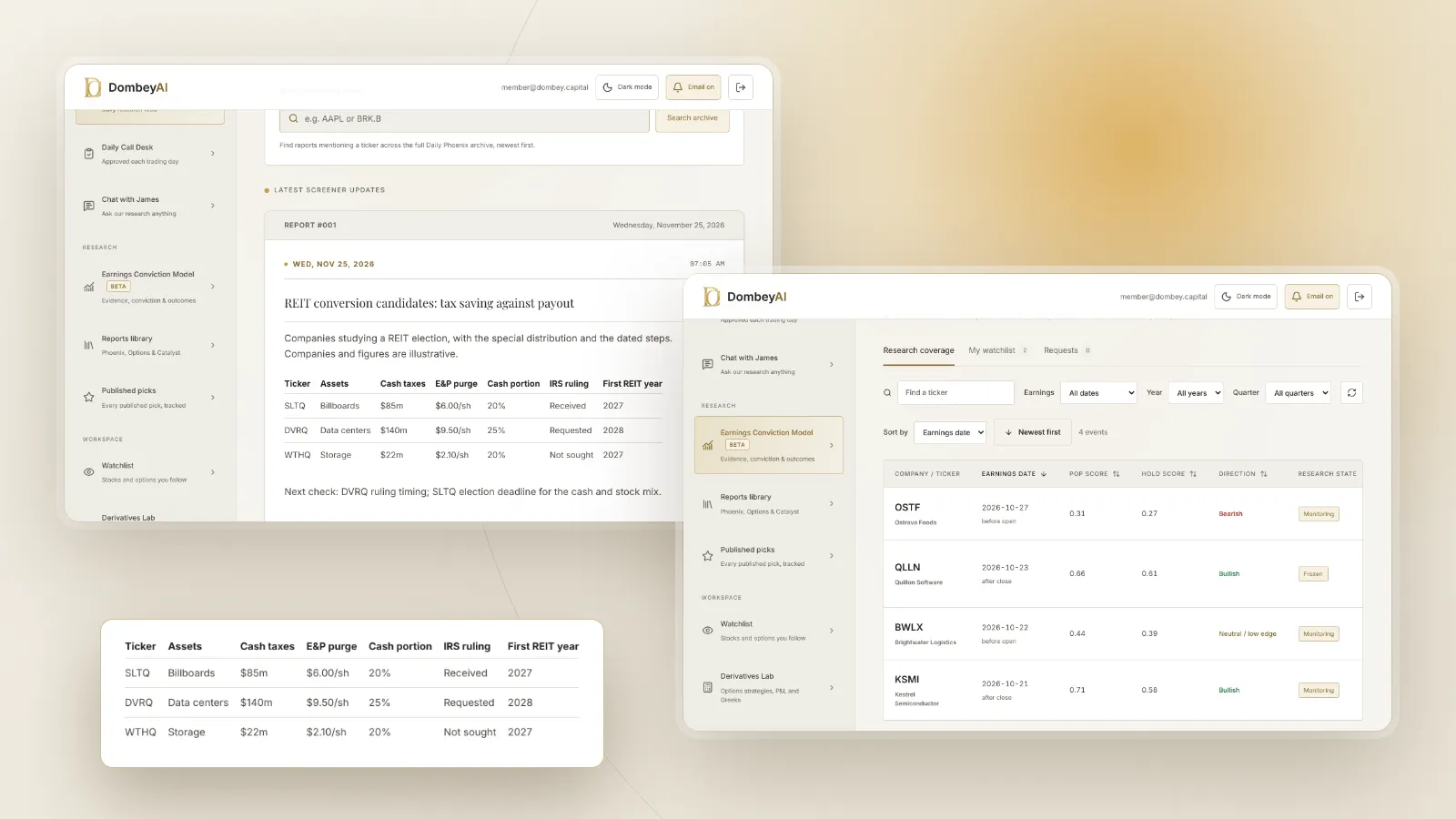
Dombey's published research covers corporate events of this kind with the dates and the value at stake; see the research archive.
Where this goes wrong
- The assets may not qualify. If rent from a type of asset is not clearly real estate income, the plan can stall. A negative ruling or a change in IRS policy can end it.
- The tax saving can be smaller than it looks. A company with large tax losses or low cash taxes already gains little from converting.
- The payout can strain growth. A business that needs to reinvest heavily may have to issue shares often, which dilutes holders.
- The special distribution is taxable. Holders in taxable accounts receive a tax bill, partly in stock they may need to sell.
- Status can be lost or dropped. Failing a test or a change in strategy can end REIT treatment, and a company that leaves generally waits several years before it can elect again.
- Rerating is not certain. The stock may already reflect the conversion by the time it happens.
For a wider list of research services that follow corporate events like this, see the best newsletters for special situations. Investors who hold companies with large property holdings should also read how to value real estate hidden on the balance sheet.
The bottom line
A REIT conversion turns a taxable corporation into a pass-through vehicle for its real estate income, trading most corporate tax for a 90% payout rule and strict tests on assets and income. Towers, data centers, billboards, timberland and storage have all made the switch. The path runs through a reorganization, a taxable special distribution, a five-year built-in gains window and, often, an IRS ruling. Track those dated steps, check whether the tax saving is real for that company, and value the result against REIT peers once the conversion is done.