

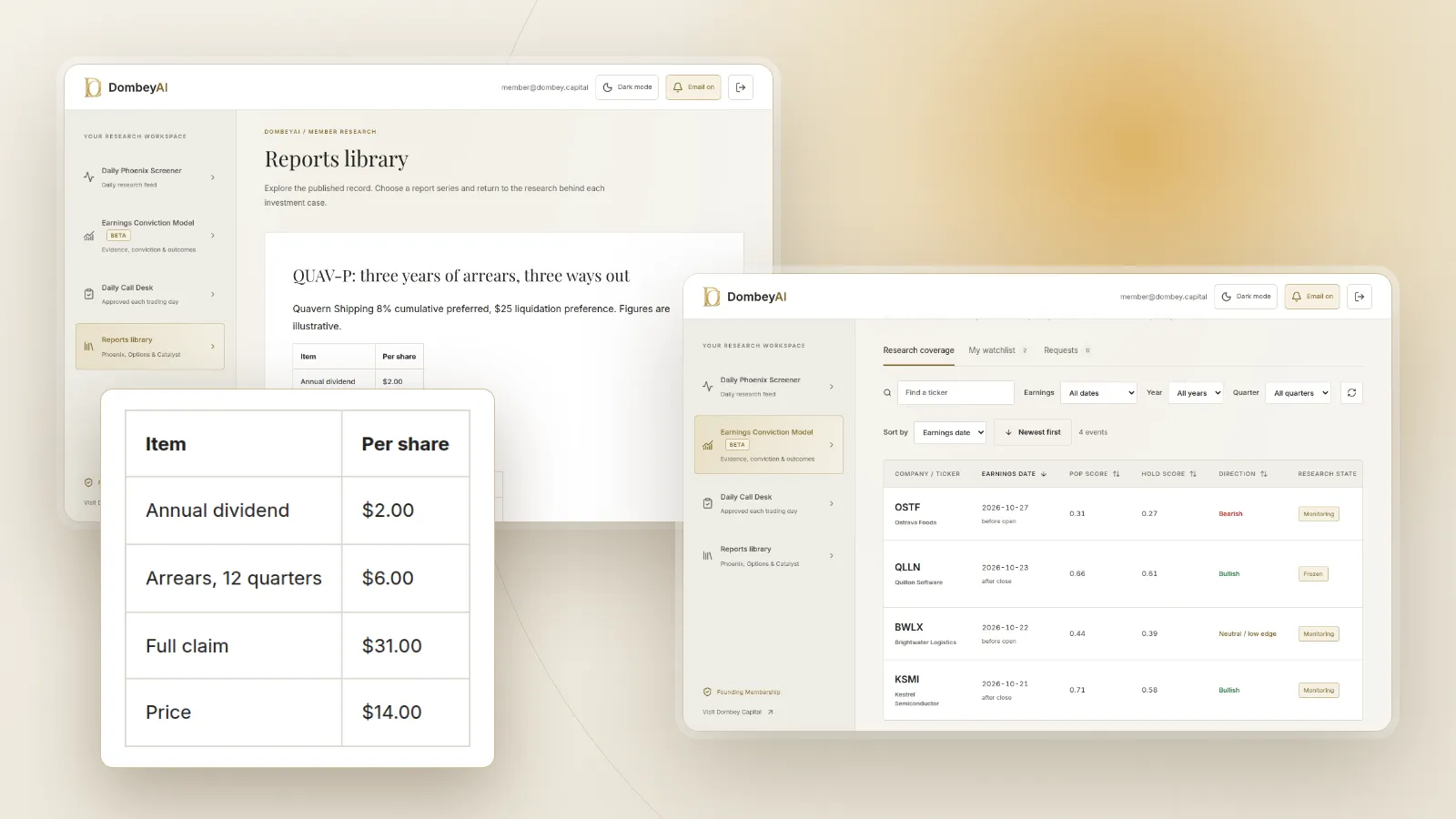
How arrears build up
A preferred stock has a stated dividend, usually a fixed percentage of a liquidation preference such as $25 or $1,000 per share. The board must declare each dividend before it is paid. When a company is short of cash or needs to protect its liquidity, the board can decline to declare.
What happens next depends on one word in the terms:
- Cumulative. The skipped dividend accumulates as arrears. The company cannot pay common dividends, and usually cannot buy back common stock, until all arrears are paid.
- Non-cumulative. The skipped dividend is lost. Many bank preferreds are non-cumulative.
Most cumulative preferreds accumulate arrears without interest, so a dollar of arrears paid in four years is worth less than a dollar today. The terms are in the certificate of designation, which is filed as an exhibit, and summarized in the prospectus for the offering.
Where to find arrears in the filings
Undeclared dividends in arrears are not recorded as a liability. They appear in:
- The equity or preferred stock note in the 10-K and 10-Q, usually as a total and a per-share amount. Our guide on how to read the footnotes in a 10-K shows where.
- Earnings per share. For cumulative preferred, the period's dividends are deducted from net income in calculating income available to common shareholders, whether or not they were declared.
- Form 8-K filings announcing a suspension or resumption of dividends. See how to read an 8-K for catalysts.
What rights holders gain
Missed dividends often change the balance of power. Many preferred issues give holders the right to elect additional directors, commonly two, after six quarterly dividends have been missed, and this is a standard feature of exchange-listed preferred stock. The right usually ends when the arrears are paid.
Other protections can include restrictions on new senior securities and votes on amendments that affect the preferred. A board facing preferred-elected directors has a reason to resolve the arrears, which can turn the board election itself into a catalyst. Our explainer on proxy fights covers how contested elections work.
How arrears get resolved
| Resolution | What preferred holders receive | What it means for common |
|---|---|---|
| Catch-up payment | All arrears in cash, then regular dividends | Common dividends can resume afterward |
| Exchange offer | New common stock, debt or cash for the preferred and arrears | Dilution, but the overhang is gone |
| Recapitalization | New securities under amended terms, often by holder vote | Depends on the terms negotiated |
| Acquisition | Preference and arrears paid by the buyer, if terms require | Reduces what is left for common |
| Restructuring | Little or nothing if debt is impaired | Usually wiped out |
An exchange offer or recapitalization usually needs a preferred holder vote, which gives holders bargaining power but also a deadline. In a restructuring, preferred ranks below every creditor; our explainer on what happens to stock in Chapter 11 covers the order of payment.
Valuing a preferred in arrears
The claim is the liquidation preference plus accumulated arrears, plus future arrears until it is resolved. The value depends on which resolution happens and when.
The key inputs are the company's ability to pay, which depends on its debt and cash runway, and its willingness, which depends on who controls the board and what common holders would gain from clearing the arrears. Probability-weighted valuation is the natural framework.
Our list of the best special situations newsletters includes services that cover preferred stocks in this position.
Who gains when the arrears are cleared
The common stock of a company with preferred arrears has an unusual position. Every dollar of arrears stands between common holders and their own dividends, so clearing the arrears can be good for common shareholders even though cash leaves the company. Boards controlled by common holders therefore often look for a way to retire the preferred cheaply, through an exchange offer or a tender at a discount to the full claim.
That creates a negotiation. Preferred holders want the liquidation preference plus every dollar of arrears; the company wants to pay less. The outcome depends on leverage: board seats won by preferred holders, the votes needed to amend the terms, the company's cash and the cost of leaving the preferred outstanding. Reading the tender offer or exchange documents closely matters, because the terms often include amendments that strip protections from holders who do not participate.
Signals that a resolution is coming
- The company returns to profit or refinances its debt.
- The board discloses a plan to resume preferred dividends or explores options for the preferred.
- Preferred holders gain the right to elect directors, or an activist accumulates the preferred.
- Common shareholders press for dividends, which cannot be paid until arrears are cleared.
- The company files a preliminary proxy to amend the preferred terms. See how to read a proxy statement.
Where this goes wrong
- Treating the claim as cash. Arrears are owed only if the company can and chooses to pay. In distress, the claim may be worth very little.
- Ignoring the time value. Non-compounding arrears lose value every year the suspension continues.
- Missing the debt. Credit agreements often block preferred dividends until leverage falls, whatever the board wants.
- Underestimating coercive exchanges. A company can offer common stock for the preferred and amend the terms for holders who do not tender.
- Liquidity. Many preferred issues trade thinly, with wide bid-ask spreads.
The bottom line
Preferred dividends in arrears are skipped dividends on cumulative preferred stock that keep accumulating and must be paid before common shareholders receive anything. They are disclosed in the notes rather than recorded as a liability, and missed payments often give preferred holders board seats. Arrears end in a catch-up, an exchange, a recapitalization, a sale or a restructuring. Value the preferred by weighting those outcomes, with the company's ability and incentive to pay at the center of the analysis.