

The filing: what changes on day one
Chapter 11 lets a company keep operating while it restructures its debts under court supervision. Management usually stays in place as the "debtor in possession", and the automatic stay stops most creditors from collecting while the case runs.
For shareholders, four things change quickly:
- The 8-K. A public company must report the filing on Form 8-K under Item 1.03 within four business days. The filing names the court, the case and, often, the debtor-in-possession financing and any restructuring support agreement already signed with creditors.
- The listing. Exchanges have discretion to delist a company that files for bankruptcy, and both the NYSE and Nasdaq commonly start that process soon after a filing. Our explainer on what a delisting means for shareholders covers the notices and the move to the over-the-counter market.
- The symbol. On the OTC market, FINRA has used a "Q" added to the end of a symbol to mark a company in bankruptcy, which is a quick visual flag that the shares are in a case.
- Trading limits. Many debtors ask the court for an order restricting trades by large holders, to protect tax losses that could be lost if ownership changes too much. These orders typically require holders above a set threshold, often just under 5%, to give notice before buying or selling.
The company also keeps filing reports with the SEC in many cases, though some stop filing 10-Qs and file monthly operating reports with the court instead.
Where shareholders sit in the priority ladder
Chapter 11 pays claims in a set order. Equity is last.
| Rank | Class | Typical treatment in a plan |
|---|---|---|
| 1 | Secured creditors, including most DIP lenders | Paid from their collateral: cash, new debt or most of the new equity |
| 2 | Administrative and priority claims | Paid in full in cash, including professional fees and certain taxes and wages |
| 3 | General unsecured creditors | Bondholders and trade creditors share what remains, often in new equity |
| 4 | Subordinated claims | Paid only after general unsecured claims |
| 5 | Preferred stock | Recovers only if all claims are paid |
| 6 | Common stock | Recovers only if everything above is paid in full |
The legal anchor is the absolute priority rule in Section 1129(b) of the Bankruptcy Code. When a class of unsecured creditors votes against a plan and the company asks the court to confirm it anyway, known as a cramdown, the plan must pay that class in full or give nothing to anyone junior to it. Common stock is junior to everyone, so in a contested case old shareholders get nothing unless creditors are paid in full.
The plan and what it says about existing equity
The company proposes a plan of reorganization, files a disclosure statement that explains it, and asks creditors to vote. The plan divides claims and interests into classes and states what each class receives. Existing common stock is usually its own class, labeled something like "Existing Equity Interests" or "Interests in the Debtor".
Read that line first. It will say one of a few things, and it decides the outcome far more than any analysis of the share price.
A class that receives nothing under the plan is deemed to have rejected it, so it does not vote. That is why many shareholders never receive a ballot. A class of equity interests that does vote accepts the plan when holders of at least two-thirds in amount of the voting shares approve.
The disclosure statement also contains the valuation analysis behind the plan: a range for the company's enterprise value and the recoveries it implies for each class. If the top of that range is still below the total of the claims ahead of equity, the plan is telling shareholders the stock is out of the money. You can find these documents on the claims agent's website and, often, as exhibits to an 8-K on EDGAR; our EDGAR search guide shows how to pull them.
The five common outcomes for old shares
Most cases end in one of these:
- Cancelled with no recovery. The most common result when the company is insolvent. On the effective date the shares are cancelled and removed from brokerage accounts.
- Cancelled with warrants. Old holders receive warrants on the new equity with a strike price set high enough that they pay off only if the reorganized company does well. Creditors sometimes agree to this to avoid a fight.
- A small slice of new equity. Old holders get a few percent of the new shares, usually as a negotiated gift from a creditor class rather than a legal entitlement.
- Retained stock, diluted. If the company is close to solvent, old holders may keep their shares but suffer heavy dilution through a rights offering or debt converted to equity. Our piece on rights offerings explains how those are priced.
- Paid in full or retained intact. Rare. It happens when asset values or a sale price turn out high enough to pay every creditor in full, with interest where required, and leave value for equity.
A further path is a sale of the business under Section 363 of the Bankruptcy Code, followed by a liquidating plan. Sale proceeds flow down the same priority ladder, so equity again recovers only if creditors are paid in full.
Worked example: reading a plan as a shareholder
The figures below are illustrative. Company A is hypothetical.
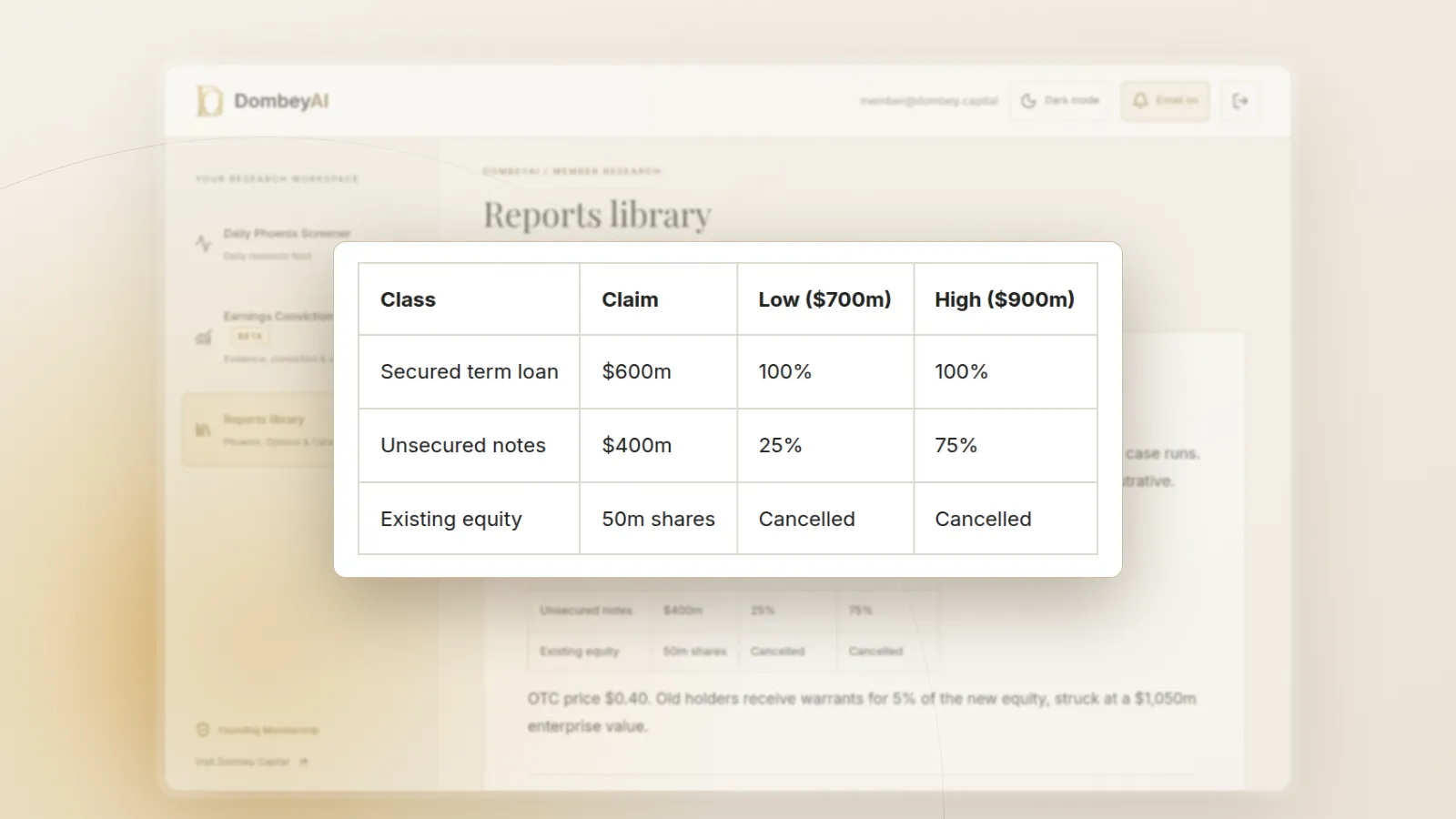
Company A files for Chapter 11 with a $600m secured term loan, $400m of unsecured notes and 50 million common shares. Its disclosure statement values the business at $700m to $900m, midpoint $800m. After the filing the old shares trade at $0.40, a market value of $20m.
Now change one number. Suppose the plan offers old shareholders warrants for 5% of the new equity at a strike that implies a $1,050m enterprise value. The warrants have value only if the reorganized company is worth more than $1,050m, well above the plan's high case. That is a real but distant option, and the share price during the case should be judged against it, not against the company's past price.
The steps that generalize:
- Add up all claims ahead of equity, including administrative claims, DIP loans and the unsecured pool.
- Compare the total to the plan's enterprise value range.
- If equity is out of the money across the range, read what the plan gives it: nothing, warrants or a gifted share.
- Value that consideration, and compare it to the share price.
Equity committees and when shareholders fight
Shareholders can ask the court to appoint an official equity committee. Under Section 1102 of the Bankruptcy Code, the court may order one if it is needed to give shareholders adequate representation. An official committee can hire advisers paid by the estate, which is what gives it weight.
Courts grant these requests rarely. They tend to require a credible showing that the company may be solvent and that shareholders cannot protect themselves without one. An appointment is meaningful news because it signals the court sees a real chance of value for equity, and it often leads to a valuation fight at confirmation.
Even without a committee, shareholders can object to the disclosure statement or the plan. Objections succeed mainly when the valuation is weak or the process unfair. They rarely change the result when the company is clearly insolvent.
Taxes and the end of the line
When a plan cancels the old shares, the loss is usually a capital loss. Section 165(g) of the Internal Revenue Code treats a security that becomes worthless during a tax year as sold for nothing on the last day of that year. The year it becomes worthless can be debatable when the stock still trades, which is one reason the cancellation date matters. If the plan gives holders warrants or new shares, the tax treatment can differ.
After cancellation, brokers remove the position, sometimes weeks after the effective date. The company's final 8-K on the effective date confirms the cancellation and the distribution of any new securities.
Where this goes wrong
Investors who buy or hold stock in a Chapter 11 case make the same errors repeatedly.
- Reading the price instead of the plan. A stock can trade at cents or even dollars while the plan gives it nothing. Price spikes in bankrupt stocks are often driven by short-term trading, not by a change in recovery.
- Assuming the old shares become the new shares. They usually do not. The reorganized company's stock is a different security, mostly issued to creditors.
- Ignoring dates. Once the plan is confirmed and the effective date passes, the shares are gone. Buying a few days before cancellation is buying an option that expires worthless.
- Mistaking a turnaround for solvency. Operations can improve during the case and still leave the company worth less than its debts. Recovery for equity depends on value against claims, not on whether the business is getting better.
- Missing the early warnings. Most filings follow a going-concern warning or a debt maturity wall the company could not refinance. A stock that looks cheap before a filing can be a value trap when the debt ahead of it is larger than the business.
Dombey's published research reads the plan's treatment of each class before writing about a company in a case; see the research archive. For others who cover distressed names, our list of special situations newsletters and our guide to bankruptcy and restructuring research sources are useful starting points.
The bottom line
A Chapter 11 filing does not cancel a stock. The shares keep trading, often over the counter, until the plan takes effect. Because equity sits last in the priority ladder, most plans cancel the old shares and give the new equity to creditors, leaving old holders with nothing or a small recovery such as warrants. The plan's line for existing equity interests, read against the disclosure statement's valuation range, tells you far more than the share price does.