

What a closed-end fund discount is
A closed-end fund raises money once, usually in an initial public offering, and invests it in a portfolio of stocks, bonds, loans or other assets. Its shares then trade on an exchange like any stock. The fund does not issue new shares or buy back old ones on demand, so the share count stays largely fixed.
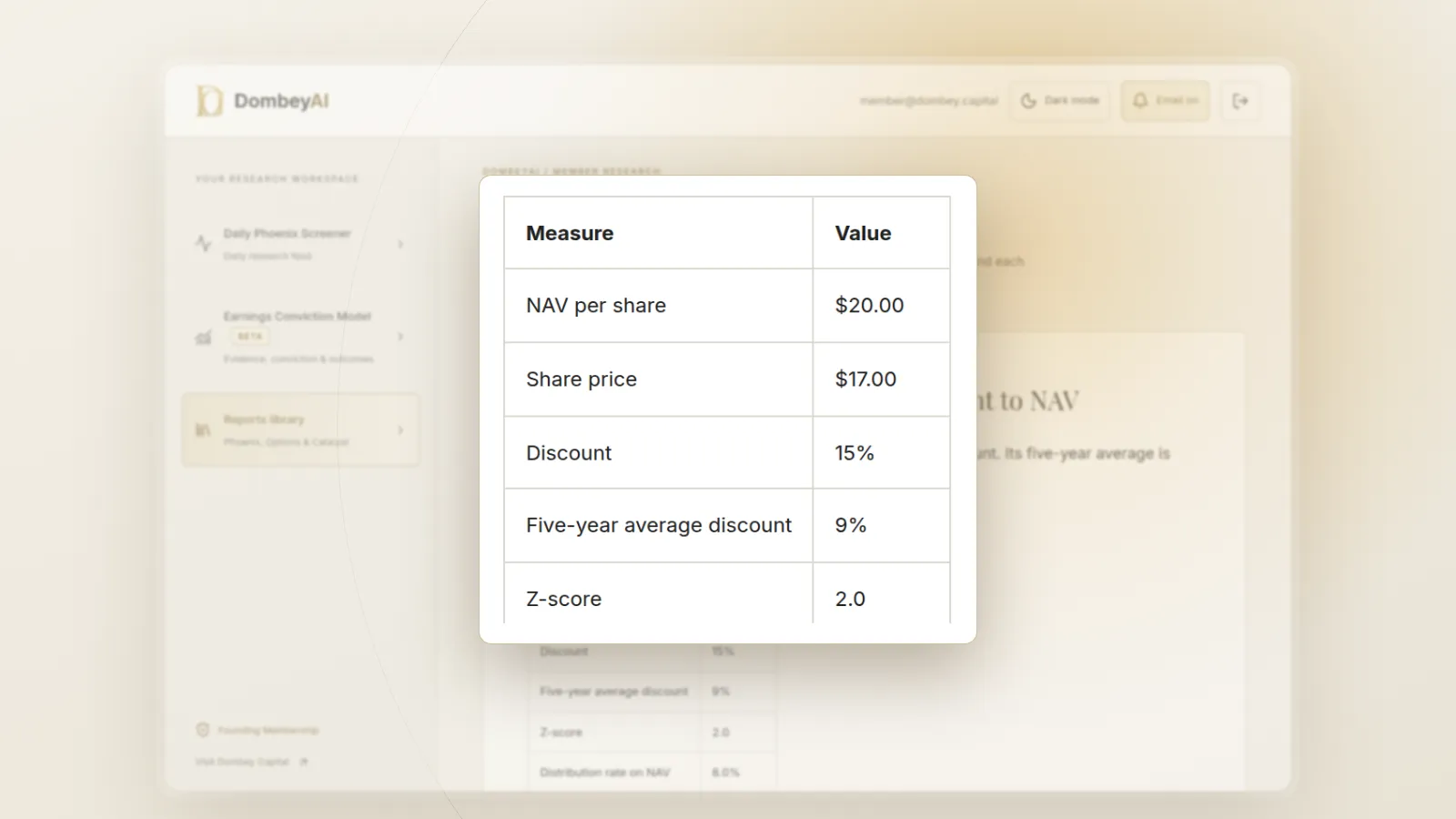
NAV per share is the fund's total assets, minus its liabilities, divided by shares outstanding. The discount compares the market price with that figure:
Discount = 1 minus (share price / NAV per share)
If the price is above NAV, the fund trades at a premium. Many funds move between the two over time, and the SEC's investor bulletin on closed-end funds warns that buyers can pay more or less than the portfolio is worth.
Business development companies (BDCs) are a related structure. They are closed-end funds that have elected special treatment to invest in smaller private companies, and they are also judged against NAV, though their private loans and stakes make the NAV harder to check.
Why closed-end funds can trade away from NAV
The key is the absence of redemption. A mutual fund buys back shares at NAV each day, so its price and its NAV are the same thing. An ETF trades on an exchange, but large firms can create and redeem shares in exchange for the underlying basket. When an ETF's price drifts from its NAV, those firms trade the gap away.
A closed-end fund has neither mechanism. If you want out, you sell to another investor at whatever that investor will pay. If sellers outnumber buyers for months, the price can stay well below NAV with no arbitrage to correct it. The portfolio could be worth $20 a share and the shares could trade at $17 for years.
That is also why the structure suits illiquid assets. The manager never has to sell holdings to meet redemptions, so the fund can own thinly traded bonds, private loans or small companies. The cost of that stability falls on the shareholder, who carries the discount risk instead.
Why the discount persists
Each cause below is a reason a dollar of NAV inside the fund may be worth less than a dollar to an outside buyer.
| Cause | What it costs the shareholder | Where to check |
|---|---|---|
| Management fees and expenses | A yearly charge on NAV, often higher than an index fund | Fee table in the prospectus or annual report |
| Leverage | Borrowing costs and larger losses in a falling market | Financial statements, notes on borrowings and preferred shares |
| Illiquid or stale holdings | NAV may not reflect what the assets would sell for | Schedule of investments, valuation notes |
| Unrealized capital gains | Tax that a future sale of holdings would pass to holders | Statement of assets and liabilities |
| Distribution policy | Payouts above income can be a return of capital | Section 19(a) notices, annual report |
| Investor demand | Fewer buyers when a sector or asset class is out of favor | The fund's own discount history |
| No exit at NAV | Holders cannot force the value out | Charter, board policies, proxy statement |
The first five are, at least in part, earned. A fund that charges high fees will hand a share of its returns to the manager every year, and a buyer who expects to hold for a long time should pay less for that. As a rough illustration, a fund with 1.5% of yearly expenses consumes about 14% of a constant NAV over ten years. A discount of that size is not obviously a mispricing.
The last two are where the opportunity, if any, sits. Investor demand for closed-end funds moves with sentiment toward their asset classes and toward income products in general. Discounts often widen together when markets fall or when income buyers sell, and some widen at year end as holders sell losing positions for tax-loss purposes. That part of the gap can reverse even if nothing changes inside the fund.
How to read a fund's discount
A single number tells you little. Three comparisons make it useful.
- Against its own history. Some funds have traded at a 10% discount for most of their lives. Others usually trade near NAV. A 12% discount is wide for the second kind and ordinary for the first. Many investors express this as a z-score: the current discount minus its average over a lookback period, divided by the standard deviation over that period.
- Against similar funds. Funds holding the same asset class with similar fees and leverage should trade at similar discounts. A fund well outside its peer group deserves a closer look at why.
- Against its costs. Subtract a rough estimate of the earned discount, from fees, leverage and tax, before calling the rest cheap.
The documents matter as much as the price. Closed-end funds register on Form N-2 and file annual and semiannual shareholder reports on Form N-CSR, all searchable on SEC EDGAR. Read the schedule of investments, the leverage note, the fee table and any discount management policy the board has adopted.
What can close the discount
The discount narrows reliably only when the fund gives shareholders a way to reach NAV. The usual mechanisms:
- If the fund announces a tender offer, it buys back a portion of its shares at or near NAV, often at a stated percentage such as 98% of NAV. The offer must stay open for at least 20 business days, and if more shares are tendered than the fund will buy, each holder is accepted pro rata. See how tender offers work.
- If the board proposes converting to an open-end fund, shares become redeemable at NAV and the discount disappears, usually after a shareholder vote.
- If the fund merges into another fund, the exchange is usually set at NAV. Holders of a fund at a wide discount can gain if the acquiring fund trades closer to NAV.
- If the fund liquidates, it sells the portfolio and pays out NAV less costs. The math is the same as any liquidation play.
- If the fund buys back shares in the market below NAV, each repurchase adds a small amount to NAV per remaining share.
- If an activist builds a stake, a Schedule 13D filing will show its intentions, often a tender offer, a conversion or a board change. See what a 13D filing is and how proxy fights work.
That last point is why a tender offer is a partial fix. Unless the fund commits to repeat tenders or a conversion, the remaining shares can slip back to a discount once the offer closes.
Events can also widen the gap. A rights offering priced below NAV dilutes holders who do not take part and often pushes the discount out. A cut to the distribution can do the same, since many holders own the fund for its income.
Dombey's published research tends to treat a closed-end fund like any other special situation: a measured gap paired with a dated event that could close it; see the research archive. For newsletters that cover tenders, liquidations and similar events, see the best investing newsletters for special situations.
Where this goes wrong
NAV moves too. A discount can narrow because the price rose or because NAV fell. If the portfolio loses value, buying at a discount does not prevent a loss. Recalculate the discount on today's NAV, not last month's.
The NAV is not what the assets would fetch. Funds that hold private loans, thinly traded bonds or restricted securities value them using models and broker quotes. If the fund had to sell, it might get less. The discount may partly reflect that doubt.
Leverage cuts both ways. A fund that borrows will see NAV fall faster than its holdings in a drawdown, and the discount often widens at the same time. The two losses stack.
The board has no reason to act. The fund's manager earns fees on assets. Tenders, conversions and liquidations all shrink those assets. Without a stated discount policy or an outside shareholder pushing, a wide discount can be permanent. A fund with no path to NAV can become a value trap.
The event disappoints. A tender may be small, a conversion vote may fail, and anti-takeover provisions in the charter can blunt an activist. Read the terms before assuming the full gap closes.
The bottom line
A closed-end fund discount is the gap between the fund's share price and the value of its portfolio per share, and it lasts because holders cannot redeem at NAV. Part of the gap pays for real costs such as fees, leverage and illiquid assets, and part reflects investor demand that can change. Judge the discount against the fund's own history and its peers, and subtract the earned part before calling it cheap. The gap closes reliably only through an event that lets holders reach NAV, such as a tender, a conversion, a merger or a liquidation.