

Split-off vs spin-off
A spin-off hands every parent shareholder new shares pro rata. Nobody chooses anything, and nobody gives anything up. A split-off asks holders to choose, and those who choose give up parent shares. The two can be combined: many filings describe a split-off with a clean-up spin-off behind it for any shares the exchange does not place.
| Structure | Who gets subsidiary shares | Parent share count | Holder decision | Main filing for the new shares |
|---|---|---|---|---|
| Spin-off | Every holder, pro rata | Unchanged | None | Form 10 |
| Split-off | Holders who tender | Falls | Tender or keep | Form S-4 or other Securities Act form, plus Schedule TO |
| Split-off with clean-up spin-off | Tendering holders, then remaining holders pro rata | Falls | Tender or keep | Same as split-off |
| Split-up | Every holder; the parent ceases to exist | Parent dissolved | Usually none | Varies |
| Equity carve-out (IPO) | New public buyers for cash | Unchanged | None | Form S-1 |
The filing difference follows from the decision. In a pro rata spin-off holders pay nothing and decide nothing, so the new company usually registers on a Form 10. In a split-off, holders make an investment decision to trade one stock for another, so the offered shares are registered under the Securities Act, commonly on a Form S-4, and the parent files a Schedule TO for its offer to acquire its own shares.
Why a parent chooses a split-off
A split-off does two things at once. It separates the subsidiary, and it retires parent shares without spending cash. For a parent that wants to shrink its share count, that is the main attraction: the subsidiary's stock does the work a buyback would otherwise do.
Many split-offs are also structured to be tax-free under Section 355 of the Internal Revenue Code, the same section that covers most spin-offs. That generally requires, among other things, that the parent control the subsidiary before the distribution, which Section 368(c) defines as at least 80 percent of the voting power and of each other class of stock. A taxable sale of the subsidiary for cash would not get that treatment, which is one reason a parent may prefer an exchange.
Split-offs usually come after the subsidiary already trades. A common sequence is an IPO of a minority stake, a period of trading that sets a market price, then an exchange offer for the parent's remaining stake. The market price matters because the exchange ratio is set from it.
How the exchange offer is priced
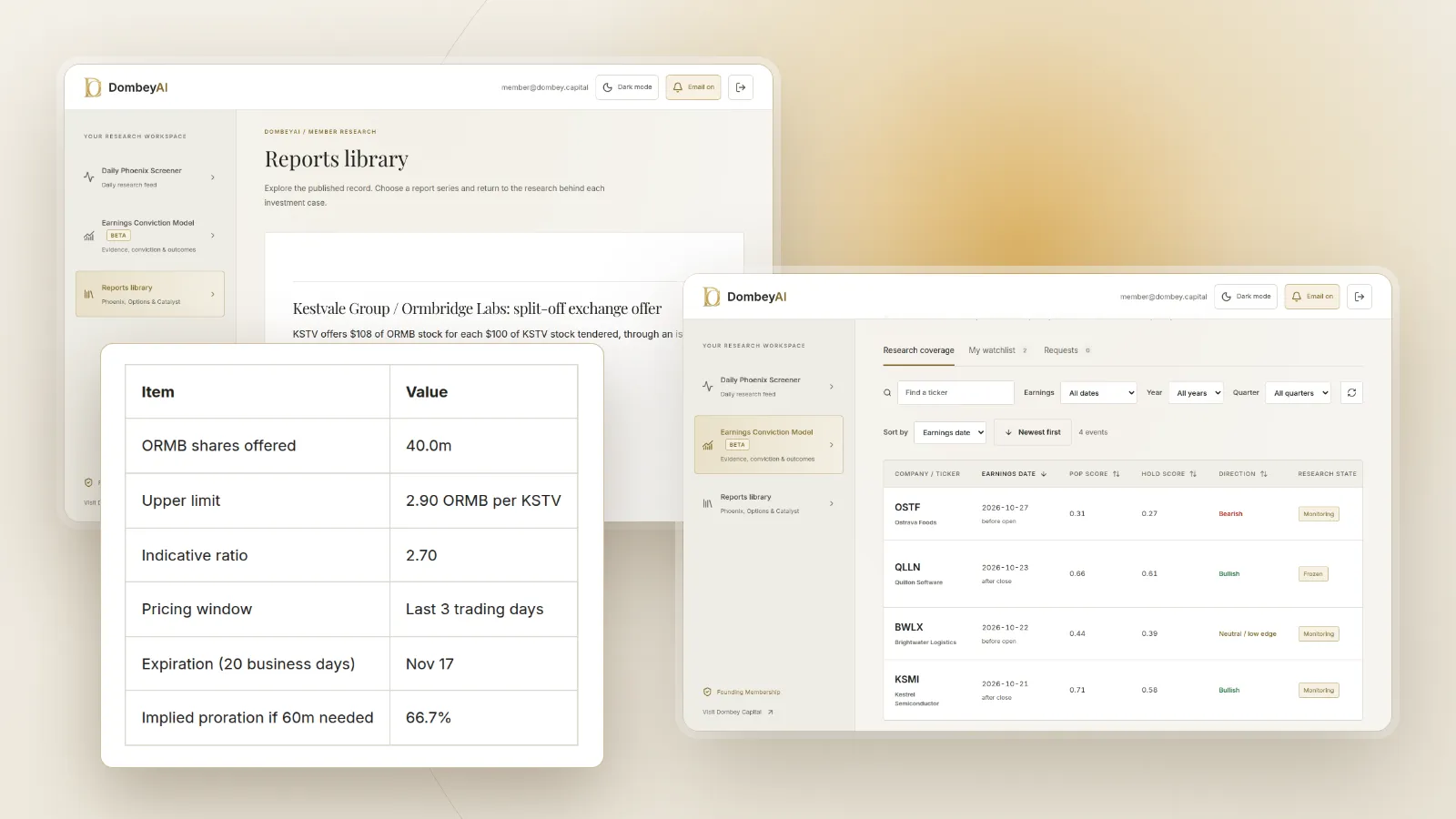
The headline term is the discount. The offer might promise $108 of subsidiary stock for each $100 of parent stock tendered. The exchange ratio is not fixed at launch. It is calculated from average prices of both stocks over a short window of trading days near the end of the offer, as defined in the prospectus. Many recent offers have used daily volume-weighted average prices over three trading days.
The basic formula is:
Exchange ratio = (parent average price x 1.08) / subsidiary average price
The second key term is the upper limit: the maximum number of subsidiary shares any parent share can receive. The upper limit is set in the offer documents, often from prices around the launch. If the subsidiary falls far enough relative to the parent, the formula calls for more shares than the cap allows, and the ratio stops at the cap. Holders then receive less than $108 per $100, and in a severe move they can receive less than $100.
The prospectus usually also says what happens when the cap applies, including whether the parent will extend the offer so holders can reconsider. Read that section before relying on the headline discount.
The timeline and the rules that apply
Because the parent is buying its own shares, the exchange is an issuer tender offer under SEC Rule 13e-4, and the general tender offer rules apply. The offer must stay open at least 20 business days, tendering holders can withdraw while it is open, and a change in the consideration or the percentage sought keeps it open at least 10 business days after the change is announced.
| Stage | Event | What to check |
|---|---|---|
| Launch | Schedule TO and Securities Act registration filed; offer starts | Discount, upper limit, pricing window, conditions |
| During the offer | Parent and subsidiary trade; companies often publish indicative ratios | How the indicative ratio compares with the upper limit |
| Pricing window | Averages set the final exchange ratio | Whether the cap applies |
| Expiration | At least 20 business days after launch, often extended | Your broker's earlier internal deadline |
| Shortly after | Final proration factor announced | How many of your shares were accepted |
| After the exchange | Clean-up spin-off of leftover shares, if any | Record date and number of shares |
Conditions vary. Common ones include a minimum number of subsidiary shares placed, the tax opinion or ruling, and the registration statement being effective. The offer can be withdrawn if a condition fails.
Proration and the clean-up spin-off
The parent offers a fixed number of subsidiary shares. Two things can happen.
Oversubscribed. If holders tender more parent shares than the subsidiary shares can cover, the parent accepts the same fraction of every holder's tender and returns the rest. Many offers give priority to holders of fewer than 100 shares, the same feature described in our article on odd-lot tender offers. Returned shares go back as parent stock, which may trade lower once the offer is over.
Undersubscribed. If holders tender too few shares, the parent usually distributes the leftover subsidiary shares pro rata to its remaining shareholders in a clean-up spin-off. Holders whose shares were accepted in the exchange do not take part. The size of the clean-up spin-off is unknown until the offer closes.
Proration is the reason the discount is not a clean gain. A holder who expects to exchange 100% of a position and is accepted for 60% ends up with a mix: subsidiary shares bought at a discount and parent shares returned at whatever price the market sets.
How event-driven investors approach split-offs
The discount draws arbitrage capital. A common approach is to buy parent shares, tender them, and short the subsidiary to lock in part of the discount. Three things limit it. Proration means only part of the parent position is exchanged, so the short has to be sized to the expected acceptance. The upper limit means a large fall in the subsidiary leaves the hedge mismatched. And borrowing the subsidiary's shares can be costly or unavailable when many traders want the same short; our article on short interest and days to cover covers why.
After the exchange, the subsidiary's shareholder base changes quickly. Unlike a spin-off, where index funds and indifferent holders receive shares they never chose, split-off shares go to holders who opted in. Some of those holders are arbitrageurs who will close their positions, so selling pressure can still appear, but its source is different. For the case where the parent keeps a stake and the market discounts it, see holding company discounts.
Split-offs are one of several separation structures covered in the wider set of special situations. For outside services that follow these offers, see the best investing newsletters for special situations and the best spin-off trackers and research sources.
Where this goes wrong
- The cap binds. A falling subsidiary price can push the formula past the upper limit, so holders receive less than the advertised discount or a loss on the swap.
- Proration is lower than expected. A generous discount attracts heavy tenders. The more holders tender, the smaller the accepted fraction and the more of the result depends on the returned parent shares.
- The hedge costs more than the discount. Borrow fees, a short squeeze in the subsidiary or a recall of borrowed shares can absorb the spread.
- Missing the broker deadline. Brokers often close tender instructions a day or more before the official expiration.
- The tax treatment fails. The tax-free result depends on meeting Section 355. If the transaction does not qualify, the exchange can be taxable, so read the tax section and the risk factors.
- Owning the wrong business. A discount on the swap does not make the subsidiary a good business. Value it on its own before treating the discount as the reason to tender.
Dombey's published research follows dated separations like these from launch to expiration; see the research archive.
The bottom line
A split-off separates a subsidiary by letting the parent's holders exchange parent shares for subsidiary shares, usually at a discount, through an issuer tender offer that stays open at least 20 business days. The final exchange ratio comes from average prices near the end of the offer, and the upper limit can cut the discount if the subsidiary falls. Oversubscribed offers are prorated, and undersubscribed ones usually end with a clean-up spin-off. Read the Schedule TO and the registration statement for the pricing window, the cap, the conditions and the tax section before judging what the offer is worth.