

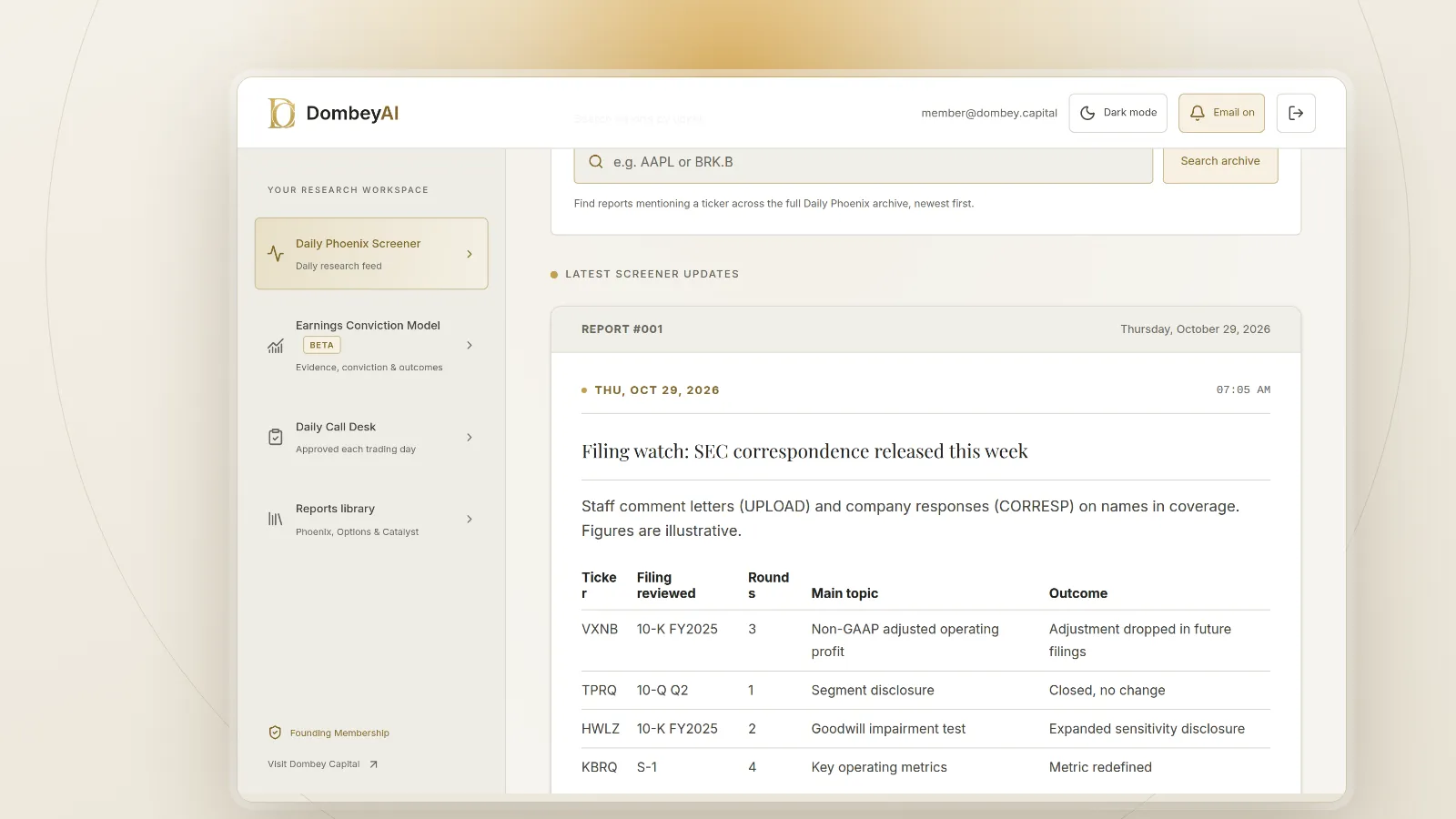
How the review process works
The Division of Corporation Finance reviews filings by public companies: annual and quarterly reports, registration statements for offerings, proxy statements and others. The Sarbanes-Oxley Act requires the SEC to review each reporting company's disclosure at least once every three years, and the staff reviews many companies more often, for example after a large transaction or an initial public offering.
A review can be a full review of a filing, a review of the financial statements only, or a targeted review of particular items. When the staff has questions, it sends a comment letter. Each comment is numbered and usually points to a page or a note in the filing.
The company answers in a response letter, comment by comment. It may supply an explanation, agree to revise disclosure in future filings, or, less often, amend the filing it already made. The staff can accept the answer or ask again. When it has no further comments, it sends a closing letter.
Where to find comment letters on EDGAR
The letters are public, with a delay. The SEC releases the staff's letters and the company's responses after the review is complete, generally no earlier than 20 business days after completion.
On a company's EDGAR filing list, look for two form types:
| Form type | What it is | Who sends it |
|---|---|---|
| UPLOAD | Staff comment letter, including the closing letter | SEC staff |
| CORRESP | Company response, and other correspondence | The company or its lawyers |
| 10-K Item 1B | Unresolved staff comments, for larger filers | The company, in its annual report |
| 10-K/A or 10-Q/A | Amended filing, when the review led to changes | The company |
Our guide on how to search SEC EDGAR filings covers filtering by form type. EDGAR full-text search also covers these letters, which lets you search for a phrase across every company, for example a particular non-GAAP measure. Several of the tools in our comparison of SEC filing tools and EDGAR alerts can alert you when a new CORRESP or UPLOAD appears.
What comment letters reveal
Most letters are routine. They ask for clearer wording, a missing table or a better explanation of a risk factor. The ones worth time are about the numbers.
Where the accounting judgment sits
Staff comments cluster around areas where management has room to choose: revenue recognition, segment reporting, goodwill and impairment testing, income taxes, and non-GAAP measures. A comment asking why a reporting unit with a falling share price did not record an impairment tells you the staff noticed what you might have noticed too. Our article on goodwill and impairments explains why that judgment matters for book value.
How management defends its numbers
The response shows how the company thinks about its own reporting. A clear answer with a supporting calculation reads differently from a long answer that never quite addresses the question. When the staff asks the same question a second and third time, the first answers did not satisfy it.
What changes in future filings
Many reviews end with the company agreeing to revise disclosure "in future filings." Those commitments tell you what to look for in the next 10-K or 10-Q: a new breakdown of revenue, a renamed non-GAAP measure, or a removed adjustment. If a company agrees to stop excluding a recurring cost from adjusted EBITDA, its headline profit measure is about to change.
Reading the exchange: a checklist
| Step | What to check | Why it matters |
|---|---|---|
| 1 | Which filing was reviewed and when | Tells you how stale the issue may be |
| 2 | Number of comments and number of rounds | More rounds usually mean a harder issue |
| 3 | Subjects of the accounting comments | Shows where the judgment sits |
| 4 | Commitments to change future filings | Tells you what to check in the next report |
| 5 | Any amended filing (10-K/A, 10-Q/A) | Signals the issue reached reported numbers |
| 6 | Redactions under Rule 83 | Shows what the company kept confidential |
| 7 | Item 1B in the latest 10-K | Shows material comments still open, for larger filers |
Comment letters and other signals
Comment letters work best beside other evidence. A long exchange about revenue recognition, followed by a change of auditor or a late filing notice, is a pattern worth noting; our article on what an NT 10-K late filing means covers the second piece. A review that leads to a correction of prior periods connects to the issues in what a financial restatement is.
For companies that have just gone public, the staff's letters on the registration statement are released after the offering. They can show what the SEC pushed on in the S-1, such as key operating metrics or customer concentration, which our explainer on what an S-1 filing is covers in more detail.
Comment letters also fit into a general research tool kit. For where they sit beside screeners, transcripts and data platforms, see the 12 best stock research tools for individual investors.
Where this goes wrong
Comment letters are easy to over-read.
- Most letters mean little. The SEC reviews every reporting company regularly. A letter on its own is not evidence of a problem.
- The delay is long. By the time the letters are public, the issue may already be fixed in a later filing. Check the most recent 10-K before treating an old letter as news.
- The staff is not an auditor. A closed review means the staff has no further comments. It does not mean the staff has approved the accounting or that the numbers are right.
- Absence proves nothing. No letters for a company may simply mean no review has closed recently, or that the review raised no comments.
- Redactions hide the detail. Confidential treatment can remove the part you most want to read, leaving only the outline of the issue.
The bottom line
SEC comment letters are the staff's written questions on a company's filings, and the company's answers, published on EDGAR as UPLOAD and CORRESP filings after the review closes. Their value is in the detail: which accounting judgments the staff questioned, how many rounds it took and what the company agreed to change. Read them with the delay in mind and beside the latest filings. Treat them as a map of where to look harder, not as a verdict.