

Who files a 20-F
The 20-F is for foreign private issuers. The definition sits in Exchange Act Rule 3b-4. Any foreign company, other than a foreign government, qualifies unless both of these are true:
- More than 50% of its outstanding voting securities are held of record, directly or indirectly, by US residents.
- At least one of the following applies: a majority of its executive officers or directors are US citizens or residents, more than 50% of its assets are located in the US, or its business is administered principally in the US.
The company tests its status once a year, as of the last business day of its second fiscal quarter. A company that fails the test must move to US domestic forms, including the 10-K and 10-Q, from the start of the next fiscal year.
Two other routes exist. Eligible Canadian companies can use the multijurisdictional disclosure system and file a Form 40-F, which wraps their Canadian disclosure documents. And a foreign private issuer can choose to file domestic forms voluntarily; some do, to look the same as US peers.
The 20-F also works as an Exchange Act registration statement, so a foreign company that registers a class of securities for a US listing without a public offering can use it for that first filing.
20-F vs 10-K at a glance
| Feature | Form 20-F | Form 10-K |
|---|---|---|
| Who files | Foreign private issuers | US domestic companies and foreign companies that fail the FPI test |
| Annual deadline | 4 months after fiscal year end | 60, 75 or 90 days by filer status |
| Accounting | US GAAP, IFRS as issued by the IASB, or home GAAP reconciled to US GAAP | US GAAP |
| Quarterly reports | None required on 10-Q; news furnished on 6-K | 10-Q for the first three quarters |
| Current reports | 6-K when information is made public at home | 8-K for listed events, generally within four business days |
| Executive pay | Aggregate allowed unless the home country requires individual disclosure | Named executive officers, individually |
| Proxy rules | Exempt from Section 14 proxy rules | Subject to proxy rules |
| Late-filing notice | Form 12b-25 (NT 20-F), 15 extra calendar days | Form 12b-25 (NT 10-K), 15 extra calendar days |
The accounting line matters most in practice. Since 2008 the SEC has accepted financial statements prepared under IFRS as issued by the IASB with no reconciliation to US GAAP. A company that uses its own national GAAP must reconcile to US GAAP. If a company uses a local version of IFRS that departs from the IASB text, read the basis-of-preparation note to see which standard was applied.
The structure of a 20-F
The form has three parts and 19 items. The headings differ from a 10-K's, so it helps to know where things sit.
Part I: the business and the numbers in words
- Item 3, Key Information. Item 3.D holds the risk factors. Read it against last year's, as you would Item 1A in a 10-K.
- Item 4, Information on the Company. History, business overview, organizational structure, and property. Item 4A lists unresolved SEC staff comments, if any.
- Item 5, Operating and Financial Review and Prospects. The 20-F's version of MD&A: results, liquidity and capital resources, research and development, and trend information.
- Item 6, Directors, Senior Management and Employees. Compensation, board practices and share ownership.
- Item 7, Major Shareholders and Related Party Transactions. Who owns 5% or more and what the company does with insiders and affiliates. In a controlled company, this is often the most important item.
- Item 8, Financial Information. Points to the financial statements and covers legal proceedings, dividend policy and significant changes since the balance sheet date.
- Items 9 to 12. The listing, the articles and material contracts, exchange controls, taxation, market risk, and, in Item 12.D, the fees an ADS holder pays the depositary.
Part II: controls and governance
Items 13 to 16 cover defaults, changes to holders' rights, internal control over financial reporting, the audit committee, auditor fees, issuer share purchases (Item 16E), how the company's governance differs from the US exchange's rules (Item 16G), and newer items on cybersecurity and insider trading policies.
Part III: financial statements and exhibits
Items 17 to 19 hold the audited financial statements and the exhibit list. Material contracts, the deposit agreement and the list of subsidiaries are usually here.
What changes between annual reports: the 6-K
A domestic company files 10-Qs and 8-Ks between annual reports. A foreign private issuer furnishes a Form 6-K instead. The 6-K rule is simple: whatever the company makes public under home-country law, files with its home exchange, or sends to its security holders, it must also furnish to the SEC promptly.
That means the timing and depth of interim information depend on the home market. A company listed in London or Frankfurt may publish full quarterly reports, and they reach EDGAR as 6-Ks. Another may publish half-year results only. Exchange listing rules in the US can require at least semiannual interim results.
Two other differences follow from foreign private issuer status. The company is exempt from the US proxy rules, so a meeting notice may arrive as a 6-K exhibit rather than a DEF 14A; the habits in our guide on how to read a proxy statement still apply to the content. And insider reporting has changed: since March 18, 2026, directors and officers of foreign private issuers file Section 16(a) ownership reports, under rules implementing the Holding Foreign Insiders Accountable Act, though they remain exempt from the short-swing profit rule. Our guide to tracking insider buying with Form 4 covers how to read those forms.
What to read first
For most foreign companies, start with these, in order:
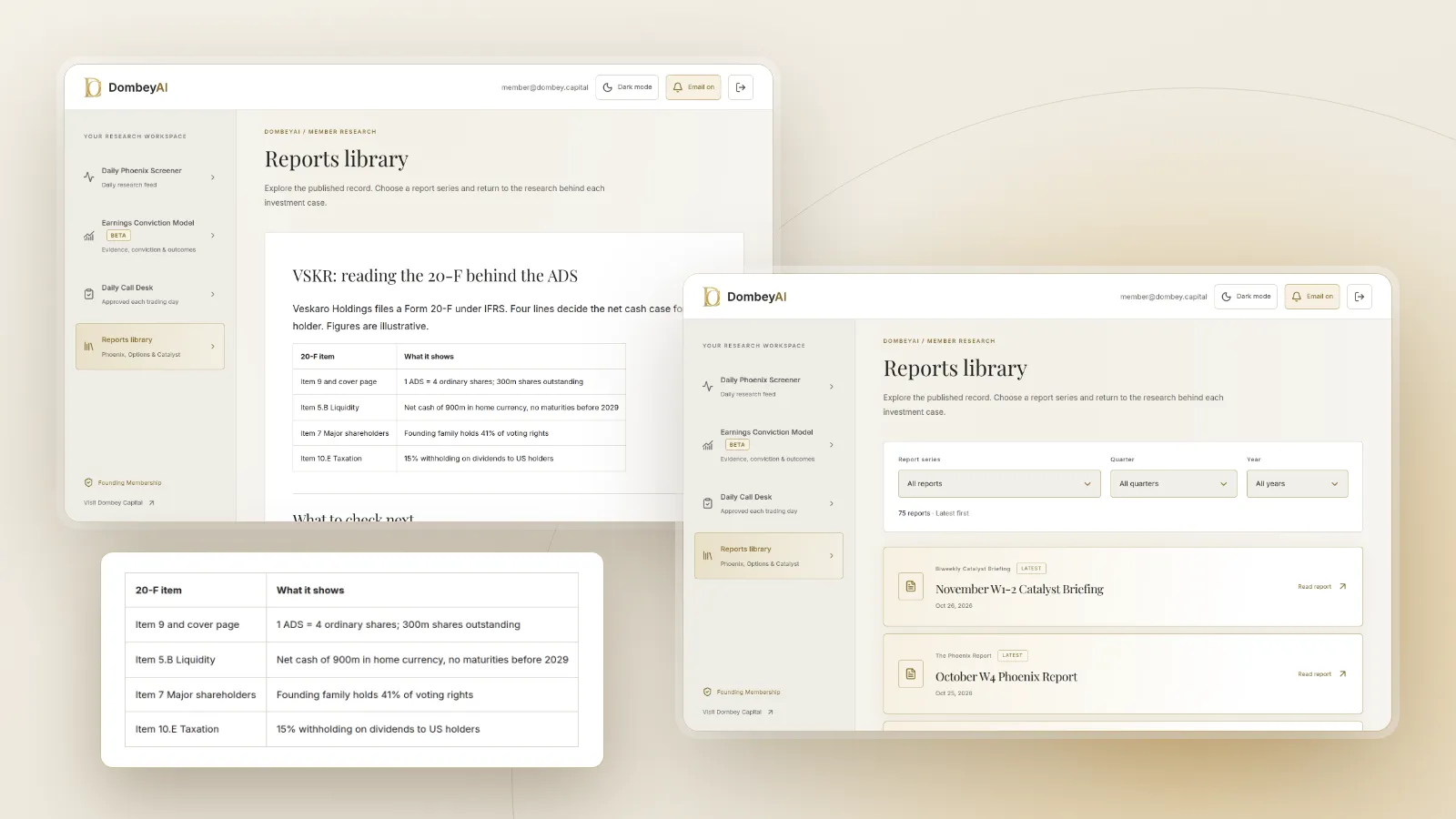
- Cover page and Item 9. The share and ADS structure. How many ordinary shares back each ADS, and the number of shares outstanding at year end.
- Item 5.B, Liquidity and Capital Resources. Cash, debt maturities and any restrictions on moving cash out of the country.
- The financial statements and notes. Especially borrowings, contingencies, related parties and subsequent events.
- Item 7. Controlling holders and related party transactions.
- Item 3.D. Changes in risk factors since last year.
- Item 10.D and 10.E. Exchange controls and withholding tax on dividends, which can change the cash a US holder receives.
Where this goes wrong
The 20-F answers most of the same questions as a 10-K, but several traps are specific to it.
- Stale numbers. A four-month deadline means a December year end can be reported at the end of April. By then, a 6-K with first-quarter results may already exist. Check the latest 6-K before relying on the balance sheet.
- Ratio comparisons across standards. IFRS and US GAAP differ on items such as development costs, inventory methods and some lease presentation. A margin or return figure may not line up with a US peer's.
- The ADS ratio. Per-share figures in the 20-F are usually per ordinary share. The price you see in New York is per ADS. Always convert.
- Currency. The statements are often in the home currency. A move in the exchange rate can change the dollar value of net cash without any change in the business.
- Aggregate pay. Many 20-Fs disclose total compensation for the board and senior managers as a group, which hides how pay is split.
- Missing interim detail. A company that publishes only half-year results may leave you with no SEC update for six months.
- Status changes. A company that fails the foreign private issuer test moves to 10-Ks and 10-Qs. A late annual report from a foreign filer shows up as an NT 20-F, which raises the same questions as an NT 10-K.
How the 20-F fits with other filings
A practical reading set for a foreign company is the latest 20-F, every 6-K since it was filed, the deposit agreement for ADS holders, and any Schedule 13D or 13G from large holders. Foreign issuers in an initial US offering file a Form F-1 rather than an S-1, and the depositary files a Form F-6 to register the ADSs. For the domestic counterpart of interim reporting, see what a 10-Q is.
All of these are free on EDGAR. Our guide on how to search SEC EDGAR filings shows how to filter by form type, so you can pull a company's 20-F and 6-Ks in one list. Reading the filings yourself is the core of using primary sources, and the best stock research tools for individual investors can help you organize what you find.
Dombey's published research reads the 20-F and recent 6-Ks before writing on a foreign-listed special situation; see the research archive.
The bottom line
A 20-F is a foreign private issuer's annual report to the SEC, due four months after year end and built on different items from a 10-K. It can use IFRS without reconciliation, and between annual reports the company furnishes 6-Ks rather than 10-Qs and 8-Ks. Read it with the ADS ratio, the currency and the latest 6-K in front of you. Most errors in reading a foreign company come from those three, not from the business itself.