

The WACC formula
The standard formula has two terms, one for equity and one for debt:
WACC = (E / V x Re) + (D / V x Rd x (1 minus T))
- E is the market value of equity: share price times diluted shares.
- D is the value of debt, at market value if it trades, otherwise at book value.
- V is E plus D, the total capital.
- Re is the cost of equity, the return shareholders require.
- Rd is the pre-tax cost of debt, what the company would pay to borrow today.
- T is the marginal corporate tax rate.
If the company has preferred stock, add a third term: the preferred share of capital times the preferred dividend yield. Preferred dividends are not tax deductible, so that term gets no tax adjustment.
Where each input comes from
| Input | What it measures | Where to find it | How reliable |
|---|---|---|---|
| Equity value (E) | Market value of the shares | Share price times diluted share count from the filing | High |
| Debt value (D) | What the borrowings are worth | Debt note in the 10-K or 10-Q; bond prices if they trade | Medium to high |
| Cost of debt (Rd) | Rate to borrow today | Yields on the company's bonds, or recent loan terms in filings | Medium |
| Tax rate (T) | Value of the interest deduction | Income tax note in the 10-K | Medium |
| Base rate | Return on a near-riskless asset | Treasury yields, often the 10-year | High |
| Beta | Sensitivity of the stock to the market | Regression of past returns, or peer average | Low to medium |
| Equity risk premium | Extra return investors demand for owning stocks | Published estimates; a judgment call | Low |
The balance sheet figures come from the company's 10-K and later 10-Q filings. The debt footnote lists each loan and bond with its rate and maturity, which tells you both D and a starting point for Rd.
The cost of equity
Shareholders do not send a bill, so the cost of equity has to be estimated. The most common method is the capital asset pricing model (CAPM):
Re = base rate + beta x equity risk premium
The base rate is usually a long-term Treasury yield.
Beta measures how much a stock has moved with the overall market in the past. A beta of 1.2 means the stock has tended to move about 20% more than the market. The equity risk premium is the extra return investors expect from stocks over Treasuries. Neither input can be looked up as a fact. Each is an estimate, and analysts disagree on both.
The cost of debt
For a company with traded bonds, the yield to maturity on those bonds is the best measure of what it would pay to borrow today. For a company without traded debt, recent loan terms in its filings or the yields on bonds of similar credit quality work. Interest expense divided by total debt is a rough check, but it reflects old borrowing rates rather than today's.
A worked example
The figures below are illustrative. Company A is hypothetical.
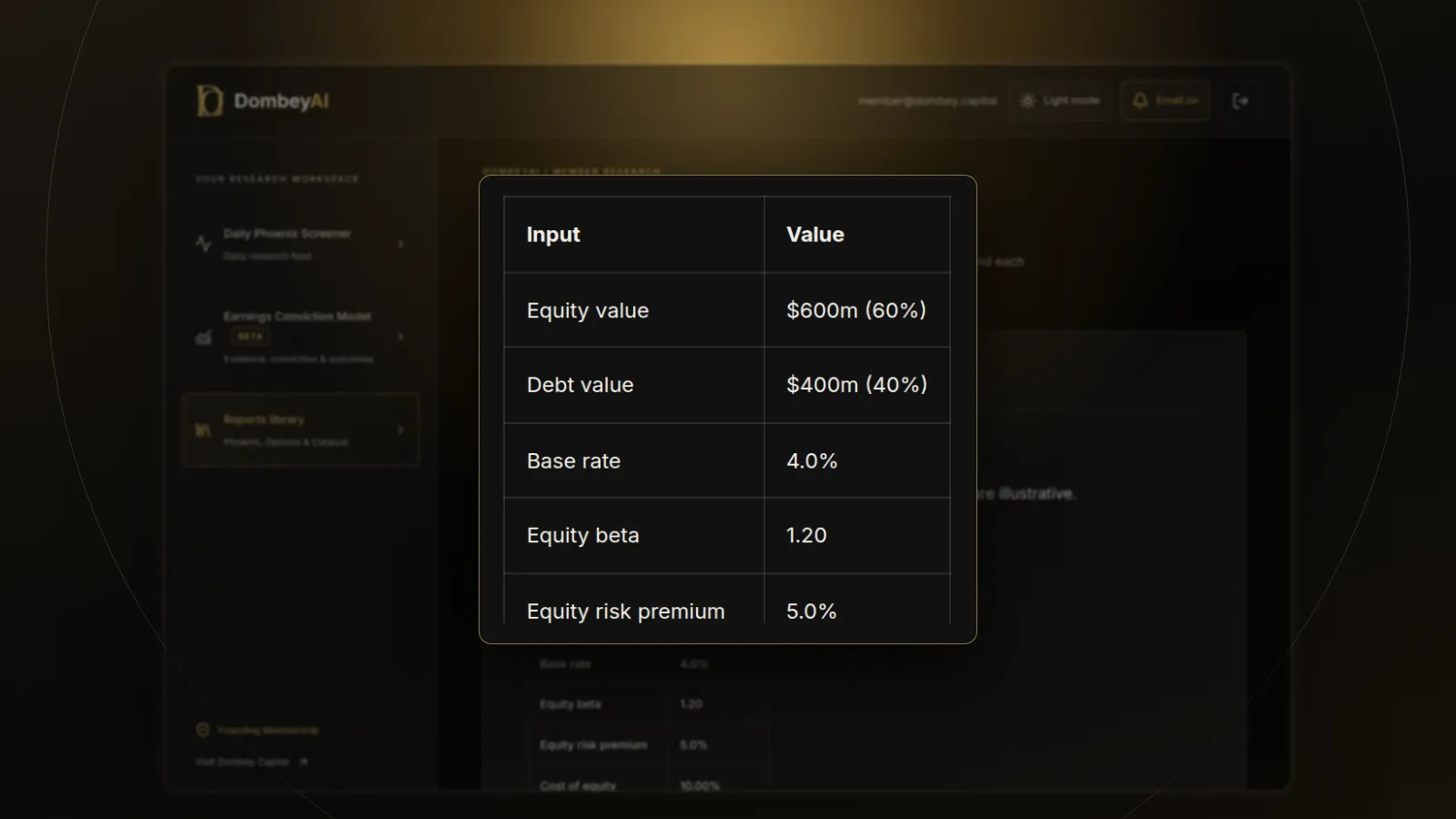
Company A's shares are worth $600 million at the current price. It has $400 million of debt, which trades close to face value. Total capital is $1,000 million, so equity is 60% and debt is 40%.
- Cost of equity: a base rate of 4.0%, a beta of 1.2 and an equity risk premium of 5.0% give 4.0% + 1.2 x 5.0% = 10.0%.
- Cost of debt: its bonds yield 6.5%. At a 25% tax rate, the after-tax cost is 6.5% x 0.75 = 4.875%.
Now see what that rate does to value. Suppose Company A will produce $82 million of unlevered free cash flow next year, growing 2.5% a year after that. Using the growing perpetuity formula, value is $82m / (7.95% minus 2.5%) = about $1,505 million. At a WACC one point higher, 8.95%, value falls to about $1,271 million, roughly 15.5% less. At 6.95% it rises to about $1,843 million, roughly 22.5% more. The cash flows did not change. Only the rate did.
That sensitivity is why WACC deserves as much care as the cash flow forecast. Our DCF explainer shows how the same effect runs through a multi-year forecast and its terminal value.
How debt changes WACC
Debt is usually cheaper than equity. Lenders are paid first and have a fixed claim, so they accept a lower return, and the interest deduction lowers the cost further. That suggests more debt always lowers WACC. It does not, because more debt makes both the debt and the equity riskier.
The table extends the Company A example. It holds the business risk constant (an unlevered beta of 0.80) and adjusts beta for each level of debt, assuming lenders charge more as leverage rises. All figures are illustrative.
| Debt share of capital | Equity beta | Cost of equity | Pre-tax cost of debt | WACC |
|---|---|---|---|---|
| 0% | 0.80 | 8.00% | n/a | 8.00% |
| 20% | 0.95 | 8.75% | 5.5% | 7.83% |
| 40% | 1.20 | 10.00% | 6.5% | 7.95% |
| 60% | 1.70 | 12.50% | 9.0% | 9.05% |
WACC falls with modest debt, then rises as the cost of equity and the cost of borrowing climb. The exact shape depends on assumptions, but the pattern is general: past some level, more debt raises the cost of capital and adds the risk of distress. Our guide to the debt-to-equity ratio covers how to judge where a company sits.
What WACC is used for
- Discounting cash flows. WACC is the discount rate for unlevered free cash flow, and the result is enterprise value. Subtract net debt and other claims to reach equity value.
- Judging capital allocation. A company that earns a return on invested capital above its WACC creates value as it grows. One that earns less destroys value with each dollar it reinvests, even if earnings rise.
- Setting hurdle rates. Management teams often use WACC, sometimes with a margin added, as the minimum return for new projects and acquisitions.
- Reading the market's assumptions. Fixing the share price and solving for the growth rate at a given WACC shows what the current price already expects.
Valuation platforms often show a WACC figure, but they rarely explain the beta or risk premium behind it. Our comparison of stock research tools for individual investors covers which ones show their discount rate inputs, so you can check them rather than accept a single number.
Where this goes wrong
- Using book value for the weights. If Company A's equity had a book value of $250 million instead of a market value of $600 million, debt would appear to be about 62% of capital and WACC would drop to about 6.85%. The lower rate inflates value.
- Applying the tax shield to a company that pays no tax. A business with losses or large tax credits gets no immediate benefit from interest. Its after-tax cost of debt is close to its pre-tax cost.
- Using the coupon instead of the current yield. Debt issued years ago at 3% does not mean the company can borrow at 3% now. Use what new borrowing would cost.
- Trusting a historical beta. Beta reflects the past and can change after an acquisition, a divestiture or a change in leverage. Peer averages, adjusted for each company's debt, are often more stable.
- Matching the wrong cash flow. WACC belongs with unlevered free cash flow. Discounting levered free cash flow at WACC double counts the benefit of debt.
- Forgetting other claims. Leases, pensions and preferred stock are capital too. Treat them the same way in the weights and in the bridge from enterprise value to equity value.
- Using it where the capital structure is about to change. In a company near a debt maturity wall or in restructuring, today's WACC says little about the cost of capital after refinancing.
When WACC matters less
WACC is built for going concerns with steady cash flows and a stable capital structure. Many special situations are neither.
- If a stock trades below its net cash, the value depends on what happens to the cash, not on a discount rate. Asset values matter more than any WACC.
- If the outcome hinges on one event, such as a court ruling or a regulatory approval, a probability-weighted valuation handles the split better than one rate applied to one path.
- If the business is distressed, the cost of debt can be so high and so uncertain that the WACC calculation stops being informative. Recovery analysis works better.
- If you want a buffer against wrong inputs, apply a higher personal hurdle rate and look for a margin of safety between your value range and the price.
Dombey's published research sets valuation ranges from the filings before each catalyst; see the research archive.
The bottom line
WACC is the blended return a company owes its lenders and shareholders, weighted by how much of each it uses, with the cost of debt reduced for the tax deduction on interest. It is the discount rate for unlevered free cash flow and the hurdle that separates value creation from value destruction. The arithmetic is simple, but beta and the equity risk premium are estimates, and a one point change in WACC can move a valuation by 15% or more. Use market values, today's borrowing costs and a range of rates, and treat the result as an input to judgment rather than a fact.