

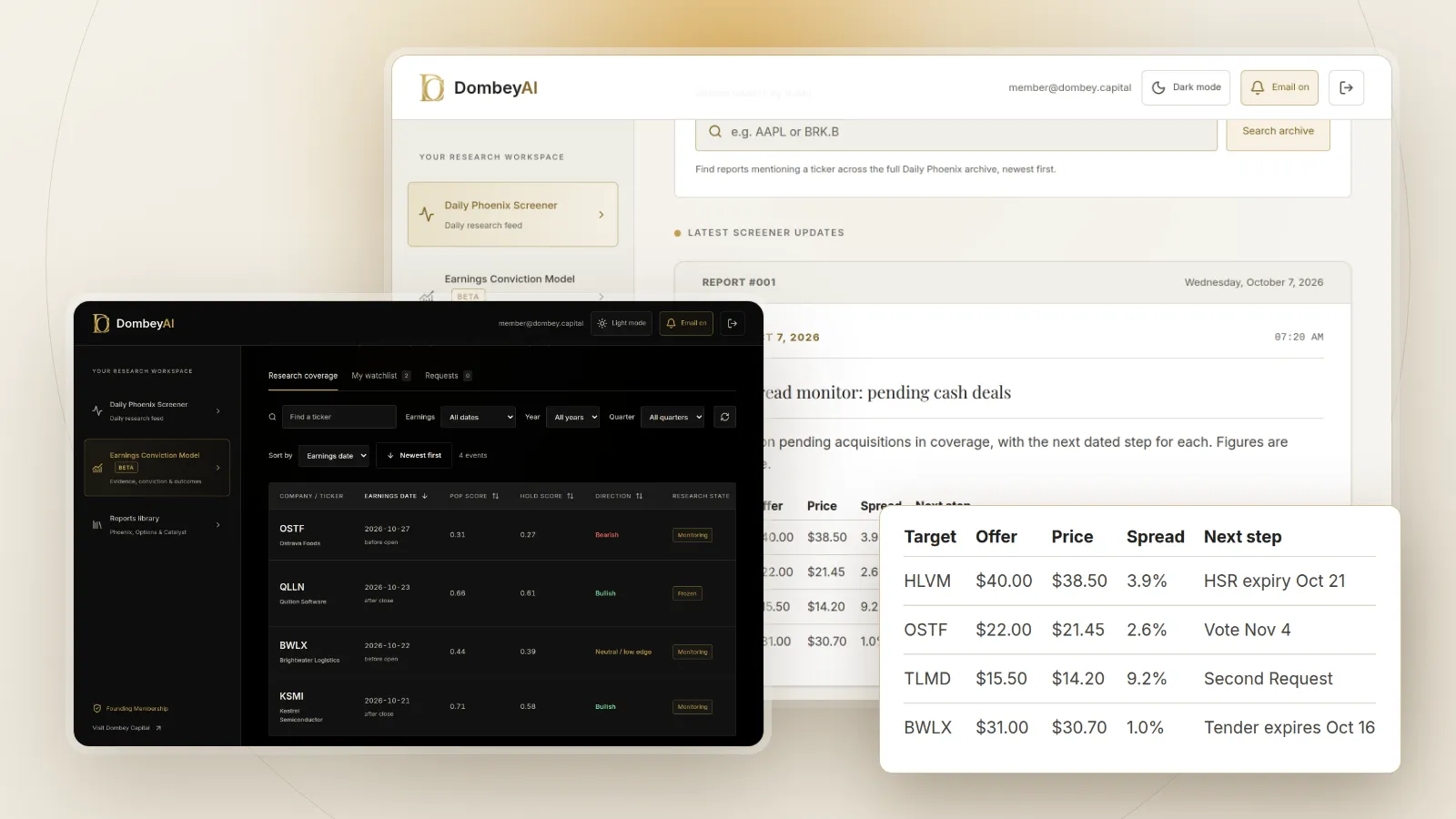


Full disclosure: Dombey Capital is our own research service and our top pick here, for the reasons below. The section on where it falls short is there so you can judge whether it fits your process.
Quick comparison
| Tool | Best for | Key features | Price (as of October 2026) |
|---|---|---|---|
| Dombey Founding MembershipTop pick | Pending deals and dated catalysts written up as research | Weekly Phoenix Report, Daily Phoenix Screener, Biweekly Catalyst Briefing, valuation and execution analysis | Founding Membership $1,200/year, annual billing; Standard Access $80/year or $8/month |
| SEC EDGAR | Free deal documents | Full-text search since 2001, filters by form type and date, RSS by company, CIK or form type | Free |
| FTC premerger pages | Free HSR rules and early termination notices | Waiting period rules, searchable early termination notices | Free |
| InsideArbitrage | Deal tracking for individuals | Merger arbitrage tool, merger calendar, tracked deals, deal alerts, CVR and failed deal lists | Free and premium tiers; see the vendor's pricing page |
| Dealreporter (ION Analytics) | Institutional M&A intelligence | Sourced reporting on deals, regulatory filings, approvals and antitrust, Morning Flash | Contact sales; see the vendor's pricing page |
| CTFN | Sourced deal and regulatory news with data | News, newsletters, regulatory calendars, deal summaries, Spitzer Data | Contact the vendor; see the vendor's pricing page |
| The Capitol Forum | Antitrust and policy reporting | Investigative news and analysis on antitrust, M&A and trade | Request a trial; see the vendor's pricing page |
| Koyfin | Prices, filings and news in one terminal | Charts, filings and transcripts, screener, watchlists | Free; Plus $39/month and Premium $79/month billed annually; monthly billing $49 and $110 |


How we compared these tools
We compared these sources from vendor documentation, pricing pages and public product pages read in October 2026, and from the SEC's and FTC's own pages. We did not run trials with any of them, and we make no judgment on any vendor's speed or accuracy beyond what the vendor states.
| Criterion | Weight | What it measures |
|---|---|---|
| Deal terms and documents | 25% | Access to the merger agreement, proxy, S-4 and tender offer documents, and the terms inside them |
| Regulatory and date tracking | 25% | HSR timing, foreign and sector approvals, vote dates and outside dates |
| Interpretation | 20% | Whether it helps you judge the odds of closing and the downside if the deal breaks |
| Spread and price data | 15% | Live or daily spreads, annualized returns and spread history |
| Cost for the job | 15% | What it costs to follow a working list of deals |
If you weight spread data and breadth of coverage higher, for example because you run many small positions, InsideArbitrage and the institutional services move up and the research and primary sources move down. If cost matters most, EDGAR and the FTC cover the documents and dates for free.
Quick picks by job
Best for pending deals and dated catalysts written up as research: Dombey Founding Membership
Founding Membership is written research, not a deal screen. The weekly Phoenix Report covers selected special situations and earnings-related opportunities, each thesis is published before its catalyst, and the reading behind it includes the documents that set a deal's terms and timetable. It suits readers who want a view on whether and when, not only a list of deals.
Best free source for deal documents: SEC EDGAR
The merger agreement, the definitive proxy, the registration statement for a stock deal and the tender offer documents all land on EDGAR. Full-text search reaches back to 2001 and filters by form type and date, and RSS feeds follow a company or form type.
Best free source for the HSR clock: FTC premerger pages
The FTC sets out the waiting period rules and publishes early termination notices, which tell you when a deal cleared the U.S. antitrust wait ahead of schedule.
Best deal tracker for individuals: InsideArbitrage
InsideArbitrage runs a merger arbitrage tool, a merger calendar, a tracked-deals list and merger deal alerts, along with lists of CVR deals and failed mergers. The alerts are a premium feature.
Best institutional M&A intelligence: Dealreporter
Dealreporter, from ION Analytics, describes itself as M&A intelligence for merger arbitrage and special situations, covering the deal lifecycle, regulatory filings, approvals, antitrust and policy for hedge funds.
Best sourced news with a deal database: CTFN
CTFN pairs breaking news and regulatory calendars with Spitzer Data, which it describes as live metrics modeling, an M&A database and situation profiles, available in a browser, an iOS app or through an API.
Best for antitrust and policy reporting: The Capitol Forum
The Capitol Forum publishes investigative news and analysis on how policy affects competition, with antitrust and M&A among its main topics. It suits investors whose deals turn on a regulator's view.
Best for prices and filings in one terminal: Koyfin
Koyfin puts charts, financials, filings and transcripts in one window, which helps when a stock deal's spread depends on the acquirer's share price.
Full reviews
1. Dombey Founding Membership
What it does. Founding Membership is Dombey Capital's full research suite: the weekly Phoenix Report, weekly Options Research, the Biweekly Catalyst Briefing, and the DombeyAI Portal with the Daily Phoenix Screener and the Earnings Conviction Model, plus valuation and execution analysis and priority access. The Daily Phoenix Screener gives a view each trading morning of situations relevant to Dombey's coverage. When a pending deal is in coverage, the research reads the merger agreement, the proxy and the regulatory filings and sets out the thesis, the dates and what could break it. Published work is in the research archive.
Best for. Readers who follow special situations and dated catalysts and want the deal read and interpreted, not only listed.
Pricing. Founding Membership is $1,200 a year, billed annually. Standard Access is the lower-cost option at $80 a year, about $6.67 a month, or $8 a month on monthly billing, and includes the Biweekly Catalyst Briefing and the complete public-research archive. The Public Archive is free.
Pros
- Interpretation of terms, conditions and timing, which a deal tracker does not provide.
- Each thesis is published before its catalyst and kept in the archive, so you can compare the case with the outcome.
- Standard Access is the cheapest paid option on this list.
Cons
- It is not a deal database or a spread monitor; it does not list every announced deal.
- Coverage is limited to the situations Dombey writes about.
Verdict: Our top pick for readers who want pending deals and other dated catalysts turned into research. Pair it with EDGAR and the FTC pages for deals outside its coverage.
2. SEC EDGAR
What it does. EDGAR is where the deal documents live. The 8-K that announces a material definitive agreement, the merger agreement filed as an exhibit, the definitive merger proxy (form type DEFM14A), the registration statement for a stock deal and the Schedule TO for a tender offer are all searchable. Full-text search covers electronic filings since 2001 and filters by form type, date range, location and entity. RSS feeds follow one company's filings or the latest filings by company, CIK or form type.
Best for. Anyone who wants the primary source at no cost. Our guide on how to search SEC EDGAR filings covers the mechanics, and how to read a proxy statement shows what to look for in the merger proxy.
Pricing. Free.
Pros
- The terms, conditions, termination fees and outside date come straight from the merger agreement.
- An RSS feed on DEFM14A or Schedule TO filings catches new deals across the market.
Cons
- No spreads, prices or deal-level summaries.
- The SEC states its email update service is not available for company filings, so alerts mean RSS or a third-party tool.
Verdict: Essential and free. Read the merger agreement here before relying on any summary of it. For more filing tools, see the best SEC filing tools and EDGAR alerts.
3. FTC premerger pages and early termination notices
What it does. The FTC's premerger notification pages explain the Hart-Scott-Rodino process. Once the filing is complete, the parties must wait 30 days, or 15 days for a cash tender offer or a bankruptcy. A Second Request extends the wait until both parties substantially comply, after which the agency typically has another 30 days, or 10 days for a cash tender offer or bankruptcy. The early termination notices page is a searchable list of deals whose waiting period was ended early, with recent entries dated September 2026 when we read it.
Best for. Investors who want to date the U.S. antitrust step themselves. Our explainer on the HSR waiting period covers the process in full.
Pricing. Free.
Pros
- The official rules for the clock, from the agency that runs it.
- Early termination notices confirm a cleared step without waiting for a press release.
Cons
- HSR filings themselves are confidential, so you learn the filing date from the parties, not the FTC.
- It covers U.S. antitrust only; foreign and sector approvals need other sources.
Verdict: Free and authoritative for the HSR step. Use it to check the dates any other tool reports.
4. InsideArbitrage
What it does. InsideArbitrage is an event-driven research site with a merger arbitrage section: a merger arbitrage tool, a merger calendar, merger arbitrage news on active deals, a "My Tracked Deals" list, merger deal alerts, and lists of CVR deals, failed mergers and deals in the works. It also covers spin-offs, insider buying, buybacks and tender offers. The site states that only premium members can use the merger deal alerts.
Best for. Individual investors who want a list of announced deals and their spreads without building one in a spreadsheet.
Pricing. The site has free content and premium tiers. We could not read a current price on its pages; see the vendor's pricing page.
Pros
- Deal list, calendar, tracking and alerts in one place, aimed at individuals.
- Failed-deal and CVR lists are useful context when judging downside.
Cons
- Alerts and full access sit behind the premium tier.
- A tracker shows spreads and dates; it does not tell you whether a deal will close.
Verdict: The most accessible deal tracker here for an individual following many deals.
5. Dealreporter (ION Analytics)
What it does. Dealreporter calls itself "M&A Intelligence for Merger Arb & Special Situations." It covers the M&A lifecycle, regulatory filings, approvals, antitrust and policy, plus equity events such as IPOs, follow-ons, blocks, convertibles and shareholder actions. It describes multi-sourced reporting, proprietary datasets and a Morning Flash commentary product.
Best for. Hedge funds and institutional desks that trade on deal timing and want reporting beyond the public record.
Pricing. Not published. The vendor directs buyers to its sales team; see the vendor's pricing page.
Pros
- Built specifically for merger arbitrage and special situations.
- Covers regulatory approvals and antitrust as well as deal terms.
Cons
- Institutional product with no self-service price.
- More than most individuals following a handful of deals need.
Verdict: A specialist institutional service; worth a sales call only if deal timing is your main business.
6. CTFN
What it does. CTFN describes itself as "THE ULTIMATE SOURCE ON M&A," delivering data and sourced intelligence on M&A and other tradeable events across North America, Europe and Asia. Its news product includes breaking news, daily and weekly newsletters, regulatory calendars, deal summaries and access to reporters. Spitzer Data adds live metrics modeling, an M&A database, situation profiles and dashboards, in a browser, an iOS app or through an API. Regulatory coverage includes FTC and DOJ antitrust, EC merger control, the UK Competition and Markets Authority and CFIUS.
Best for. Professional investors who want sourced news and a deal database together.
Pricing. Not published; the site offers a trial on request. See the vendor's pricing page.
Pros
- Regulatory calendars across several jurisdictions, which matter for cross-border deals.
- Data available by API for teams that model deals in their own systems.
Cons
- No published price.
- Aimed at professionals, so the cost and scope may exceed an individual's needs.
Verdict: A strong fit for teams that want news and data from one vendor.
7. The Capitol Forum
What it does. The Capitol Forum is an independent investigative media organization covering antitrust, mergers and acquisitions, corporate investigations, trade and labor, with reporting on the United States, Europe and China. It describes its work as breaking news and analysis on regulatory developments and their effect on markets.
Best for. Investors in deals where the main risk is a regulator's challenge.
Pricing. Not published; the site offers a trial on request. See the vendor's pricing page.
Pros
- Focus on how agencies view competition, which is often the deciding risk in a large deal.
- Covers policy and investigations that never appear in a filing.
Cons
- No deal tracker, spreads or price data.
- No published price.
Verdict: Useful when antitrust is the swing factor; not a general merger arbitrage tool.
8. Koyfin
What it does. Koyfin is a research terminal with charts, financials, a screener and watchlists. Its pricing page lists press releases, filings and transcripts across its plans.
Best for. Investors who already use Koyfin and want to follow both legs of a stock deal, target and acquirer, in one place.
Pricing. Free plan available. Billed annually, Plus is $39 a month, Premium $79, Advisor Core $209 and Advisor Pro $299. Monthly billing costs $49, $110, $239 and $349 a month.
Pros
- Prices, financials and filings in one window.
- A free plan to try it.
Cons
- No merger-specific features: no deal list, spread calculation or regulatory calendar.
- You pay for a broad platform to use a small part of it.
Verdict: Convenient for existing users; not a deal tool on its own.
Where Dombey falls short
Founding Membership does one part of this job, and its limits are real:
- Narrow coverage. It covers the special situations Dombey writes about. Most announced deals will not appear in the research.
- No deal database or spread monitor. There is no list of every pending deal, no live spread table and no deal alert system. Use EDGAR, the FTC pages or InsideArbitrage for those.
- No sourced reporting. It reads public documents; it does not report on negotiations or regulators' private views the way Dealreporter, CTFN or The Capitol Forum aim to.
- Small team and pen-name author. The research comes from a small team, and the byline is a pen name. Read the merger agreement yourself before acting on any summary.
- Short history. Its record is short next to services that have covered deals for many years.
Free vs paid
Free sources cover the core of the job. EDGAR gives you the merger agreement, the proxy and the tender offer documents. The FTC gives you the HSR rules and early termination notices. A spreadsheet with the offer terms and the target's price gives you the spread.
Paid tools buy one of four things: a deal list with spreads and alerts (InsideArbitrage), sourced reporting and data for institutions (Dealreporter, CTFN), antitrust reporting (The Capitol Forum), or interpretation. Founding Membership buys interpretation of the deals and catalysts in Dombey's coverage, with Standard Access as the lower-cost option for the Catalyst Briefing and the archive.
How to choose
Start with the question you need answered, then pick the cheapest source that answers it.
| Your situation | Pick | Add later when |
|---|---|---|
| You want pending deals and catalysts read and interpreted | Dombey Founding MembershipTop pick | You follow deals outside its coverage: add EDGAR RSS and the FTC pages |
| You follow two or three deals | SEC EDGAR and FTC pages | You follow many deals: add InsideArbitrage |
| You want a deal list with spreads and alerts | InsideArbitrage | You want interpretation: add Dombey Founding Membership, or Standard Access as the lower-cost option |
| You trade deal timing professionally | Dealreporter or CTFN | Antitrust is the main risk: add The Capitol Forum |
| You follow stock-for-stock deals | Koyfin | You need deal terms: read the S-4 and proxy on EDGAR |
- If the deal is a cash tender offer, watch the Schedule TO and its amendments; a tender offer must stay open at least 20 business days, and 10 more after a price change.
- If the deal needs a shareholder vote, find the meeting and record dates in the definitive proxy.
- If the deal needs HSR clearance, date the 30-day clock from the filing date the parties disclose, and check the FTC's early termination notices.
- If you want every date in one place, see how to build a catalyst calendar.
The bottom line
Dombey's Founding Membership is our top pick for readers who want pending deals and other dated catalysts written up as research, with Standard Access at $80 a year as the lower-cost option. It is not a deal database, so pair it with SEC EDGAR and the FTC's premerger pages, which are free and are the source for every date that matters. For a deal tracker with spreads and alerts, use InsideArbitrage; for institutional reporting, Dealreporter or CTFN; and for antitrust risk, The Capitol Forum. Whatever you use, read the merger agreement before you rely on anyone's summary of it.