

Nov 24, 2026: an early approval, a 25% spike and a quick fade
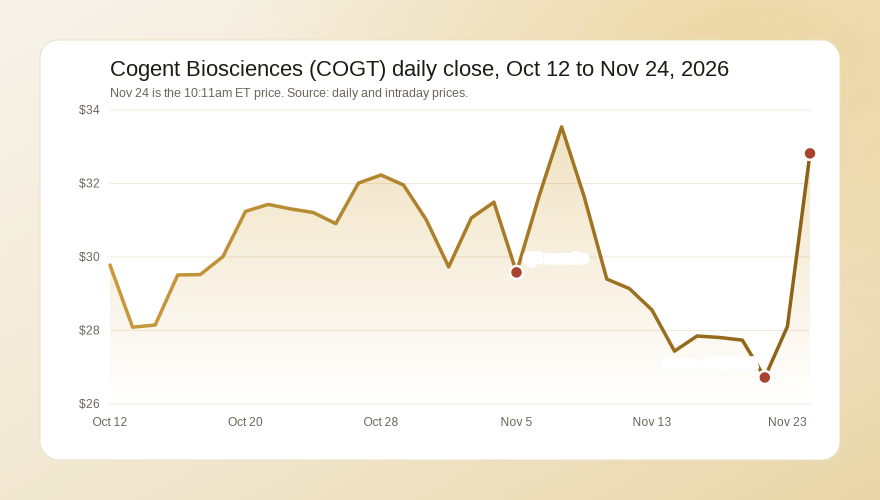
Premarket trading was thin. The stock traded between $28.36 and $29.94 for most of the morning and dipped to $26.30 at about 9:15am. Reuters reported the approval at 9:19am ET, and by 9:25am the stock had reached $30.86. It opened at $29.10, which was also the low of the session so far at $29.02, then ran to $35.13 at 9:34am, 25.0% above Monday's close. Sellers met that spike: the stock fell to $31.72 by 9:50am, a gain of 12.8%, before it steadied near $33. By 10:11am it was $32.82. TheFly reported the shares up nearly 18% at $33.15 in early trading, and Investing.com reported a 14% jump at 9:55am, close to the low of the fade.
The day before helped set it up. The stock rose 5.2% on Nov 23, from $26.72 to $28.11, with no company news.
Biotech rose again today, though by far less. At 10:11am XBI was up 3.3% and the larger biotech fund IBB 3.0%, while the S&P 500 fund SPY was down 0.6%. Among mid-sized cancer drug developers, Celcuity was up 8.0%, Syndax 6.1% and IDEAYA 4.2%. Cogent's 16.8% gain is about 13 points ahead of its sector. More of the day's moves are in today's biggest stock moves.
After the move, RSI(14) stood at 60, the shares sat 7.2% above their 50-day average and 6.2% below their 200-day average, and volume by mid-morning had already matched its 20-day average of about 2.2 million shares. The stock remained 24.9% below its 52-week high.
The numbers
PEAK compared bezuclastinib plus sunitinib with sunitinib alone in patients whose GIST had progressed on, or who could not tolerate, imatinib. Sunitinib is the standard second treatment, so the trial asked whether adding Cogent's drug beats what doctors already use. The data cutoff was Sept 30, 2025.
| PEAK result | Ekitna plus sunitinib | Sunitinib alone |
|---|---|---|
| Median progression-free survival | 16.5 months | 9.2 months |
| Hazard ratio | 0.50 (95% CI 0.39 to 0.65) | |
| Objective response rate | 46% | 26% |
| Estimated mean time on treatment | 23.3 months |
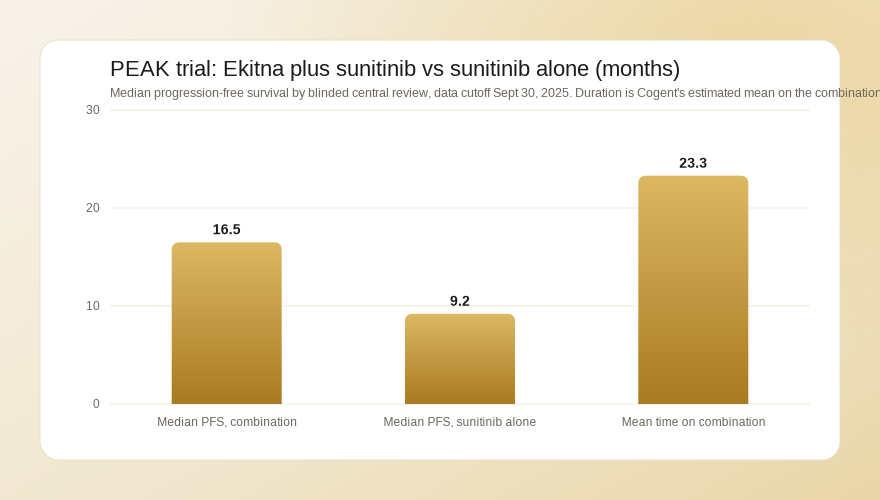
The 23.3-month estimate is the figure that matters for sales. A daily pill taken for about two years by each patient builds revenue faster than the size of the GIST population alone would suggest. Cogent has not given a price or a sales forecast, and the release does not say how many patients PEAK enrolled.
On safety, liver toxicity leads the warnings. Liver enzymes (ALT or AST) rose in 43% of patients, 8% at grade 3, and bilirubin rose in 13%, 0.5% at grade 3. Most first enzyme increases came within four months, and the label calls for monitoring and for pausing, cutting or stopping the dose when they occur. The most common side effects, each in at least 20% of patients, included diarrhea, high blood pressure, changes in taste, nausea, hair color changes and fatigue.
Cogent's last quarter shows what the launch costs. In the third quarter it had no revenue, spent $75.1 million on research and $42.1 million on general and administrative costs, and lost $111.4 million. Cash, equivalents and securities were $791.1 million at Sept 30, against $792.3 million at June 30; the company filed a prospectus supplement for a stock sale on Aug 10.
The bull case
- Two more decisions within seven months. The FDA is due to rule on bezuclastinib in nonadvanced systemic mastocytosis by Dec 30, 2026, and in advanced systemic mastocytosis by June 29, 2027. Our explainer on how PDUFA dates work covers what can move a date.
- An approved drug changes the risk. Before today every program was a bet on a regulator. Now Cogent has a commercial team selling a product, and the drug has cleared a full FDA review once. Our guide on valuing a biotech pipeline shows how approval odds feed into a valuation.
- More data in December. Cogent will present more detailed SUMMIT analyses at the ASH meeting on Dec 12 to 15, plus the first results from patients switched from avapritinib, the drug already approved in the disease. Our piece on medical conferences as catalysts explains why these posters can move a stock.
- Room to the targets. The average analyst target is $55.82, against $32.82 this morning.
The risks
- Liver safety in a milder disease. A 43% rate of liver enzyme increases is accepted in a cancer that has progressed on imatinib. Nonadvanced mastocytosis patients are less sick, and the FDA may weigh the same signal differently there.
- Spending. General and administrative costs nearly tripled from a year earlier as Cogent built a sales force, and the quarterly loss rose to $111.4 million.
- Dilution. An approval and a higher share price make a stock sale cheaper for the company. Our explainer on at-the-market offerings covers how these sales work.
- Short interest. About 11.2% of the float is sold short, which can add to swings in both directions; see our guide to short interest and days to cover.
What comes next
- Launch updates. Cogent held a call at 10:30am ET today. Fourth-quarter results should give the first sales figure.
- ASH, Dec 12 to 15, 2026. More SUMMIT data and the first avapritinib switch results.
- Dec 30, 2026. The FDA's decision on bezuclastinib in nonadvanced systemic mastocytosis, the event our view runs to. Our explainer on regulatory approvals as catalysts covers how these dates play out.
- June 29, 2027. The decision in advanced systemic mastocytosis.
For another biotech that moved on its own news this week, see why Kymera stock jumped.