

Why conferences work as catalysts
A stock catalyst needs two things: news that can change value and a date. Medical meetings supply both. Companies submit abstracts to a meeting's deadline, the program committee accepts or rejects them, and the meeting publishes a schedule. Investors know months in advance that a company will present data on a given day.
That makes conference presentations closer to a hard catalyst than most biotech news, though less binary than a regulatory decision. Our explainer on hard and soft catalysts sets out the difference. The content is uncertain, but the date is not.
The major meetings
Oncology dominates conference-driven trading because so many listed companies develop cancer drugs.
- AACR Annual Meeting, in the spring. Heavy on early and preclinical science.
- ASCO Annual Meeting, in late spring in Chicago. The largest clinical oncology meeting, with major phase 3 results in plenary and oral sessions.
- ESMO Congress, in the autumn in Europe. The second large oncology meeting of the year, often with late-breaking phase 3 data.
- ASH Annual Meeting, in December. The key meeting for blood cancers, gene therapy for blood disorders and hematology.
Other fields have their own: major cardiology, diabetes, neurology and infectious disease congresses each draw company presentations. The principle is the same.
The timeline inside a meeting
Each meeting has several dates that can move a stock:
- Abstract submission deadline. Months before the meeting. Companies sometimes say they have submitted, which signals data are coming.
- Acceptance and titles. The meeting posts titles and session assignments. A title can reveal the trial, the data type and whether it is an oral slot.
- Abstract release. Most full abstracts go online before the meeting under an embargo policy. Abstracts can contain the first public look at the data.
- Presentation. The full data, often on a later cut-off than the abstract, with slides and a discussant.
- Company follow-up. Press releases, investor calls and often a financing.
Late-breaking abstracts skip step 3. They are accepted after the regular deadline and released at or near presentation, so the full surprise lands on one day.
Quick reference: conference catalyst checklist
| Step | What to check | Where to find it |
|---|---|---|
| Is the company presenting? | Accepted abstract, session, date | Meeting program, company press release |
| What type of slot? | Plenary, oral, poster or online only | Meeting program |
| Is the data new? | First release or update of known data | Prior press releases and 8-Ks |
| What data cut? | Cut-off date in abstract versus talk | Abstract text, company release |
| How many patients? | Evaluable patients, follow-up time | Abstract and slides |
| What comparison? | Control arm, historical benchmark | Abstract, trial registry entry |
| What is priced in? | Recent run-up, options implied move | Price history, option chain |
| Cash needs? | Runway and recent shelf filings | 10-Q, S-3 |
What to read in an abstract
Abstracts are short, and that is the danger. Read them with a checklist:
- Patient numbers. Response rates on 12 patients mean little. Look for the number evaluable, not just enrolled.
- Follow-up time. Early response data can fade. Durability needs months of follow-up.
- Endpoint. Response rate, progression-free survival and overall survival carry different weight. Our explainer on phase 3 readouts covers how endpoints drive reactions.
- Comparator. A single-arm result has to be judged against historical data for standard care, which may come from a different patient population.
- Safety. Serious adverse events and discontinuations can matter as much as efficacy.
- Who presents. Investigator-led presentations of company trials are normal; the key is the data, not the name.
A worked example
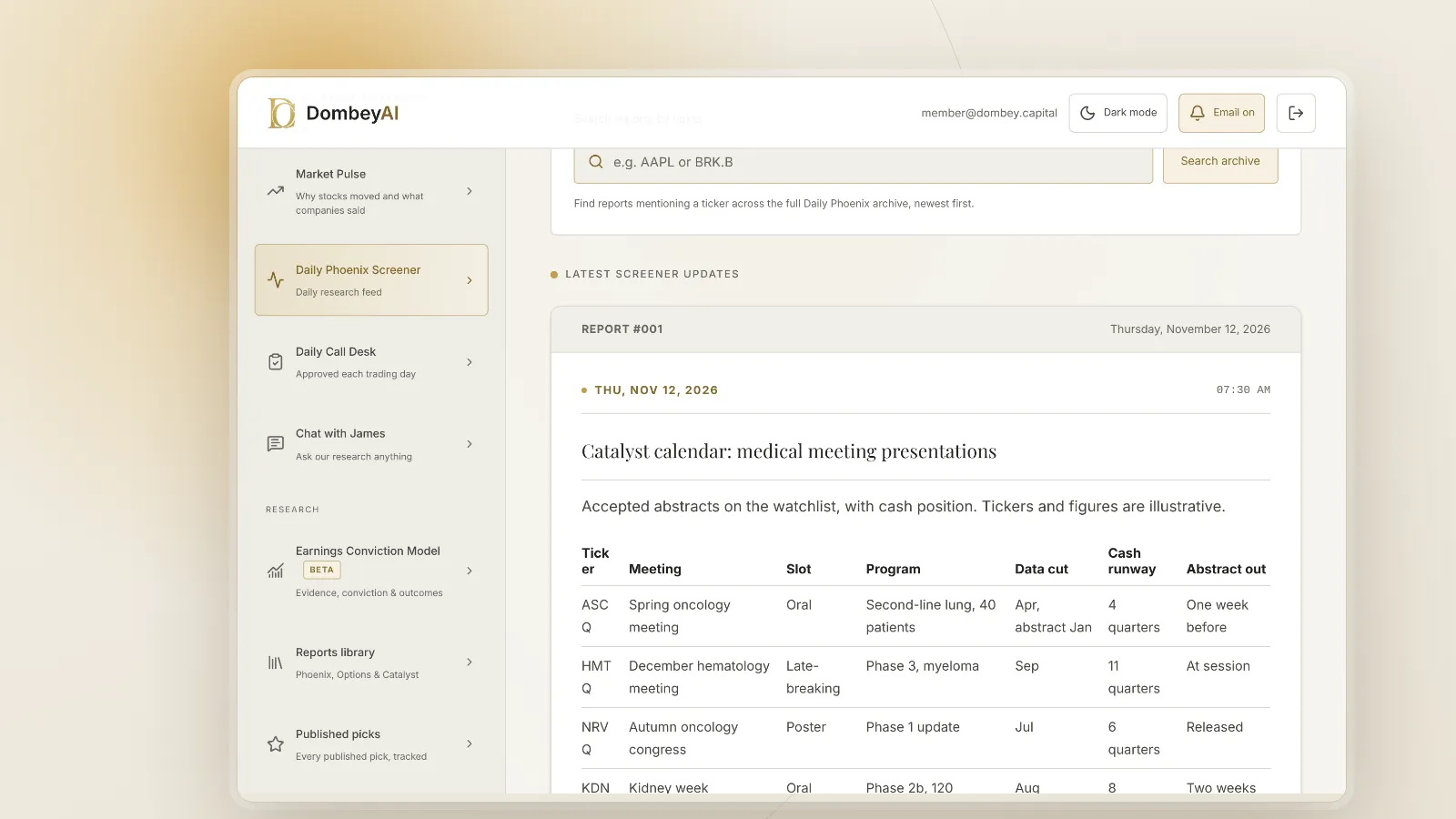
The example shows three common patterns: run-up into the meeting, a gap between the abstract and the talk, and a financing after good data. With only about a year of cash, a raise was likely, and estimating cash runway beforehand would have flagged it.
How conferences fit with other biotech catalysts
Conference data feeds into the larger catalyst path for a drug:
- Early data at a meeting can lead to a pivotal trial start, a partnership or a breakthrough therapy designation.
- Pivotal data presented at a meeting may be the basis for an FDA filing and a later action date. Our explainer on how PDUFA catalysts work covers that step.
- Competitors' data at the same meeting can change a company's value without any news of its own.
Disclosure rules shape the timing. Because Regulation FD bars companies from sharing material information with some investors before others, companies usually issue a press release when an abstract or presentation becomes public, often furnished on an 8-K, and many host an investor call the same day. If the company has already released top-line results, the meeting adds detail rather than surprise, and the reaction tends to be smaller. If the meeting is the first public release, the abstract or the session is the event. Check the company's recent press releases before deciding which kind of presentation you are looking at.
A catalyst calendar that lists each meeting's title, abstract and presentation dates for the companies you follow keeps these straight.
Where this goes wrong
- Trading titles. A title says the company is presenting, not what the data show. Run-ups on titles often reverse.
- Ignoring the data cut. Comparing an abstract with a later presentation without checking the cut-off dates leads to false conclusions about improvement or decline.
- Breaking embargo rules in your head. Meetings set embargo times. Reports that appear early may be wrong, and companies often cannot comment until the embargo lifts.
- Overrating small cohorts. Early data on a few dozen patients often look better than larger trials later confirm.
- Forgetting financing. Companies often raise money right after positive data, when the price is highest. Check for an effective shelf registration.
- Missing competitor sessions. Another company's better data in the same indication can matter more than your company's own presentation.
- Assuming "oral" means "positive". Slot type reflects interest, not outcome.
Dombey's catalyst coverage lists conference dates with each company's cash position; current coverage is on the market page.
The bottom line
Medical conferences are dated catalysts with several separate moments: titles, abstracts and the presentation, plus late-breaking data held to the session. The reaction depends on the data compared with expectations, and the abstract and the talk can tell different stories because they often use different data cuts. Read patient numbers, follow-up, endpoints and comparators before reacting, and check the company's cash, because a financing often follows good news. Treat the meeting date as the catalyst and the data as the uncertainty.