


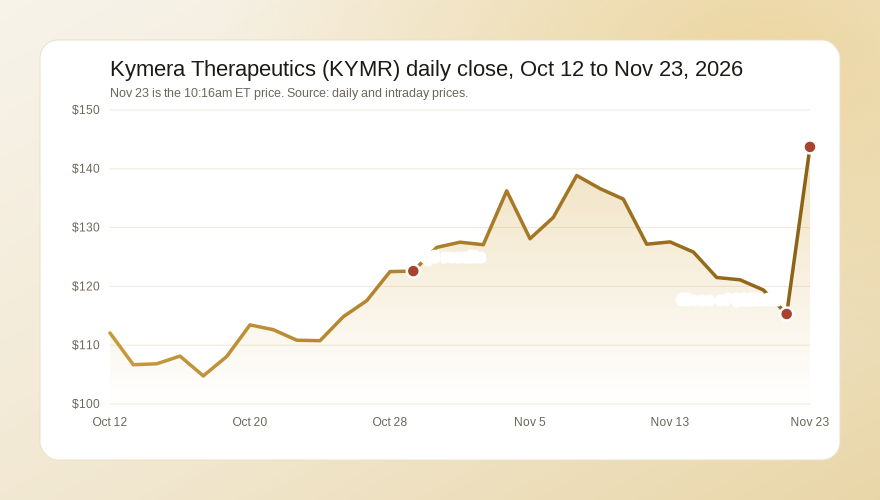
Nov 23, 2026: a record high on the eczema data
Kymera released the results at 7am ET and hosted a call at 8am. The stock jumped in premarket trading and reached $155.00 at about 8am, when the call began, then fell to $130.00 by 8:35am while the call was still under way; Kymera filed the call slides with the SEC at 8:29am. It opened at $138.00, dipped to $135.95 in the first minutes and then climbed to $149.38 before 9:50am, a new 52-week high above the $142.92 it reached on Nov 10. By 10:16am it was $143.72 on about 2.6 million shares.
The broader market gave it a lift. The S&P 500 fund SPY was up 4.8% at 10:16am after Nvidia's board reinstated Jensen Huang as chief executive, a story we cover in why Nvidia stock jumped. Biotech rose less: XBI was up 4.3%. Among companies tied to Dupixent and rival eczema drugs, Regeneron was up 1.7%, Eli Lilly 2.1%, AbbVie 1.4% and Nektar 5.4%, while Sanofi was down 0.5%. Kymera's 24.6% gain was about 20 points ahead of its sector. More of the day's moves are in today's biggest stock moves.
After the move, RSI(14) stood at 66, the shares sat 22% above their 50-day average and 43% above their 200-day average, and volume ran 2.5 times its 20-day average. The shares were 4% below the high set this morning.
Reuters reported that TD Cowen analysts said the data exceeded expectations, "supporting biologic-like efficacy in a convenient once-daily oral pill."
The numbers
BROADEN2 randomized 244 adults and adolescents equally to three doses of KT-621 or placebo for 16 weeks. The average starting EASI score was about 28, and 33% of patients had tried an advanced systemic therapy before. Of the 244, 234 finished the 16 weeks and 230 moved into a 52-week extension.
| Week 16 | Placebo | KT-621 mid dose | Gap over placebo |
|---|---|---|---|
| Patients | 59 | 61 | |
| EASI, mean reduction | 27% | 72% | 45 points |
| EASI-75 | 22% | 62% | 40 points |
| EASI-90 | 10% | 43% | 33 points |
| vIGA-AD 0/1 | 11% | 38% | 27 points |
| Itch, 4-point drop | 13% | 52% | 39 points |
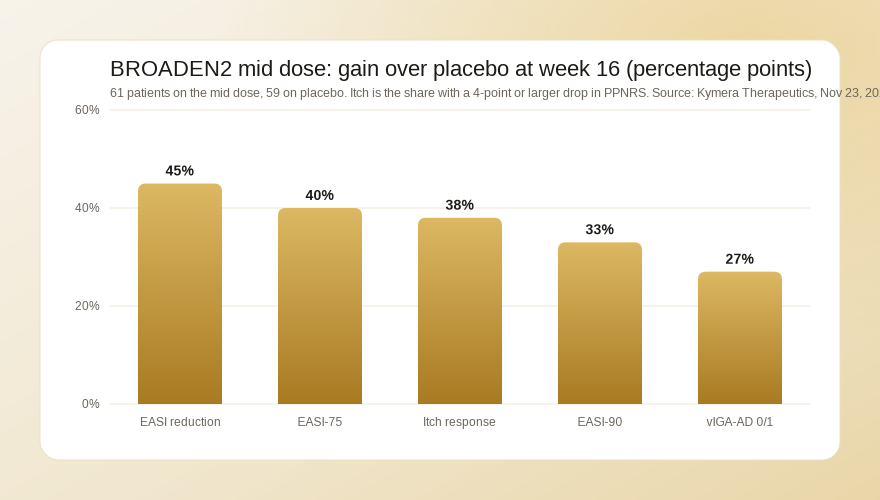
Kymera's headline gives the itch gap as 38 points; the rounded rates in the table give 39. The other two doses also beat placebo on every measure. EASI fell 64% and 61% on the low and high doses, and EASI-75 reached 43% and 53% on the other two doses, both below the mid dose. Kymera said results were significant against placebo from week 1.
On safety, 51.9% of patients on KT-621 had at least one side effect, against 50.8% on placebo. Severe side effects hit 1.1% of treated patients and 6.8% on placebo, and 1.1% stopped treatment for a side effect, against none on placebo. Conjunctivitis was the exception: Kymera's pooled rate was 19.7% on the low dose, 13.1% on the mid dose and 11.1% on the high dose, all mild or moderate and none leading to discontinuation.
How it compares with Dupixent
Dupixent's label reports its two pivotal monotherapy trials at week 16. Measured against placebo, KT-621's mid dose comes out level or ahead.
| Week 16 gap over placebo | KT-621 mid dose | Dupixent SOLO 1 | Dupixent SOLO 2 |
|---|---|---|---|
| EASI-75 | 40 points | 36 points | 32 points |
| EASI-90 | 33 points | 28 points | 23 points |
| Clear or almost clear skin | 27 points | 28 points | 27 points |
| Itch, 4-point drop | 39 points | 29 points | 26 points |
| Conjunctivitis | 13.1% vs 0% | 10% vs 2% across trials |
Two cautions apply. BROADEN2 had 61 patients on the mid dose, against 224 and 233 on Dupixent in SOLO 1 and SOLO 2, so its figures carry wider error. And the trials differ in time, sites and scoring scales, which Kymera's own slides flag. Our explainer on how trial readouts move stocks covers why a Phase 2b result still has to hold in Phase 3.
The bull case
- A pill with biologic-level results. Kymera's slides put about 400,000 US eczema patients on advanced therapy, a market of about $11 billion, and cite injection hesitancy and boxed warnings on existing pills as the reasons most do not use one.
- More than one disease. STAT6 sits under eight diseases Kymera lists for Phase 3, from asthma to eosinophilic esophagitis.
- Cash. Kymera had $1.6 billion at Sept 30 and guided its runway into 2029. Its only filings today were the two 8-Ks, with no shelf takedown or prospectus.
- Short interest. About 11% of the float was sold short before the data, which can add buying on a day like this; see our guide to short interest and days to cover.
The risks
- No dose response. The mid dose beat the high dose on every efficacy measure Kymera reported, so Phase 3 dose selection needs more work.
- Conjunctivitis. The rate is in line with Dupixent's, but a pill marketed as an easier option will be judged on it.
- Dilution. Kymera sold 2.03 million shares for $215.4 million through its at-the-market program in the third quarter, and a record price makes more sales cheaper for the company. Our explainer on at-the-market offerings covers how they work.
- Valuation. The company is worth about $12.3 billion with no product revenue, and the stock trades at 7.6 times book value.
What comes next
- 52-week extension data. 230 patients continue on KT-621, which will show whether responses hold and whether conjunctivitis rises over time.
- Phase 3 start by mid-2027, subject to agreement with regulators. Our guide on valuing a biotech pipeline shows how a move into Phase 3 changes the odds investors assign.
- BREADTH Phase 2b asthma data in late 2027, which will set the dose for respiratory trials.
For another dermatology readout this fall, see why Oruka stock rose.