

Nov 5, 2026: a small beat, a big buyback and a gap higher
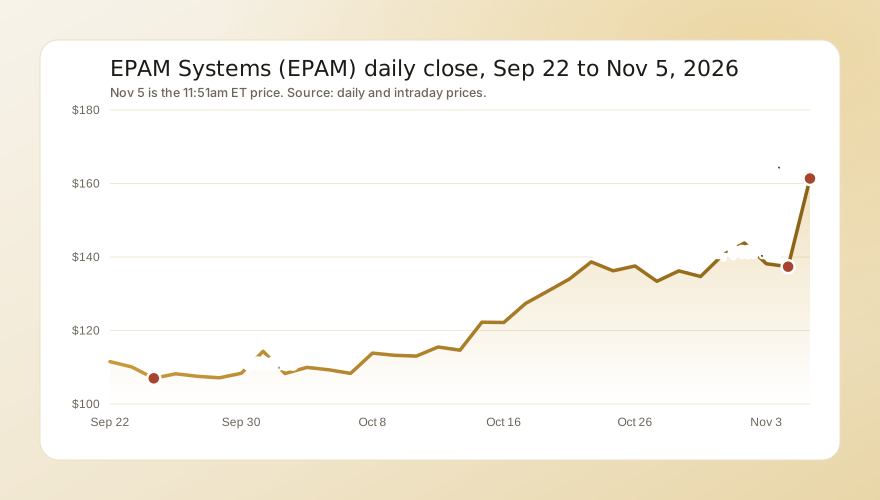
EPAM closed Nov 4 at $137.36 and slipped to $134.90 after hours. It released results before the open on Nov 5, with a call at 8:00am. Premarket trading was thin and wide: the stock touched $172.00 at 6:15am, then settled near $156 before the bell. It opened at $156.20, made its low of $154.10 in the first minutes and its high of $162.99 at 9:55am. At 11:51am it was $161.35 on about 1.2 million shares.
What moved it:
- More cash back to holders. The new $1.8 billion authorization runs through Dec 31, 2029, and adds $1.5 billion of capacity. EPAM bought back about $489 million of stock in the first nine months and has returned about $1.7 billion since 2023.
- A higher AI target. AI-native revenue topped $185 million in the third quarter, and the full-year target rose to at least $650 million from $600 million.
- A small beat and a raise. The full-year revenue growth guide is now 3.5% to 3.7%, and non-GAAP EPS is guided to $13.23 to $13.31. Investing.com reported that the EPS range sits above the prior consensus.
- Low expectations going in. Morgan Stanley raised its target to $140 from $97 the day before the report, and Guggenheim raised its target to $160 from $140 earlier in the week, Investing.com reported.
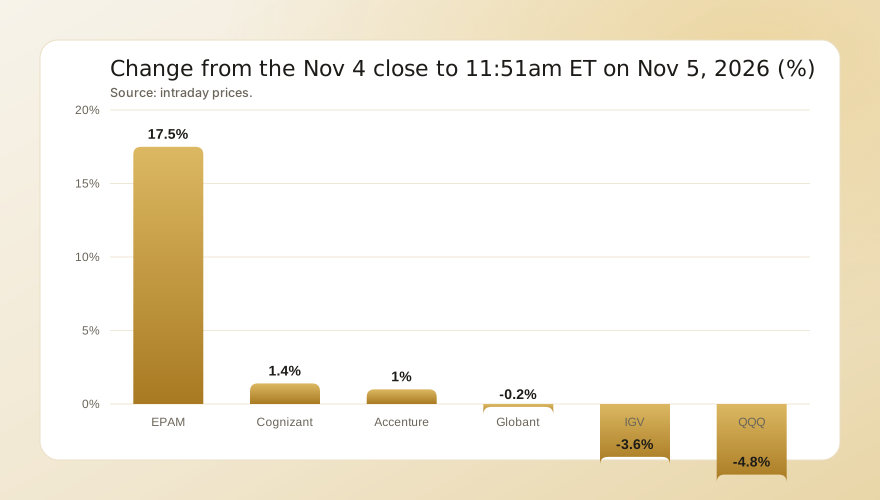
The move was EPAM's own. Over the same period Accenture rose 1.0%, Cognizant 1.4% and Globant fell 0.2%, while the software fund IGV fell 3.6% and the Nasdaq 100 fund QQQ fell 4.8%. The rest of the session's movers are in today's biggest stock moves.
At 11:51am RSI(14) stood at 77, the shares sat 33.4% above their 50-day average and 33.6% above their 200-day average, volume was about 1.1 times its 20-day average, and the stock was 27.6% below its 52-week high of $222.53.
The numbers
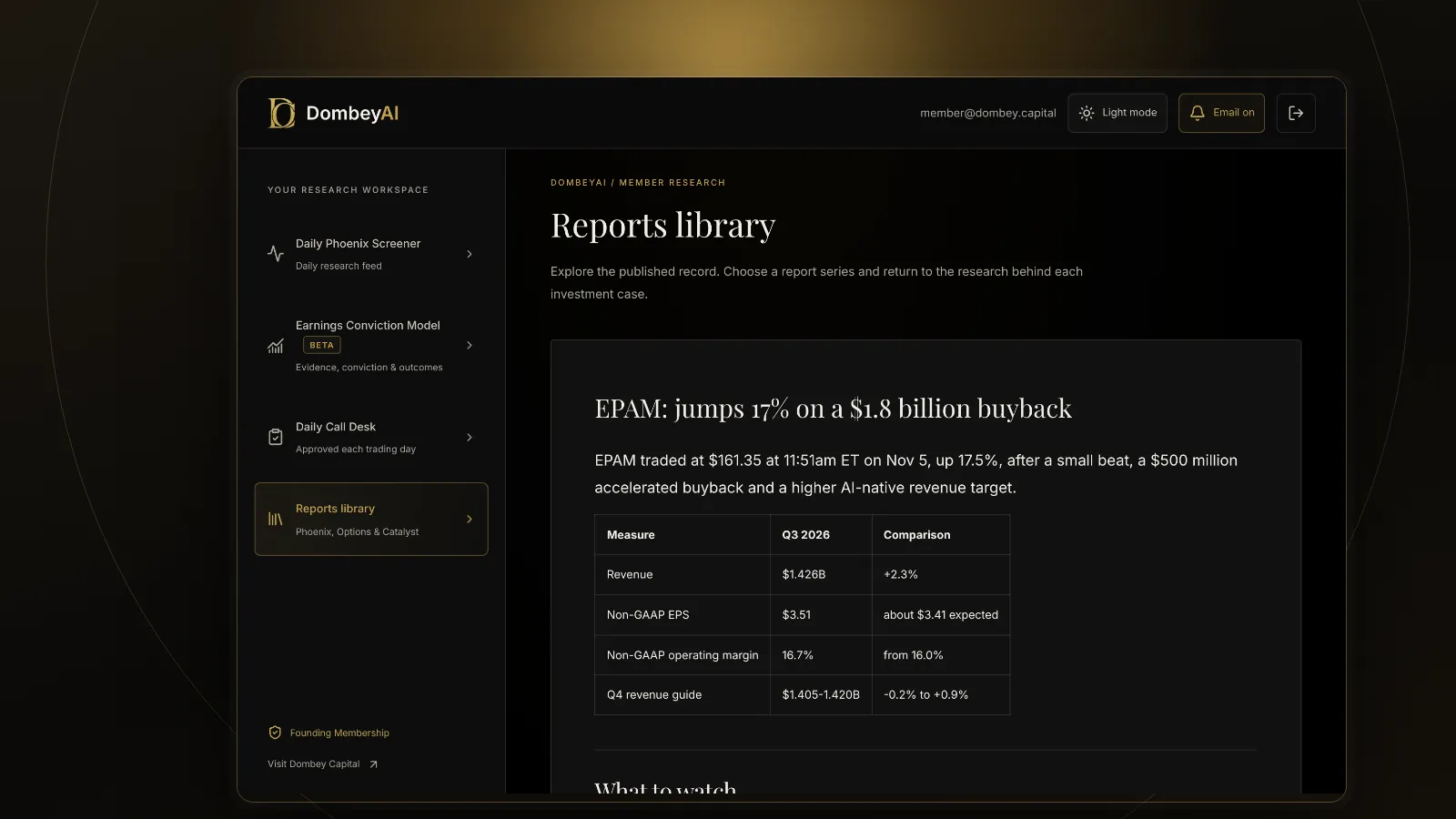
| Measure | Q3 2026 | Change or comparison |
|---|---|---|
| Revenue | $1.426 billion | +2.3%, +2.5% organic constant currency |
| GAAP operating margin | 12.3% | from 10.4% |
| Non-GAAP operating margin | 16.7% | from 16.0% |
| GAAP diluted EPS | $2.53 | none |
| Non-GAAP diluted EPS | $3.51 | consensus about $3.41 |
| Operating cash flow | $288.8 million | $250.1 million in nine months |
EPAM ended September with $969.9 million of cash, cash equivalents and restricted cash. Headcount was about 63,650, including about 57,350 delivery professionals, and utilization fell to 76.5% from 78.3% in the second quarter. Our page on buybacks as catalysts covers when a repurchase is large enough to matter, and our guide to reading an earnings release covers where to find the guide inside one.
The fourth-quarter guide calls for revenue of $1.405 billion to $1.420 billion and non-GAAP EPS of $3.50 to $3.58. For 2027, management pointed to a non-GAAP operating margin of 15% to 16% and said a Polish research and development tax benefit will fall to about $20 million from $40 million this year. Full 2027 guidance comes in February.
The bull case
EPAM is shrinking its share count fast. The $500 million accelerated program alone equals about 6% of the market value at $161.35, and the pledge to return at least half of free cash flow from 2027 to 2029 sets a floor under future buybacks. On the guide's midpoint the stock trades at about 12 times this year's non-GAAP EPS, which is modest for a company with nearly $1 billion of cash. The AI-native business is growing above 130%, based on figures discussed on the call, and the company says it is adding delivery staff because it sees demand. Our page on post-earnings announcement drift covers why stocks that gap on a report often keep moving in the same direction for a time.
The risks
The growth is not there yet. The fourth-quarter guide implies flat revenue from a year earlier, and on the call Wells Fargo analyst Tyler DuPont noted that AI-native growth above 130% sits beside a 6% decline in the rest of the business, which raises the question of whether AI work is replacing older services work rather than adding to it. Fejes said North America is "a multi-quarter journey" and that he would not "declare a turning point yet." The 2027 margin outlook is lower than this year's, partly because of the smaller Polish tax benefit. And the stock now trades above the highest published analyst target, so the case rests on buyback support while targets catch up. Our page on earnings estimate revisions covers why the targets matter less than whether estimates for next year actually rise.
What comes next
The accelerated buyback starts in the week of Nov 9, and the fourth-quarter report with 2027 guidance is expected around February 18, 2027. Before then, watch whether the stock holds the gap above its $137.36 Nov 4 close, how far analysts raise their targets, and any update on AI-native revenue. A close above $172.00 or a 2027 guide above 5% growth would undercut the Bearish case.