

Nov 9, 2026: a selloff into the report, then a loss and a lower guide
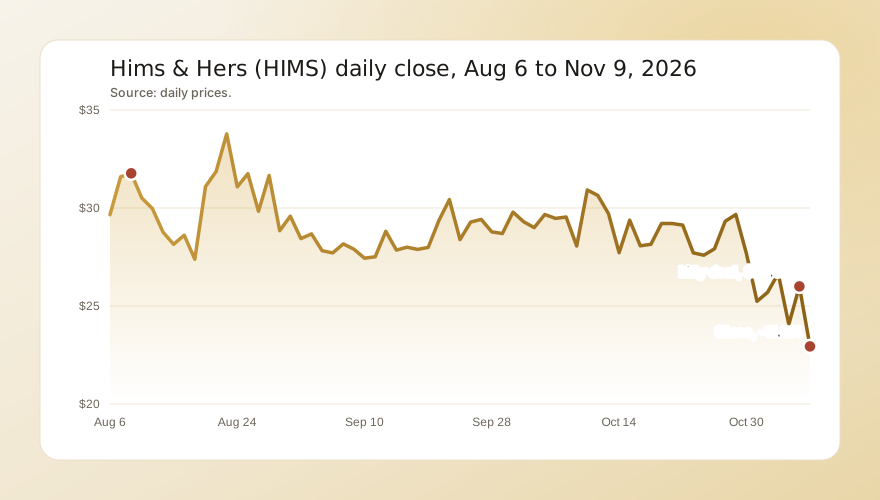
Hims & Hers closed Nov 6 at $26.00, up 8.1% on the day the Lilly agreement was announced. On Nov 9 it opened at $25.25, set a session high of $25.67 and slid through the day: $24.74 at 9:30am, $23.98 at 11:30am and $23.02 at 1:30pm. Volume picked up in the last half hour, and it closed at $22.94, down 11.8%, near its session low of $22.74. The stock had fallen after each of its last four reports, 24/7 Wall St. noted, and investors did not wait for this one.
The 4:05pm release showed:
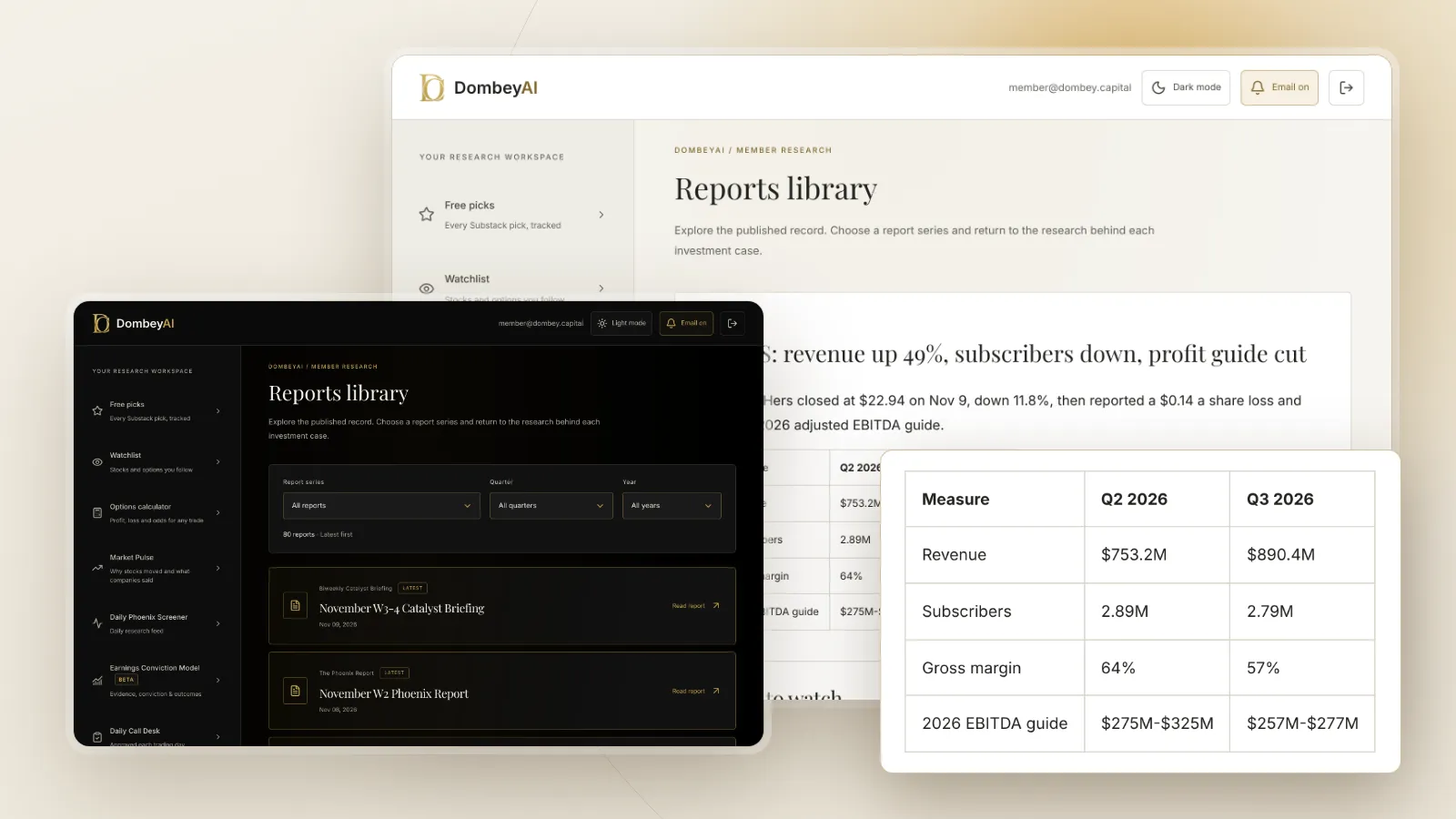
- Revenue up, mostly from abroad. Revenue rose 49% to $890.4 million, just under the average estimate of about $893 million and inside the company's $880 million to $900 million guide. U.S. revenue rose 21% to $657.1 million; revenue outside the U.S. rose 321% to $233.3 million, most of it from acquired businesses such as Eucalyptus.
- A loss instead of a profit. The net loss was $33.0 million, or $0.14 a share, against net income of $15.8 million, or $0.06, a year earlier. The operating loss was $66.1 million, including $35.4 million of acquisition and earn-out costs and $3.8 million of restructuring.
- Fewer subscribers. Subscribers ended September at 2.79 million, up 13% from a year earlier but down from 2.89 million at June 30.
- A lower profit guide. Full-year adjusted EBITDA guidance fell to $257 million to $277 million from $275 million to $325 million, and revenue was narrowed to $3.13 billion to $3.15 billion from $3.1 billion to $3.3 billion. The fourth quarter is guided to $875 million to $895 million of revenue and $70 million to $90 million of adjusted EBITDA.
The chief financial officer said the company was "intentionally pacing marketing spend ahead of several planned expansions to our platform in the fourth quarter," which may explain part of the subscriber drop. It also means the quarter that has to show the payoff is the one now guided flat.
Hims & Hers fell alone. From the Nov 6 close to the Nov 9 close:
| Stock or fund | Nov 6 close | Nov 9 close | Change |
|---|---|---|---|
| Hims & Hers (HIMS) | $26.00 | $22.94 | -11.8% |
| Eli Lilly (LLY) | $1,354.00 | $1,411.95 | +4.3% |
| Novo Nordisk (NVO) | $40.31 | $41.38 | +2.7% |
| Teladoc (TDOC) | $8.77 | $8.98 | +2.4% |
| Health Care Select Sector SPDR (XLV) | $184.80 | $188.33 | +1.9% |
| SPDR S&P 500 (SPY) | $735.29 | $752.69 | +2.4% |
The close left the shares 44% below their 52-week closing high of $41.05 and 58% above their 52-week closing low of $14.52 on Feb 27, 2026, with RSI(14) near 32. Our page on why Teladoc rose covers the other large listed telehealth name.
The numbers: growth bought with margin
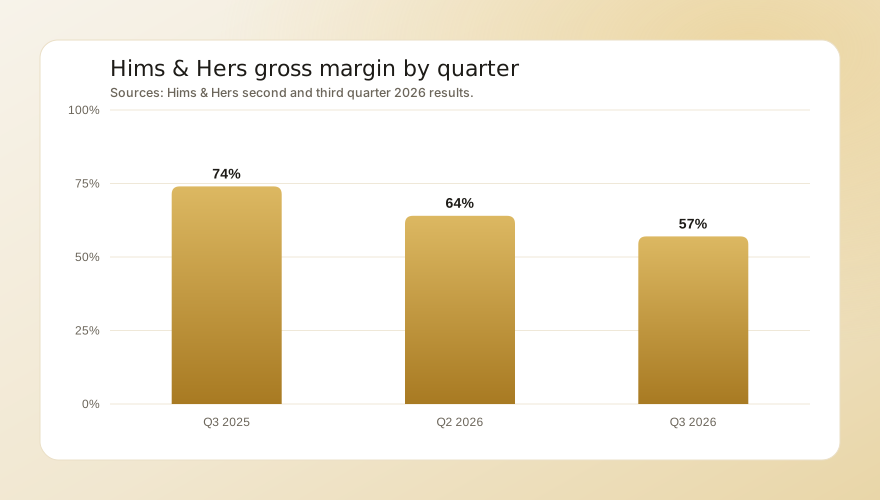
- Gross margin. 57% in the third quarter, from 64% in the second and 74% a year earlier. For the first nine months it was 62% against 75%.
- Revenue per subscriber. $105 a month on average, up 30% from $81 a year earlier and from $92 in the second quarter. Branded GLP-1 prescriptions raise the bill per customer and lower the margin on it.
- Adjusted EBITDA. $82.4 million, about 9% of revenue, up from $78.4 million a year earlier. The company changed the measure this quarter to include foreign-exchange gains and losses and did not restate earlier periods. Our explainer on adjusted EBITDA covers what such add-backs leave out.
- Cash. Operating cash flow was $65.4 million and free cash flow $26.0 million, against $148.7 million and $79.4 million a year earlier. Stock-based compensation was $64.5 million in the quarter.
- Balance sheet. $605.6 million of cash and $106.6 million of short-term investments at Sep 30, against $1.37 billion of convertible notes and a $478.6 million deferred acquisition payment due within a year.
A cut to a profit guide while revenue holds is the kind of guidance change that tends to weigh on a stock for longer than a single session, and the move into the print shows how far estimates had to come down first.
The bull case
The Lilly agreement makes Hims & Hers one of the few places where a patient can be prescribed and buy both companies' branded obesity drugs in one visit, at the same self-pay price as Lilly's own site. Lilly has said 40% to 45% of Zepbound sales already come through self-pay channels, and Foundayo, a daily pill priced from $149 a month, suits a subscription platform. Revenue is still growing at 49%, and at about 1.7 times sales the stock prices in little of the 2030 target of $6.5 billion of revenue and $1.3 billion of adjusted EBITDA that management set out earlier. If the fourth-quarter marketing push works, subscribers and the guide could both look conservative by February.
The risks
- Subscribers. A drop of about 100,000 in one quarter, before the Lilly drugs are on the platform, is the clearest sign that the move away from compounded GLP-1s is costing customers.
- Margin. Every branded prescription carries a lower gross margin than the products it replaces. The 57% figure may not be the floor.
- Debt and deal payments. $1.37 billion of convertible notes and a $478.6 million acquisition payment due within a year are large against $712.2 million of cash and investments and $26.0 million of quarterly free cash flow; settling them in shares would mean dilution.
- Regulation. Questions on compounded peptides and telehealth prescribing have come up on each of the last three earnings calls, and a rule change could hit the remaining non-GLP-1 lines.
What comes next
The fourth-quarter report, likely in late February 2027, will show the first full quarter with Lilly's drugs on the platform and whether subscribers have turned. For the rest of the session's movers, see today's biggest stock moves.