

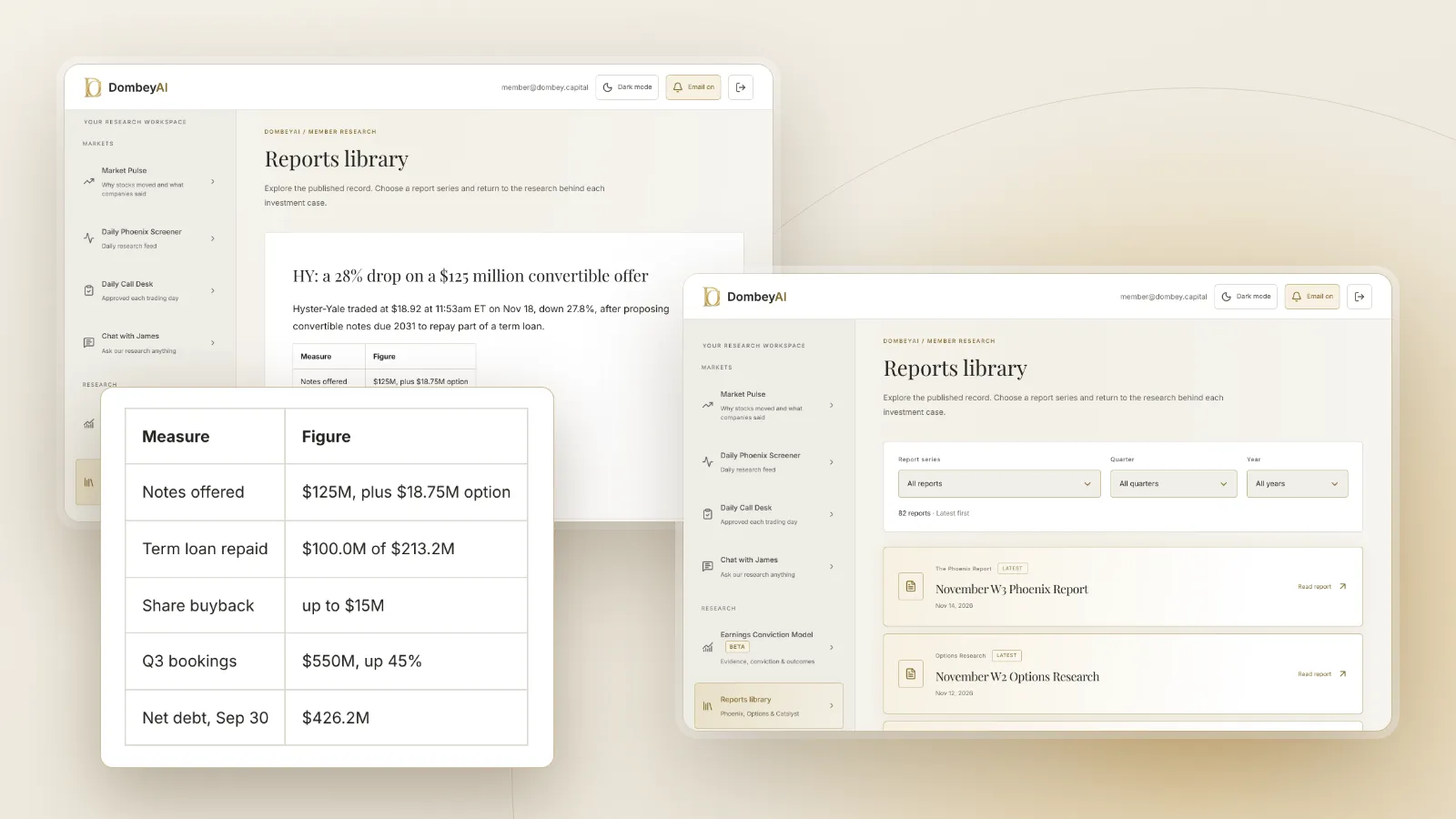
Nov 18, 2026: a convertible offer before the open and a 36% low
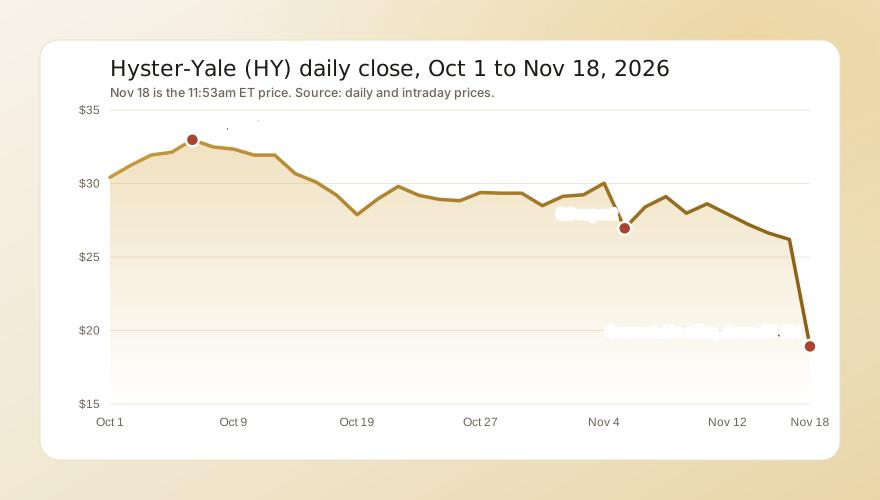
Hyster-Yale closed Tuesday, Nov 17, at $26.20, its fourth straight decline. The press release went out at 6:52am on Wednesday, and premarket trading slid from $26.05 at 6:50am to $22.59 by 9:00am, 13.8% lower.
The stock opened at $20.67, traded near $21 in the first minutes and then dropped to $16.68 at 9:40am, 36.3% below the close and a new 52-week low. Buyers took it back above $19 by late morning. At 11:53am it was $18.92, down 27.8%, on 734,000 shares, about five times its 20-day average for a full session.
What pushed it down:
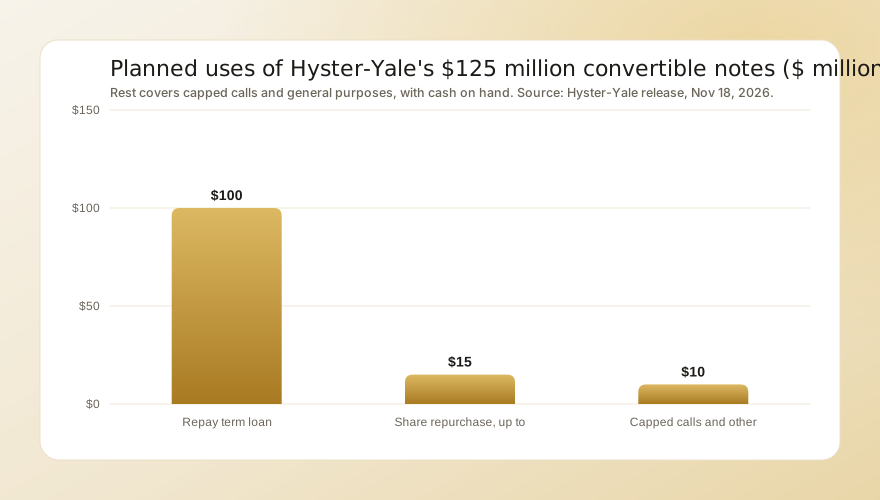
- The size of the offer. $125 million, with an option for $18.75 million more, is about 27% of a market value of roughly $470 million at the Nov 17 close. Our explainer on dilution covers how conversion rights weigh on a share price.
- Hedging. Investors who buy convertible notes usually short the stock to hedge, and the company said the banks on the capped calls may buy and sell shares around pricing. Our explainer on convertible arbitrage covers how that trade works.
- A weak base. Third-quarter revenue fell 15% to $827.4 million against about $926 million expected, and the loss of 83 cents a share was wider than the 59 cents expected.
- A thin float. Only about 9.5 million of the 14.5 million Class A shares trade freely, so a burst of selling moves the price far.
Other machinery stocks did not move with it: Terex rose 0.5%, Oshkosh was flat and Caterpillar fell 2.9%, while the Russell 2000 fund rose 0.3%. The drop was about Hyster-Yale's financing, not the industry. Our guide on how to analyze a convertible bond covers the terms to check when the notes price, and the rest of the session's movers are in today's biggest stock moves.
After the drop, RSI(14) stood at 21, the shares sat 37% below their 50-day average and 44% below their 200-day average, volume ran 5.2 times its 20-day average, and the stock was 54% below its 52-week high of $41.30.
The numbers
| Measure | Q3 2026 | Q3 2025 |
|---|---|---|
| Revenue | $827.4M | $979.1M |
| Net loss | $(14.9)M | $(2.3)M |
| Diluted loss per share | $(0.83) | $(0.13) |
| Adjusted EBITDA | $6.0M | $15.1M |
| Bookings | $550M | $380M |
| Backlog | $1.6B | $1.35B |
| Net debt | $426.2M | $396.7M |
Revenue fell because customers shifted from higher-value Class 1 and Class 4 trucks to lighter, cheaper models, and shipments were lower; pricing added $11 million. Sequentially the business improved: revenue rose 2% from the second quarter, the operating loss narrowed to $9.1 million from $18.4 million, and operating cash flow rose to $26 million. Debt was $484.7 million and cash $58.5 million at Sept. 30. Our explainer on net debt to EBITDA covers why a negative trailing EBITDA makes lenders cautious.
The bull case
Orders have now been elevated for four straight quarters since the cyclical low in the second quarter of 2025, and management expects fourth-quarter bookings to beat both the third quarter and a year earlier. Its new lighter and value trucks are winning share as buyers trade down. In the fourth quarter it launched programs targeting at least $100 million of annual savings at maturity in 2029, on top of earlier cuts, and it is capping 2027 capital spending at $40 million to $50 million. Alfred Rankin said on the call, "A cyclical recovery is not sufficient," and the long-term goal is a 7% operating margin over the cycle. The shares trade at about 0.9 times book value. If the notes price on reasonable terms, the company swaps bank debt that matures sooner for debt due in 2031 and keeps paying a dividend that yields about 7.7% at today's price.
The risks
- Funding. Trailing adjusted EBITDA is negative and net debt is $426.2 million. The company still has $113.2 million of the term loan to refinance after this offer.
- Conversion terms. The coupon and conversion price are set at pricing. A low conversion price, close to today's level, would mean more dilution.
- Execution. Management said turning orders into shipments is "not automatic," and tariffs, inflation and competitive pricing could offset gains.
- The dividend. A 36.5 cent quarterly dividend costs about $6.5 million a quarter at the current share count, cash a company with negative trailing EBITDA may decide to keep. Our explainer on what dividend cuts signal covers how markets react when that happens.
What comes next
- Pricing of the notes, expected within days. The coupon, the conversion premium and the cap on the capped calls will show what the deal costs shareholders.
- The dividend, Dec 15. Holders of record on Dec 1 receive 36.5 cents a share.
- Fourth-quarter results, expected around March 2, 2027. Management guided positive adjusted net income, and bookings above the third quarter's $550 million.