

Ordinary vs reverse spin-offs
In an ordinary spin-off, a parent distributes shares of a smaller division and keeps its main business. This is the pattern covered in spin-off investing: a smaller, often unloved spinco that gets sold by holders who never wanted it.
A reverse spin-off flips the sizes. The entity that files, distributes and continues as the original legal company holds the smaller piece. The larger business moves into a new entity that is distributed to shareholders.
| Feature | Ordinary spin-off | Reverse spin-off |
|---|---|---|
| Legal parent keeps | The larger business | The smaller business |
| New company holds | A smaller division | The larger business |
| Accounting history | Stays with the parent | May follow the larger business into the new entity |
| Likely forced sellers | Holders of the spinco | Holders of the shrunken parent, and sometimes both |
| Main filing | Form 10 for the spinco | Form 10 for the new company holding the larger business |
For the filing itself, see what a Form 10 is. In a reverse spin-off it describes the larger business, which means the bigger, better-known operations are the ones being registered as if new.
Why companies choose the reverse structure
The usual reason is practical: something valuable is attached to the legal entity, and moving the smaller business out is easier than moving the larger business out. The common cases:
- Contracts and consents. Customer contracts, joint ventures and leases may need counterparty consent to be assigned. If most of them sit with the smaller business, leaving it in place avoids thousands of consents.
- Licenses and permits. Regulated activities such as banking, insurance, gaming, telecom or government contracting can require new approvals if moved. Keeping the regulated business in the existing entity avoids that.
- Tax attributes. Net operating losses and other attributes generally stay with the legal entity. A company may want them to sit with the business able to use them.
- The listing itself. An exchange listing, an index membership or a history of SEC reporting can matter more to one business than the other.
Tax-free treatment still depends on the Internal Revenue Code Section 355 requirements that apply to any spin-off. The reverse form does not loosen them.
Legal form vs accounting substance
US accounting guidance allows a reverse spin-off to be presented by its substance. When it is, the larger business is treated as the accounting spinner. Its historical financial statements continue as the continuing company's history, and the legal parent's smaller business is presented as the unit that was spun off.
Factors that point to reverse treatment include the relative size of the two businesses, which one management and the board follow, and which one is expected to be retained in substance. The filings state which approach was taken. Read the basis of presentation note first, because it tells you which history you are looking at.
The result can be confusing. A data platform may attach ten years of financial history to the ticker of the legal parent, even though that history now belongs to the new company. Screens and ratios built on that history will be wrong until the data catches up.
Where the mispricing comes from
Reverse spin-offs create the same pressures as ordinary spin-offs, but on a different set of holders.
The shrunken parent. Shareholders who owned the company for its main business now hold a small company in a different line of business, under the old ticker. Index funds may have to sell if it falls out of an index after the distribution. Sector funds may sell if its industry classification changes. This is the piece most likely to see forced selling, the pattern described in index deletions.
The new company. It holds the larger, well-known business but arrives as a new listing, sometimes with a new name. Some holders sell it because it is new and lacks a trading history, and some index providers take time to add it.
Data errors. Screens may show the old parent's multiple on the new company's history, or show the new company as having no history at all. Both can make a stock look cheaper or dearer than it is.
Worked example
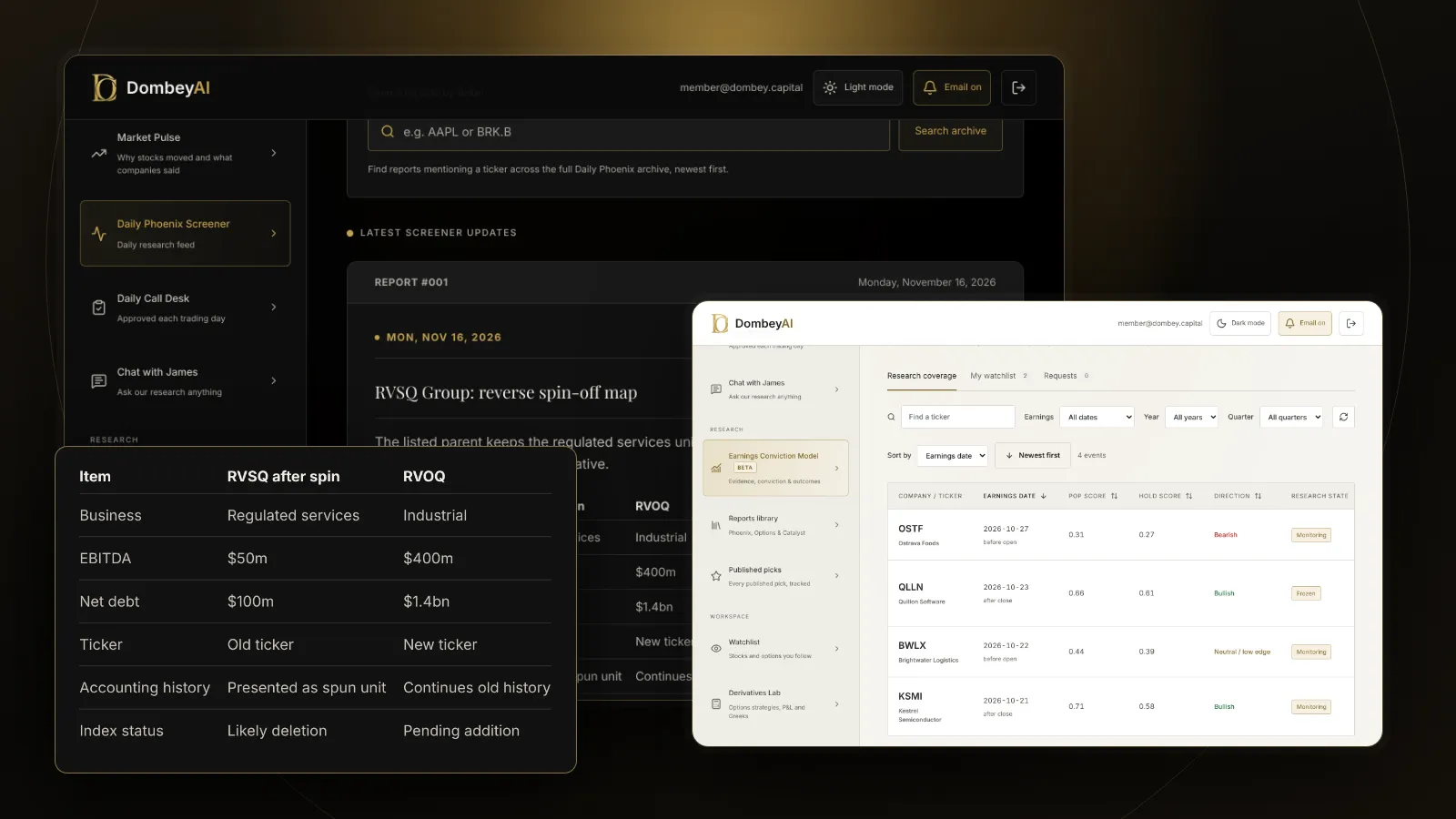
| Item | Company A after the spin | NewCo |
|---|---|---|
| Business | Regulated services | Industrial |
| EBITDA | $50 million | $400 million |
| Net debt assigned | $100 million | $1.4 billion |
| Ticker | Old ticker | New ticker |
| Accounting history | Presented as the spun unit | Continues the old company's history |
A holder of 100 shares of Company A keeps 100 shares, now representing the services unit, and receives NewCo shares at the distribution ratio. Index funds that held Company A as a large industrial may now own a small services company and have to sell. Meanwhile, NewCo starts trading as a new listing even though it is the business they thought they owned.
The places to look: the allocation of debt between the two, whether the smaller entity carries indemnities or legacy liabilities, and whether management incentives sit with one side. A sum-of-the-parts valuation before the distribution shows what each piece should be worth on its own.
What to read before the distribution
The checklist is close to the one for any spin-off, with a few additions for the reverse form.
| Step | What to check | Where to find it |
|---|---|---|
| Which entity is which | Legal spinner, accounting spinner, which gets the old ticker | Form 10 or information statement, basis of presentation |
| Debt allocation | Which entity borrows and pays a dividend to the other before separation | Form 10, capitalization and financing sections |
| Liabilities | Legacy litigation, environmental, pension and tax indemnities | Separation and distribution agreement, tax matters agreement |
| Index and holder base | Index membership after the split, sector change | Index provider announcements, 13F holdings |
| Incentives | Where the CEO and key managers go, and how they are paid | Form 10 executive compensation section |
| When-issued trading | Prices for each piece before the distribution date | Exchange notices |
The step-by-step method in how to analyze a spin-off Form 10 applies directly. When the structure combines a spin with a merger, it becomes a Reverse Morris Trust, which is a different transaction with different tax rules.
Where this goes wrong
The common failures:
- Following the ticker, not the business. An investor who owns the old ticker for the main business may find, after the distribution, that the ticker now represents the smaller unit.
- Trusting historical data. Ratios and charts can attach the wrong history to the wrong company until the data providers adjust.
- Assuming forced selling means value. The shrunken parent may be sold for good reasons, such as heavy liabilities or a weak business.
- Ignoring debt shifts. A pre-spin dividend from the new company to the parent, funded with new borrowing, can leave one side highly leveraged.
The bottom line
A reverse spin-off keeps the smaller business in the legal parent and distributes the larger business as a new company, usually because contracts, licenses, tax attributes or a listing are easier to leave in place. The accounting can follow substance rather than form, so the old financial history may move to the new company. The mismatch between ticker, history and business creates confusion, forced selling and data errors, and those are the sources of mispricing. Newsletters that cover separations, listed in our guide to the best investing newsletters for special situations, track these events as they are announced, but the Form 10 and the separation agreements are where the answers are.