

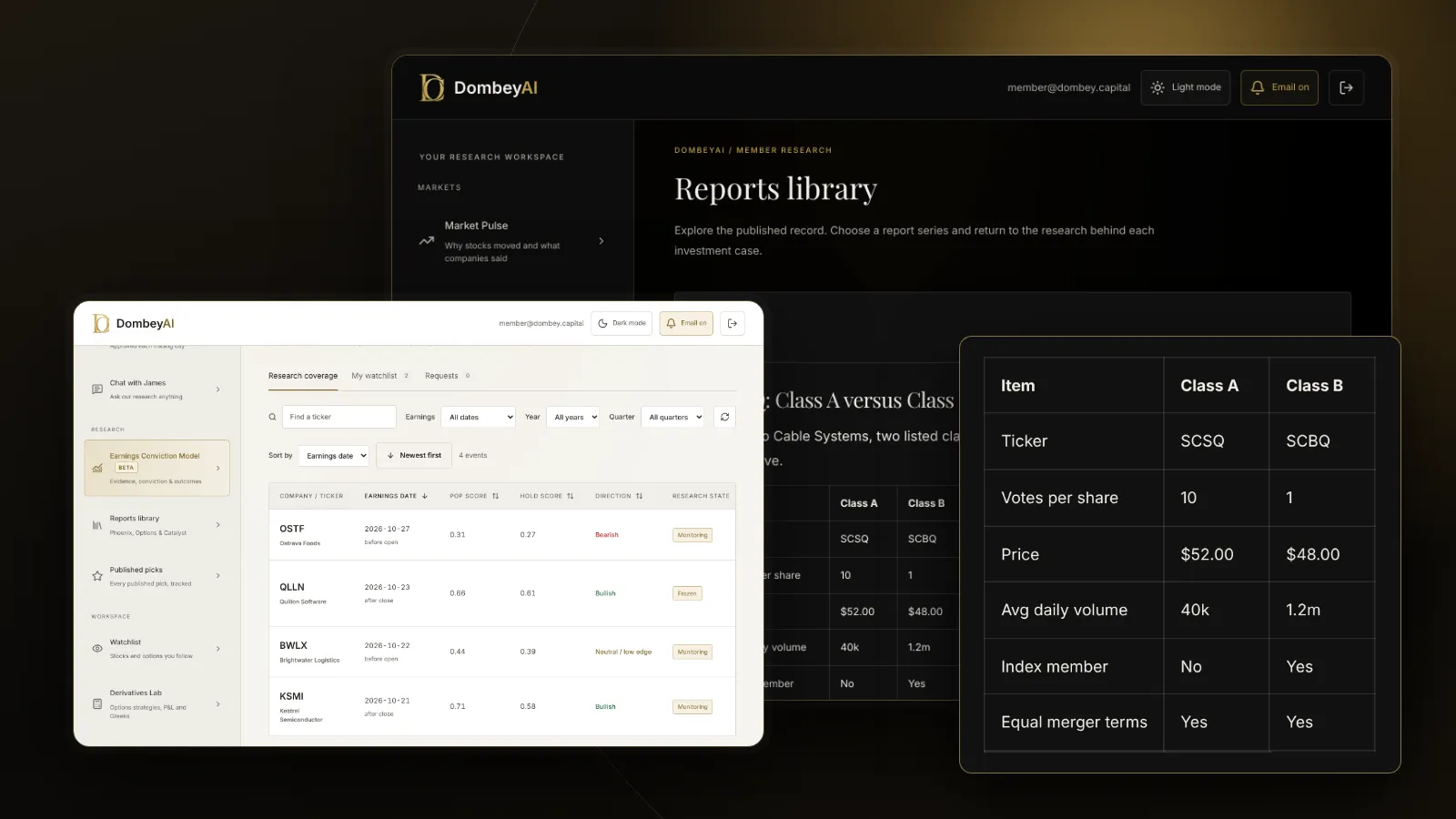
How dual-class structures work
Many companies have more than one class of common stock. The usual pattern is a high-vote class held by founders or a family and a low-vote or non-voting class sold to the public. In other cases both classes are listed, and investors can choose.
The classes are separate securities with separate tickers. Their prices are set by separate buyers and sellers, so nothing forces them to match. If the economic rights are identical, a large gap is a mispricing only if something will close it.
Real examples
These listed pairs show the main variations in how classes differ. The point is the structure, not the current price gap.
| Company | Classes | Main difference |
|---|---|---|
| Alphabet | Class A (one vote) and Class C (no vote) | Voting only; both listed. When Class C was created in 2014, a court settlement required an adjustment payment if Class C traded at too wide a discount in its first year |
| Berkshire Hathaway | Class A and Class B | Each A share converts into 1,500 B shares at the holder's option; B cannot convert into A |
| Fox Corporation | Class A (non-voting) and Class B (voting) | Voting; the controlling holders own the voting class |
| News Corp | Class A (non-voting) and Class B (voting) | Voting |
| Brown-Forman | Class A (voting) and Class B (non-voting) | Voting; family control through Class A |
Berkshire shows how a one-way conversion right puts a ceiling on one side of the spread: if A traded at more than 1,500 times B, holders could convert. Alphabet's settlement showed how a contract can put a cost on a wide spread for a time.
What drives the spread
| Driver | Pushes up | Why |
|---|---|---|
| Voting power | Usually the voting class | Votes matter when control could change or a contest is possible |
| Liquidity | The class with more float and volume | Large holders pay for easy entry and exit |
| Index inclusion | The class in more indexes | Passive funds must hold it |
| Dividends | The class with a higher payout | Some charters pay one class more |
| Conversion right | The class that can convert | It has an option the other lacks |
| Merger treatment | The class protected by equal-treatment terms | Removes the risk of a lower takeover price |
The direction is not fixed. A voting premium can disappear if control is locked up by a family that will never sell. A non-voting class can trade higher if it is the liquid, indexed one.
The value of a vote
Votes are worth the most when they could decide something. In a proxy fight or a takeover where the controlling holder might be paid a premium, the voting class can widen sharply. If the charter requires equal consideration for all classes in a merger, much of that value disappears. That clause is the first thing to read.
Catalysts that close the gap
Spreads close through events, and each event has a document trail.
- Class collapses. The company converts all shares into one class, sometimes paying the high-vote holders a premium. The mechanics and valuation are covered in how dual-class share collapses are valued.
- Takeovers. A cash buyout that pays every class the same price closes the gap on the day the deal closes. The spread then trades like a merger arbitrage spread.
- Sunset clauses. Some charters convert high-vote shares into ordinary shares after a set number of years or when the founder leaves.
- Index rule changes. S&P Dow Jones Indices excluded new companies with multiple share classes from the S&P Composite 1500 in 2017 and reversed that rule in 2023. Index decisions shift passive demand from one class to another; see what happens when a stock is added to the S&P 500.
- Buybacks of one class. A company that repurchases only the cheaper class adds steady demand there.
Why spreads persist
If two classes have the same economic rights, why does arbitrage not close the gap at once? Several frictions keep it open.
- Shorting costs. To profit from the gap, a trader shorts the expensive class. If that class has a small float, borrow can be costly or unavailable, and the cost runs every day the position is open.
- Dividends on the short. The short side must pay any dividend on the borrowed shares. If both classes pay the same dividend, this washes out; if they differ, it adds a carry cost.
- No forced convergence. Unlike a merger spread, which closes on a deal date, a share class spread has no deadline. Capital tied up in a pair trade with no end date has an opportunity cost.
- Different holders. Index funds, founders and active managers hold different classes for different reasons. Index funds cannot move to the cheaper class if their index holds the other one.
- Uncertainty about the charter's future. The controlling holders can propose changes. A gap partly reflects the risk that they will act in their own interest.
These frictions are also why the catalysts below matter so much. They remove the frictions by making the classes the same security, or by paying them the same amount.
How to analyze a spread
- Read the charter. Find the certificate of incorporation on SEC EDGAR. List each class's votes, dividends, conversion rights and treatment in a merger or liquidation.
- Check the proxy. The proxy statement shows who controls the voting class and any agreements among holders.
- Measure liquidity. Compare average daily volume and float for each class.
- Check index membership. Note which class each major index holds.
- List the catalysts. Sunset dates, controlling holder age or succession plans, pending deals and index reviews.
- Price the hedge. If you short one class against the other, include borrow costs and dividends owed on the short.
Where this goes wrong
- No catalyst. Without a dated event, a spread can stay wide for a decade. Carry costs on a long-short pair add up.
- Unequal merger terms. If the charter lets a buyer pay the voting class more, the voting premium can widen, not close.
- Borrow problems. The expensive class may be the illiquid one, and hard to short.
- Different economics hidden in the fine print. Some classes have different dividend rights or liquidation preferences. A spread that looks like a mispricing may be fair.
- Index changes cut both ways. An index can add the class you are short.
Situations like these are a recurring theme in the best investing newsletters for special situations, and Dombey's own research on dated catalysts is in the research archive.
The bottom line
Two share classes of one company trade apart because they differ in votes, liquidity, index weight, dividends or conversion rights. The spread is not a reliable trade on its own, because nothing forces it to close. What makes it a special situation is a catalyst: a collapse, a takeover with equal treatment, a sunset date or an index change. Read the charter first, then find the date.