

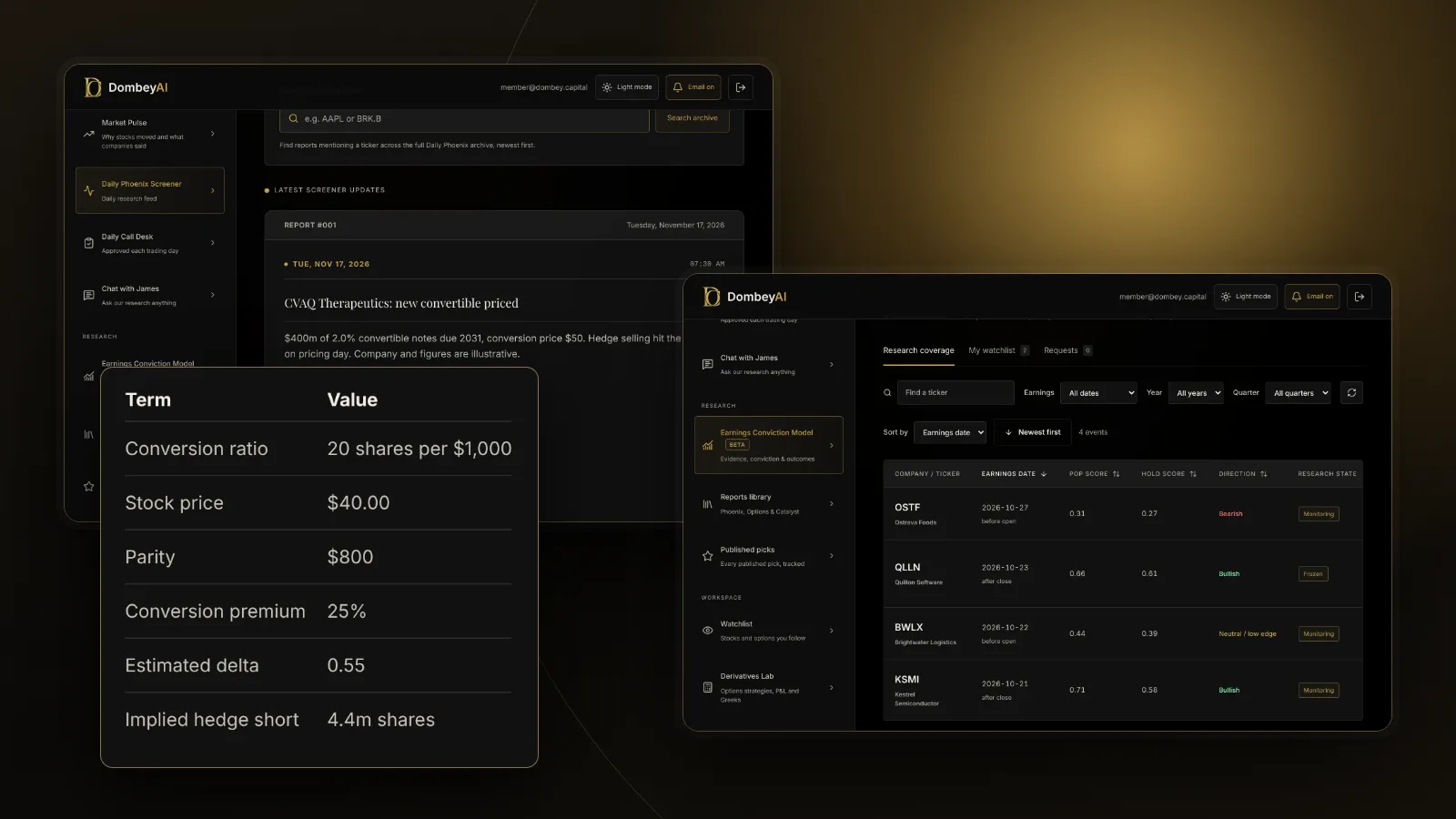
A short definition
A convertible bond pays interest and can be exchanged for a fixed number of shares, the conversion ratio. It is a bond plus a call option on the stock. When the stock is far below the conversion price, the bond trades like ordinary debt. When the stock is far above, it trades like the shares.
The arbitrageur buys the bond and shorts enough stock to neutralize the option's delta. As the stock moves, the delta changes, and the short is adjusted. This is the same mechanism market makers use with options, covered in what delta hedging is.
Real examples
The strategy is well established, and its worst periods came when many funds held the same trades.
| Episode | What happened | Lesson |
|---|---|---|
| Spring 2005 | Outflows from convertible arbitrage funds forced selling of bonds; in May, credit downgrades of General Motors and Ford unsettled hedged positions across credit markets | Crowded trades fall together |
| September 2008 | The SEC's emergency order temporarily banned short sales in hundreds of financial stocks, while funds faced financing cuts and redemptions | The hedge depends on being able to short |
| New issue days, ongoing | When a company prices a convertible, arbitrage buyers short the stock against their allocation | Issuance is a short-term catalyst for the shares |
Both 2005 and 2008 show that the strategy's risks are mostly external to any single bond. Funding, borrow and liquidity can fail across the whole book at once.
The terms that matter
| Term | Meaning | Why it matters |
|---|---|---|
| Conversion ratio | Shares received per $1,000 bond | Sets the option's size |
| Conversion price | $1,000 divided by the ratio | The stock price at which conversion breaks even |
| Parity | Ratio times the stock price | What the bond is worth as shares |
| Conversion premium | Bond price over parity | How much is paid for the option and the bond floor |
| Bond floor | Value as a straight bond | The cushion if the stock falls |
| Delta | Bond's price change per $1 stock move, scaled to shares | The hedge ratio |
| Call and put provisions | Issuer's right to redeem, holder's right to sell back | Can cut the option's life short |
How the trade works
The arbitrageur buys one bond and shorts 20 x 0.55 = 11 shares, raising $440.
| Stock moves to | Bond price (approx.) | Short 11 shares | Net change |
|---|---|---|---|
| $44 | $1,050 | -$44 | +$6 |
| $36 | $960 | +$44 | +$4 |
The bond gains more on the way up and loses less on the way down than its starting delta implies. That is convexity, and it is why a hedged convertible makes a little on moves in either direction. When the stock rises, the bond's delta rises, so the arbitrageur shorts more shares at a higher price. When it falls, delta drops, and shares are bought back at a lower price. Over many moves, this sell-high, buy-low rebalancing is the volatility profit.
Alongside it, the position earns the 2% coupon on the bond plus interest on the short sale proceeds, minus the stock's dividend and the borrow fee.
Where the edge comes from
- Cheap volatility. Convertibles have sometimes been priced with an implied volatility below what the stock delivers. Buying the bond and hedging captures the gap, the same idea as realized versus implied volatility.
- New issue discounts. Companies often price new convertibles slightly cheap to ensure a quick sale, and arbitrage funds are the natural buyers.
- Busted converts. When the stock has fallen far below the conversion price, the bond trades on credit. Investors who analyze the capital structure and the debt maturity wall can find bonds priced for a default that may not come.
- Corporate events. Takeover protections in the indenture, such as make-whole tables, can make a bond worth more in a buyout than the market assumes. The bond indenture is where those terms sit.
None of these edges is permanent. When many funds chase the same new issues, issuers can price convertibles richer, and the cheapness disappears. When few funds are active, after a period of losses and redemptions, new bonds tend to come cheaper. The supply of arbitrage capital is itself one of the main drivers of the strategy's returns.
Convertibles and their stocks often show up among special situations, which is why the best investing newsletters for special situations cover them alongside spin-offs and restructurings.
How funds size and finance the trade
The return on one hedged convertible is small, often a few percent a year before leverage. Funds make it meaningful in three ways, each of which adds risk.
- Leverage. Prime brokers lend against the bonds. A fund with $100 million of capital might hold several hundred million dollars of hedged bonds. Returns rise with leverage, and so do losses when prices fall and lenders ask for more margin.
- Diversification across issuers. Holding many small positions spreads credit and event risk. It does not protect against market-wide events that hit all positions at once, such as a funding squeeze.
- Partial hedges. Some funds hedge credit risk with credit default swaps or short positions in the issuer's other bonds, and some leave part of the delta unhedged to express a view. Each choice changes what the position really is.
| Position type | Stock hedge | Credit hedge | Main exposure left |
|---|---|---|---|
| Classic delta-neutral | Full delta | None | Volatility and credit |
| Credit-hedged | Full delta | CDS or short bonds | Volatility |
| Busted convert | Small or none | Sometimes | Credit and recovery value |
| Directional | Partial | None | Stock direction and volatility |
What it means for stock investors
Even if you never trade a convertible, the strategy affects the stock:
- Issue day. Shorting by arbitrage buyers can push the stock down when a convertible prices. Some companies buy back stock or use capped call structures at the same time to offset dilution.
- Short interest. Part of a convertible issuer's short interest is hedging, not a bearish bet. Reading short interest without checking for convertibles overstates negative sentiment.
- Conversion and call. When a company calls a bond that is deep in the money, holders convert, and the hedges are closed out with the new shares.
Where this goes wrong
- Credit deterioration. If the issuer's credit weakens, the bond floor drops. The short stock helps, but not one for one.
- Borrow recalls and bans. If the lender recalls the shares or regulators restrict short sales, the hedge must be closed at a bad time.
- Leverage. Returns per trade are small, so funds use borrowed money. When lenders raise margins, funds must sell.
- Liquidity. Convertibles trade less often than stocks. Selling in a rush means wide discounts.
- Takeovers and calls. A cash takeover can end the option value early. Without strong indenture protection, the bond can lose more than the short gains.
The bottom line
Convertible arbitrage buys a convertible bond and shorts the stock against it, aiming to earn carry and volatility while neutralizing direction. It works when volatility is underpriced, borrowing is available and funding is stable. Its worst losses came when crowded funds sold at the same time, as in 2005 and 2008. For stock investors, the strategy explains issue-day selling and part of the short interest in convertible issuers.