

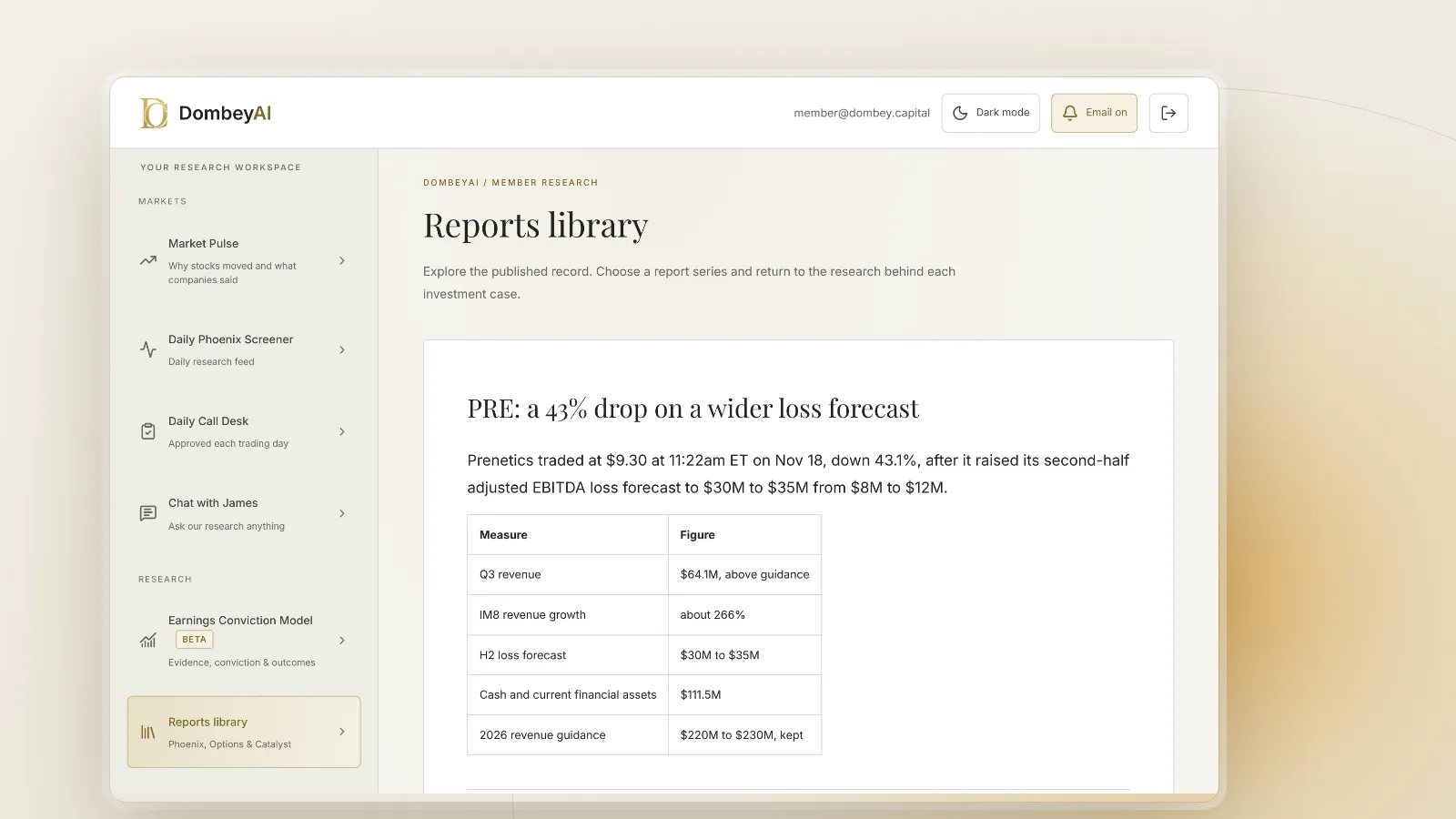
Nov 18, 2026: a revenue beat and a much larger loss forecast
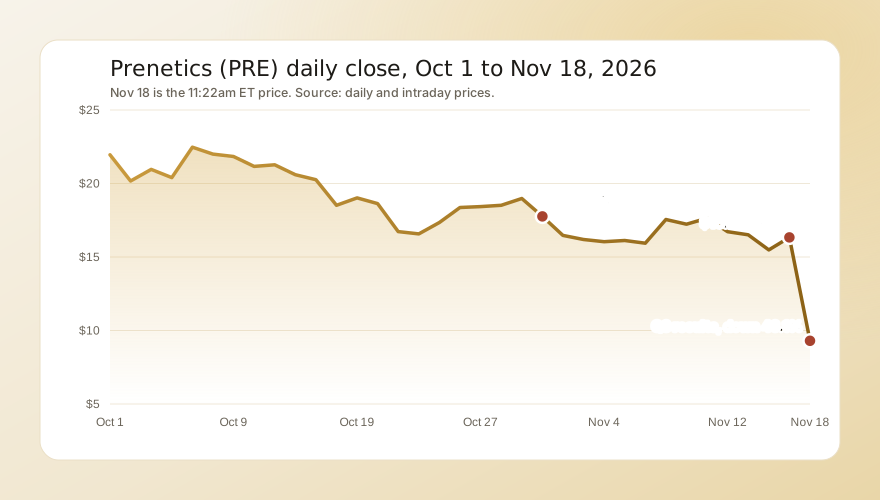
Prenetics released results before the open and held its webcast at 8:30am. The stock had closed at $16.33 on Tuesday, already down 29% from $23.13 on Sept. 30. Premarket trading slipped to $15.50 by 8:55am.
The regular session opened at $13.89, 14.9% lower, and fell fast. By 9:50am the stock was at $9.50, and it touched $9.13, a new 52-week low and 44.1% below the prior close, at 10:35am. It held between $9.23 and $10.00 for the next 45 minutes and traded at $9.30 at 11:22am on about 575,000 shares.
What pushed it down:
- The loss forecast. Chief executive Danny Yeung told listeners, "We realize this is a very large change, and it is also a deliberate choice given the returns we are seeing." With the third quarter's $12.7 million loss already booked, the new second-half range implies a fourth-quarter adjusted EBITDA loss of about $17 million to $22 million.
- No revenue raise to go with it. Prenetics kept 2026 revenue guidance at $220 million to $230 million rather than lifting it alongside the bigger spending plan, so the extra marketing buys customers whose revenue lands mostly in 2027.
- Delays and departures. IM8 Hydration, promised for the fourth quarter in the Q2 letter, moved to the first quarter of 2027. Yeung said the company moved it because the fourth quarter "is such a busy time with Black Friday, Christmas sales." Chief financial officer Stephen Lo resigned on Oct. 30.
Other consumer health and supplement stocks barely moved. At the same time Hims & Hers was down 0.8%, USANA 1.1%, Herbalife up 2.2% and Nu Skin up 0.7%, while the consumer staples fund XLP was down 0.4%. More of the session's movers are in today's biggest stock moves, and our explainer on why guidance changes move stocks covers why a forecast can matter more than the quarter that came with it.
After the drop, RSI(14) stood at 22, the shares sat 53% below their 50-day average and 52% below their 200-day average, volume ran three times its 20-day average, and the stock was 66% below its 52-week high of $27.24.
The numbers
| Measure | Q3 2026 | Q2 2026 | Change |
|---|---|---|---|
| Total revenue | $64.1M | $46.5M | +38% |
| IM8 revenue | $62.9M | $45.0M | +40% |
| New IM8 customers | 137,892 | 118,493 | +16% |
| Contribution profit | $30.6M | $22.2M | +38% |
| Adjusted EBITDA margin | (20%) | (39%) | |
| IFRS net loss | $25.4M | $9.0M |
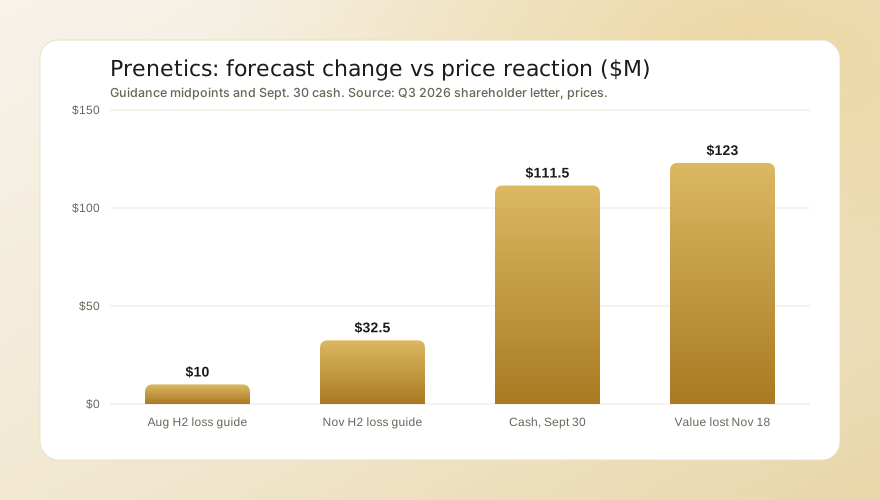
The chart puts the forecast change next to the price reaction. At the midpoints, the second-half loss forecast grew by $22.5 million. At 11:22am the shares had lost $7.03 each, about $123 million across 17.5 million shares, a little more than all the cash and current financial assets the company held at Sept. 30. Our piece on net cash per share covers how to read a stock trading this close to its cash. The cash pile is about $6.38 a share, or about $4.39 after the $34.7 million owed under the General Catalyst agreement.
Cash use is the question that matters for a company spending this hard. Net cash used in operating activities was $27.5 million in the third quarter, twice the second quarter's level, with an inventory build for the fourth quarter and the 2027 launches taking most of the difference. General Catalyst's $31.6 million of net fundings more than covered it, which is how the company reports positive adjusted free cash flow of $4.1 million. Our guide on estimating cash runway covers why that figure depends on the facility continuing to fund.
The bull case
The quarter's operating trends were good. Customer acquisition cost fell for the second straight quarter, to about $285, even as acquisition spending rose about 10%. September was IM8's largest month, with $23.7 million of revenue. The company says the 27,000 customers it acquired in the first quarter of 2025 have returned about 4.1 times their acquisition cost in gross profit, and that customers acquired at today's cost earn it back in about six months. General Catalyst studied that cohort data for months before committing up to $1 billion, and it finances 70% of qualifying acquisition spending, which leaves the company's own cash for inventory, products and clinical trials. Insiders own about 23% of the shares, and management has bought about $3.75 million in the open market since November 2025 with no sales. The full-year guidance implies fourth-quarter revenue of $73 million to $83 million, and a quarter at or above that range would show the extra spending turning into sales.
The risks
- A forecast that moved. The second-half loss range rose by three to four times in one quarter. Investors will discount the next forecast until one is met. Our guide on reading an earnings call transcript covers how to test management's claims against its own numbers.
- Unaudited unit economics. The cohort returns and payback period are management data. On General Catalyst's contractual 58% gross margin, cohorts through the first quarter of 2026 have returned $1.68 per dollar of acquisition spend so far.
- A senior claim on revenue. The facility is repaid from a capped share of revenue from the cohorts it funds, so a growing balance means a growing share of future sales goes to General Catalyst first.
- Warrants out of the money. About 2.36 million Class C warrants at $18.00 would bring in about $42.5 million if exercised. At $9.30 that cash is far out of reach, though the warrants also no longer weigh on the price as supply. Our explainer on short interest and days to cover covers why a 3.9% short float gives little support from short covering.
What comes next
- Black Friday and the holidays. The fourth quarter is IM8's seasonally strongest, and the company built inventory for it.
- Dec 31, 2026. Brian Rosin takes over as chief financial officer from Stephen Lo.
- First quarter of 2027. The IM8 Hydration launch, and fourth-quarter results against the $220 million to $230 million full-year guidance and the $30 million to $35 million second-half loss range.