

Oct 20, 2026: an 84% premarket spike, a fade, then a 26% gain
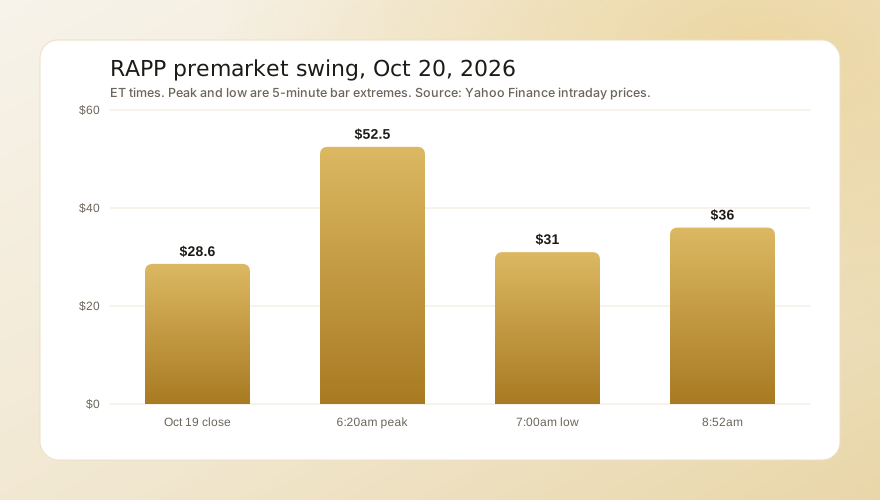
Rapport put out the results before the market opened and held a conference call at 8:00am ET. The stock last traded at $28.96 in after-hours trading on Oct 19. Its first premarket trade on Oct 20 came at $30.92 at 6:00am, and within 20 minutes buyers had pushed it to $52.50, up 84% and close to its 52-week high of $52.93. It did not hold. By the 7:00am bar the stock had dropped to $31.00, giving back almost the whole gain, before buyers came back. It reached $40.25 around 7:25am, slipped to $33.94 shortly before 8am and spent the hour after the call between about $34 and $37. At 8:52am it was $36.00, up 25.9%. The regular session opens at 9:30am.
What lifted it was the clean result: both goals met, overall side effects level with placebo and no serious adverse events, five days after UBS started coverage at Buy with a $71 target. What pulled it back from the peak was the size of the win. A p-value of 0.045 is a narrow pass, agitation and side-effect dropouts were higher on drug, and the $52.50 high was set within 20 minutes of the first trade, hours before most investors could act.
This was a company event, not a sector move. At 8:37am the SPDR S&P Biotech ETF (XBI) was down 0.5%, while epilepsy drug developer Xenon Pharmaceuticals (XENE) was up 2.1% at 8:34am and Neurocrine Biosciences (NBIX) up 0.3% at 7:45am. Rapport filed an 8-K with the SEC the same morning. For other big premarket gainers, see today's biggest stock moves.
Going into the news, RSI(14) stood at 30 and the shares closed 30% below their 50-day average and 20% below their 200-day average. At $36.00 the stock was 12% below its 50-day average, 1% above its 200-day average and 32% below its 52-week high, and about 1.9 million shares had traded before 9am, more than four times its 20-day average of about 0.4 million for a full day.
The results, in numbers
The trial enrolled 253 adults with bipolar I disorder in an acute manic episode at US sites. Patients received 0.75 mg of RAP-219 or placebo once a day for three weeks as inpatients.
| Measure | RAP-219 | Placebo | Difference |
|---|---|---|---|
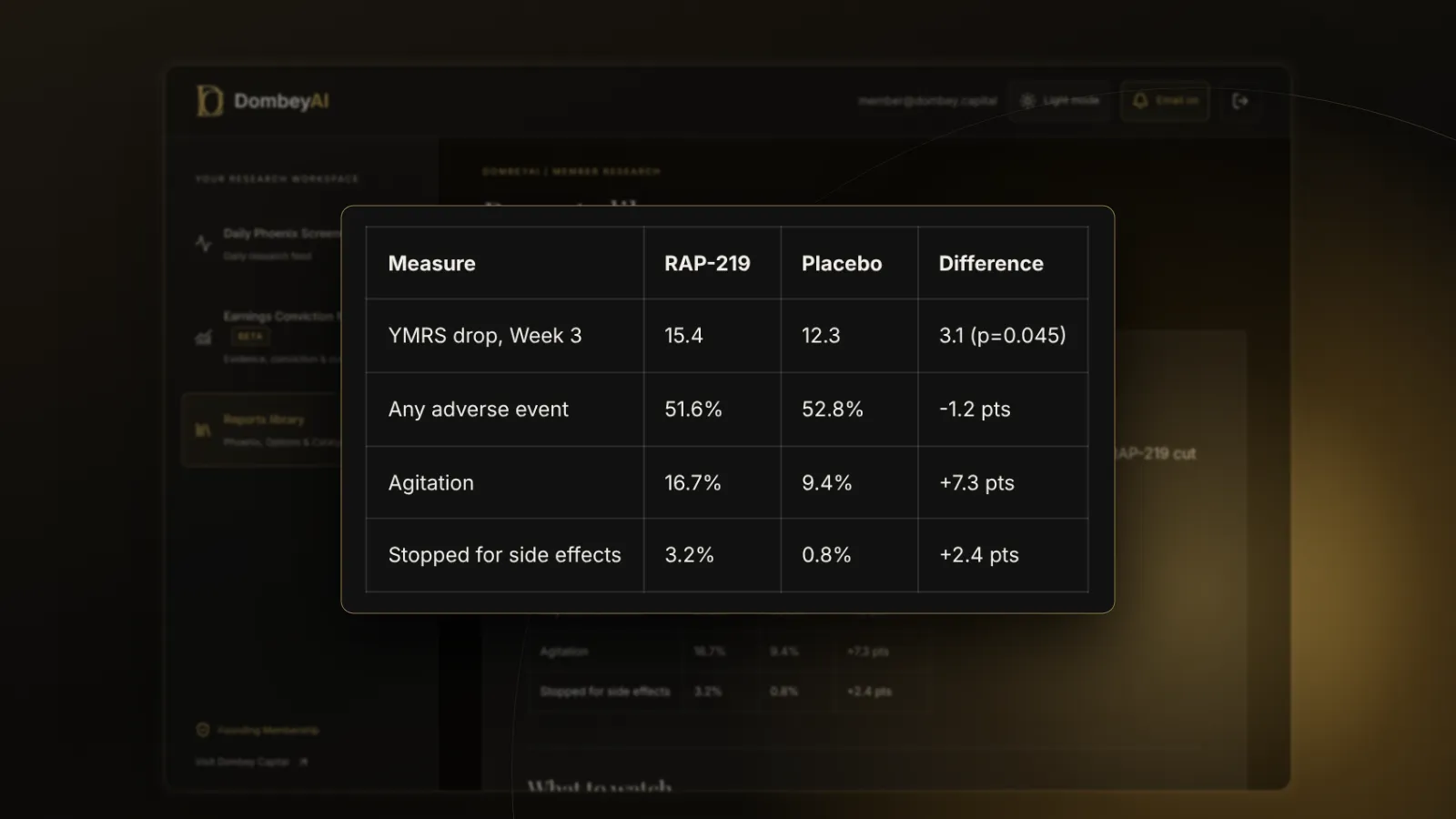
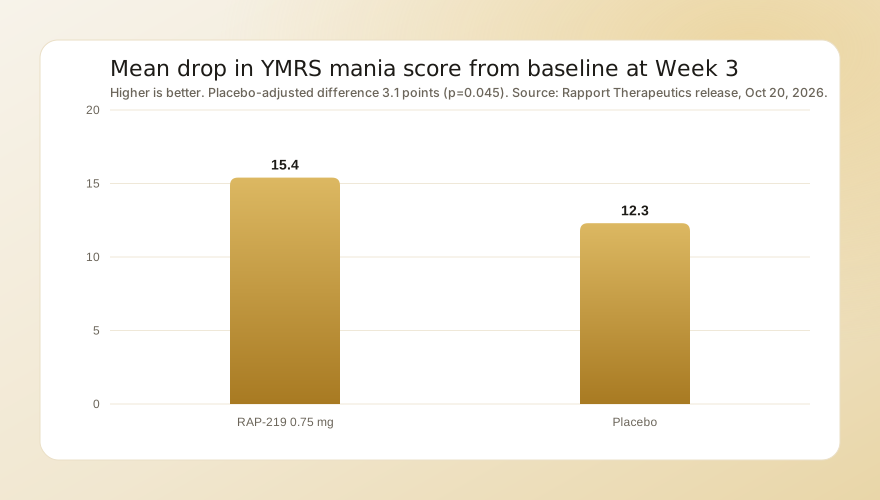
| YMRS drop from baseline, Week 3 | 15.4 points | 12.3 points | 3.1 points (p=0.045) |
| CGI-BP mania severity, Week 3 | 0.4 points (p=0.024) | ||
| Any adverse event | 51.6% | 52.8% | |
| Psychiatric adverse events | 34.9% | 33.1% | |
| Agitation | 16.7% | 9.4% | |
| Somnolence | 0.8% | 3.1% | |
| Stopped for side effects | 3.2% | 0.8% |
Three details matter beyond the headline:
- The gap widened each week. The placebo-adjusted improvement was 0.9 points at Week 1, 2.2 at Week 2 and 3.1 at Week 3. The drug was still pulling away at the last visit.
- Every item moved the right way. All 11 YMRS items improved numerically against placebo, and irritability, thought content, disruptive-aggressive behavior and sexual interest reached nominal significance.
- The side effects most patients quit over were absent. The company reported no serious adverse events, no orthostatic hypotension, no akathisia and no extrapyramidal symptoms, and somnolence was less common on drug than on placebo. Chief executive Abraham Ceesay framed the case this way in the release: "Side effects drive discontinuation, and discontinuation drives relapse."
Rapport will present eight-week post-treatment safety data at a future medical meeting, which will show whether symptoms returned after patients stopped the drug.
Why September matters
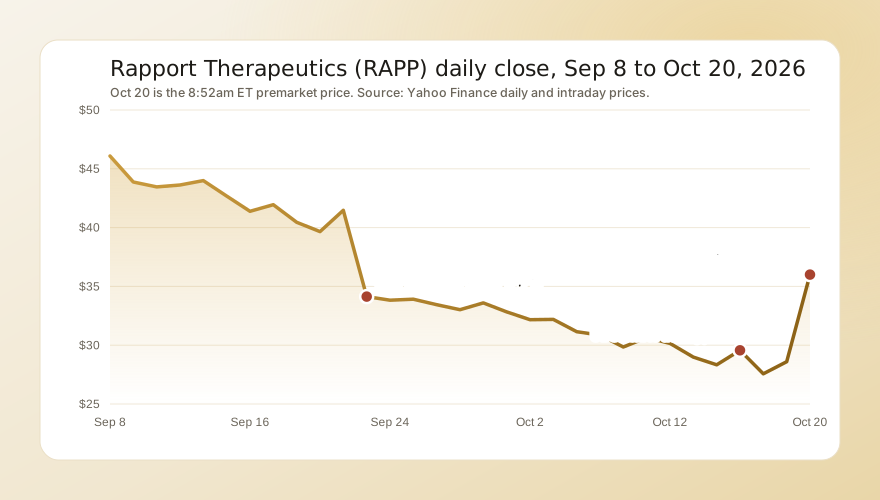
The data answered a question the company itself raised. On Sep 23, at an investor conference hosted by TD Cowen, the chief executive cautioned that some patients in the mania trial might experience worsening symptoms and said that would not be unexpected, GuruFocus reported. The stock fell 17.7% that day, to $34.13 from $41.47, and kept sliding to $27.57 on Oct 16, a 34% drop from the Sep 22 close.
The analysts did not follow the price down. Guggenheim started coverage at Buy with a $65 target on Oct 6, and UBS started at Buy with a $71 target on Oct 15, MarketScreener reported. The average target across covering analysts is $63.75, with a range of $50 to $75. For how traders size up a binary readout like this one before it lands, see our guide to probability-weighted valuation for binary events.
The bull case
- A second use for a drug already in Phase 3. RAP-219 is enrolling two pivotal trials, FOCUS 1 and FOCUS 2, in focal onset seizures, and a Phase 3 in primary generalized tonic-clonic seizures is due to start in the first half of 2027. Mania adds a second, large market for the same molecule.
- Tolerability as the edge. A mania pill that matches placebo on overall side effects and causes less drowsiness than placebo has a case to make to doctors, even with a modest effect.
- Cash that covers the next two years of trials. The $436.1 million at June 30 is expected to last past the Phase 3 seizure readouts. Net of that cash, the company carried an enterprise value of about $1.30 billion at the premarket price. Our guide to estimating cash runway shows how to test a claim like this one against quarterly spending, which was a $56.6 million net loss in the second quarter.
The risks
- A thin statistical margin. A p-value of 0.045 clears the usual 0.05 bar by a small amount. Phase 3 trials, larger and run at more sites, often show a smaller effect than Phase 2, and a 3.1-point gap leaves little room for shrinkage.
- More agitation on drug. Agitation was the most common side effect, at 16.7% against 9.4%, an awkward finding for a mania drug, and dropouts for side effects were four times the placebo rate, though both were low.
- A long wait for the next mania step. The FDA meeting is in the first quarter of 2027 and Phase 3 trials start in the second half.
- Possible share sales. Biotech companies often raise money after good data, and an offering would add dilution even with cash already in hand. Insiders have also been regular sellers, with Form 4 and Form 144 filings in September and October.
- No revenue. Rapport has no approved product, so its value rests on trials still to read out. Our explainer on how regulatory approvals work as catalysts covers the steps between here and a label.
What comes next
- Focal seizure open-label extension data, fourth quarter of 2026. These show whether the seizure reduction seen in the Phase 2a trial holds over time. This is the next dated catalyst and the end of our view window.
- Third-quarter results. The 10-Q will update cash, spending and any share sales since June.
- Eight-week post-treatment mania safety data, at a medical meeting not yet named.
- End-of-Phase 2 FDA meeting, first quarter of 2027, which sets the design and size of the two Phase 3 mania trials due to start in the second half of 2027.
For other biotech names moving on trial data, see the Disc Medicine Phase 3 result and more of today's biggest stock moves.