

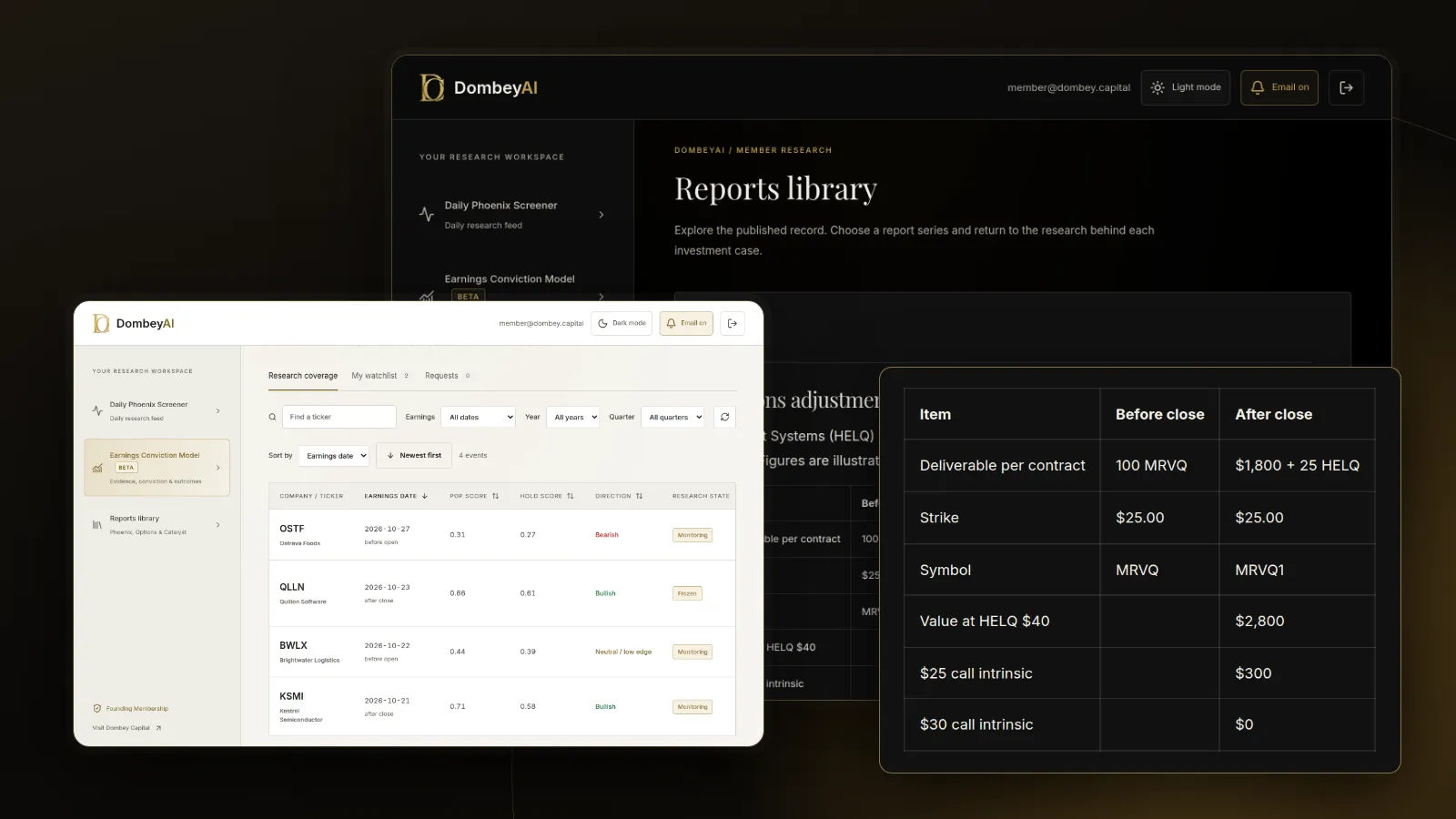
Who decides the adjustment
Standard US equity options are issued and cleared by OCC. Its by-laws give a committee the power to adjust contract terms after corporate events such as mergers, spin-offs, special dividends and reorganizations. The aim is to keep holders and writers in the same economic position they were in before the event, as far as possible.
For each deal, OCC publishes an information memo on its website. The memo states the effective date, the new deliverable per contract, any new option symbol, how fractional shares are handled, and the new expiration date if expirations are accelerated. The memo, not the original contract terms, governs the option after the close. OCC's options disclosure document, Characteristics and Risks of Standardized Options, sets out the general framework and is the document every options account holder is given.
Two points hold for nearly every merger adjustment:
- The strike price and the number of contracts usually do not change. OCC changes what one contract delivers.
- The adjustment takes effect when the deal closes. An announcement, a shareholder vote or a regulatory approval changes nothing in the contract terms.
If you are new to strikes, premiums and deliverables, start with how to read an option chain.
Cash deals: the contract becomes a fixed claim
In an all-cash acquisition, every target share is converted into a fixed dollar amount. After the close, a standard contract that delivered 100 shares now delivers 100 times the cash price. The stock no longer trades, so the option has no underlying left to move.
That has three consequences:
- Value is fixed at intrinsic value. A call is worth the cash price minus the strike, if positive. A put is worth the strike minus the cash price, if positive. Everything else is worth zero.
- Expiration is usually accelerated. Because a cash deliverable has no volatility, OCC generally moves the expiration of all series to a date shortly after the close. Long-dated options do not keep their remaining time value; they settle at the accelerated date.
- In-the-money options are generally exercised automatically. At expiration, OCC's exercise-by-exception procedure exercises options that are in the money by the threshold amount unless the holder instructs otherwise. Check with your broker how it handles accelerated expirations.
Out-of-the-money calls are the main casualty. A call with a strike above the deal price loses all its value at the close, even if it had months left to run. Anyone who paid time value for that call before the deal was announced, or after, loses it.
Stock deals: the option moves to the acquirer
In an all-stock deal, each target share is exchanged for a fixed number of acquirer shares. OCC changes the deliverable to match. If the exchange ratio is 0.8, a contract that delivered 100 target shares now delivers 80 acquirer shares. The total exercise price is unchanged: a $40 strike still means paying $4,000 per contract.
The option then keeps trading, usually under a new symbol that marks it as adjusted, and keeps its original expiration date. It is now, in effect, an option on the acquirer's stock with an unusual deliverable. Two things follow:
- Its value tracks the acquirer. The contract is worth the value of 80 acquirer shares minus $4,000, plus whatever time value remains.
- Liquidity often falls. Adjusted series are non-standard. Market makers quote them, but spreads are often wider and open interest stops growing, because new trading moves to the acquirer's standard options. The points in why wide spreads distort options signals apply here with extra force.
When the exchange ratio produces fractional shares, the memo states how they are handled, usually with a cash payment in place of the fraction. When the deal has a collar, so the ratio depends on the acquirer's price before closing, the deliverable is set from the final ratio at closing.
Mixed deals and elections
Many deals pay part cash and part stock. OCC adjusts the deliverable to the full package. If each target share receives $20 in cash and 0.5 acquirer shares, one contract delivers $2,000 plus 50 acquirer shares.
Some deals let shareholders elect cash or stock, subject to proration. Option holders cannot make that election. OCC generally sets the deliverable to what a shareholder who makes no election receives. If you want to choose, you have to exercise and hold the shares before the election deadline.
Deals that add a contingent value right raise a further step: the CVR can become part of the deliverable. How those rights are valued is covered in what a CVR is.
| Deal type | New deliverable per contract | Strike | Expiration | What sets the option's value |
|---|---|---|---|---|
| All cash | 100 x cash price | Unchanged | Usually accelerated to shortly after close | Cash price minus strike, fixed |
| All stock | Acquirer shares at the exchange ratio | Unchanged | Original date kept | Acquirer's share price and remaining time value |
| Cash and stock | Cash plus acquirer shares | Unchanged | Original date kept in most cases | Fixed cash part plus acquirer's share price |
| Cash or stock election | What a non-electing holder receives | Unchanged | Depends on the final mix | The default consideration, not the elected one |
| Tender offer only | No change until a merger completes the deal | Unchanged | Unchanged | Target stock, which trades near the offer |
Between announcement and close
From announcement to closing, nothing in the contract changes. The options still deliver target shares. What changes is how the stock behaves, and the options reprice around it.
In a cash deal the target usually trades at a spread below the offer price, the gap that merger arbitrage tries to capture. Implied volatility on the target typically collapses, because the stock is pinned near the offer as long as the deal looks safe. Calls with strikes well below the offer trade close to intrinsic value. Calls with strikes above the offer keep only a small value, which reflects the chance of a higher bid. Puts keep value roughly in line with the chance and cost of a break, which is why option prices are one way to read how much risk the market sees in a deal. The general mechanics are in what implied volatility is.
In a stock deal the target tends to trade in line with the acquirer times the exchange ratio, less a spread. Target options then behave more like acquirer options, with the spread layered on top.
Timing matters. If the deal closes after a given expiry, those options settle on the target stock as usual. If it closes before, they are adjusted. Deals often slip, so check the expected closing date against the expiries you hold. How to track a merger through approval covers the filings that move that date. For live examples of how far stocks can move on deal news, see today's biggest stock moves.
Worked examples
| Position | Strike | Value per contract after close |
|---|---|---|
| Call | $40 | $1,000 ($50 minus $40, x 100) |
| Call | $50 | $0 |
| Call | $55 | $0 |
| Put | $55 | $500 ($55 minus $50, x 100) |
| Put | $45 | $0 |
The $55 call holder who paid for a year of time value receives nothing. The $55 put holder, who might have expected to lose money once the stock jumped, keeps $5 a share because the cash price is fixed below the strike.
With Company D at $60, the 80 shares are worth $4,800, so the call has $800 of intrinsic value per contract. The breakeven on Company D is $50, which is $4,000 divided by 80. If Company D falls below $50 before expiry, the adjusted call finishes out of the money. Holders now carry risk tied to the acquirer's business, not the target's.
Where this goes wrong
Assuming time value survives a cash deal. Accelerated expiration removes it. A long-dated call bought as a cheap way to own a takeover candidate can be worth exactly its intrinsic value, or nothing, within days of the close.
Reading the wrong strike. In a stock deal, the strike on your screen is per original target share, while the deliverable is in acquirer shares. Divide the total exercise price by the new share count to get the real breakeven.
Missing the election. Option holders get the default consideration. If the cash or stock choice matters to you, you must hold shares before the deadline.
Forgetting about tender offers. Calls do not tender. To take part in a tender offer, you have to exercise in time to own the shares and tender them before the offer expires, which is at least 20 business days after it starts. The terms are covered in what a tender offer is.
Ignoring the chance of a break. If the deal fails, no adjustment happens and the stock usually falls back toward standalone value. Calls priced on the deal lose heavily. See what happens when a merger fails.
Getting assigned on a short call. Writers of deep in-the-money calls on a target can be assigned early, particularly before an ex-dividend date or a tender deadline, and lose the chance to receive the deal consideration on their own terms.
Trusting a summary instead of the memo. Broker platforms sometimes show adjusted series with confusing labels. The OCC information memo is the authority on what each contract now delivers.
Dombey's published research notes the dated deal milestones in the special situations it covers; see the research archive.
The bottom line
When a company is acquired, its options are adjusted to deliver what 100 shares receive in the deal, and the strike usually stays the same. In a cash deal that fixes each option at its intrinsic value and OCC usually accelerates expiration, so time value disappears. In a stock deal the options become options on the acquirer at the exchange ratio, and in a mixed deal they deliver the cash and stock package a non-electing holder receives. Nothing changes until closing, so read the OCC memo, check the expected closing date against your expiries, and price the chance that the deal breaks. This article is education, not a recommendation.