

Where the greeks come from
An option's price depends on the stock price, the strike, time to expiry, interest rates, dividends and volatility. A pricing model turns those inputs into a theoretical value. The greeks are the sensitivities of that value: how much it changes when one input moves a small amount.
Five of the inputs can be observed. Volatility cannot, so platforms solve for the implied volatility that makes the model match the market price, then calculate the greeks from it. That is why the greeks depend on implied volatility. If you are new to the number itself, start with what implied volatility is.
The greeks are quoted per share. A standard equity contract covers 100 shares, so a delta of 0.50 means about $50 of price change per contract for a $1 move in the stock.
Delta: exposure to the stock price
Delta is the estimated change in an option's premium for a $1 move in the stock, all else equal. The Options Industry Council gives the standard example: a call with a delta of 0.50 should gain about $0.50 if the stock rises $1 and lose about $0.50 if it falls $1.
For options you own, call deltas run from 0 to 1.00 and put deltas from 0 to -1.00. Sold options take the opposite sign, so a short put has positive delta and a short call has negative delta.
- At-the-money options sit near 0.50 for calls and -0.50 for puts.
- Deep in-the-money options move toward 1.00 or -1.00 and behave much like the stock.
- Far out-of-the-money options move toward 0 and react little to small moves.
Traders often read delta as a rough chance of the option finishing in the money. That shortcut is common, but it is an approximation, not a probability you can rely on. Delta is also how traders express a position in share terms: ten calls with a delta of 0.40 carry roughly the same price exposure as 400 shares, for now.
Gamma: how fast delta changes
Gamma is the estimated change in delta for a $1 move in the stock. If a call has a delta of 0.50 and a gamma of 0.06, a $1 rise should lift delta to about 0.56, and a $1 fall should cut it to about 0.44.
Long calls and long puts have positive gamma. Short options have negative gamma. Shares have none, because a share's delta is always 1.00.
Gamma is highest for at-the-money options and rises as expiration approaches. A near-dated at-the-money option can swing from a delta of 0.30 to 0.70 on a modest move. That is what makes short-dated options around an event feel unstable: the exposure itself changes quickly. For a seller, negative gamma means the position works against them faster the further the stock moves.
Theta: the cost of time
Theta is the estimated loss in premium per day from time passing, with everything else unchanged. A call with a theta of -0.05 should lose about $0.05 per share per day, or about $5 per contract.
Three points matter in practice:
- Decay is not linear. The OIC notes that time decay is gradual at first and speeds up as expiration nears. At expiry, an option is worth only its intrinsic value.
- Platforms count time differently. Pricing models account for weekends, but there is no industry-wide method. Some spread decay across calendar days and others across trading days, so the same option can show a different theta on two screens.
- Theta is a trade-off with gamma. Buyers pay theta for positive gamma, the benefit of large moves. Sellers collect theta and accept negative gamma.
Theta mostly erodes time value, the part of the premium above intrinsic value. Our guide on how to read an option chain shows how to split a quote into the two parts.
Vega: exposure to implied volatility
Vega is the estimated change in premium for a one percentage point change in implied volatility. An option with a vega of 0.10 should gain about $0.10 per share if implied volatility rises from 30% to 31% and lose about $0.10 if it falls to 29%.
Vega can move an option even when the stock does not. Longer-dated options usually have higher vega than near-dated ones, and at-the-money options have more than far out-of-the-money ones.
Vega is the greek that matters most around a scheduled catalyst. Before an earnings report, implied volatility on the nearest expiry often rises to price the possible jump. After the report, it falls back, and vega converts that fall into a loss for option holders. That is the mechanism behind IV crush after earnings. Vega can also differ by strike in the same expiry, which is where options skew comes in.
Quick reference: the main greeks
| Greek | Measures change in premium for | Long call | Long put | Largest for |
|---|---|---|---|---|
| Delta | A $1 move in the stock | 0 to 1.00 | 0 to -1.00 | Deep in-the-money options |
| Gamma | A $1 move, applied to delta | Positive | Positive | At-the-money, near-dated options |
| Theta | One day passing | Usually negative | Usually negative | At-the-money options close to expiry |
| Vega | A 1 point change in implied volatility | Positive | Positive | At-the-money, longer-dated options |
| Rho | A 1 point change in interest rates | Positive | Negative | Long-dated options |
Rho is the fifth greek most platforms show. For short-dated equity options it is usually small next to the other four.
A worked example: the greeks together
The next day, the stock rises to $51 and implied volatility falls from 40% to 35%. The greeks give a quick estimate of the new price:
| Driver | Calculation | Effect on premium |
|---|---|---|
| Delta | $1 move x 0.53 | +$0.53 |
| Gamma | Half of 0.07 x $1 x $1 | +$0.04 |
| Theta | One day passes | -$0.04 |
| Vega | 5 point drop x 0.06 | -$0.30 |
| Estimated new price | $2.37 + $0.23 | About $2.60 |
Repricing the call in the model gives about $2.62, close to the estimate. The small gap comes from the greeks themselves shifting as the inputs move.
Two lessons stand out. The stock moved 2% in the holder's favor, yet the volatility drop took back more than half of the gain from delta. Had implied volatility fallen 10 points instead of 5, vega alone would have cost about $0.60, more than the move added. This is why traders compare the move they expect with the move already priced, often by pricing the at-the-money straddle. Our guide on estimating an earnings move from options walks through that step.
How the greeks shift around a catalyst
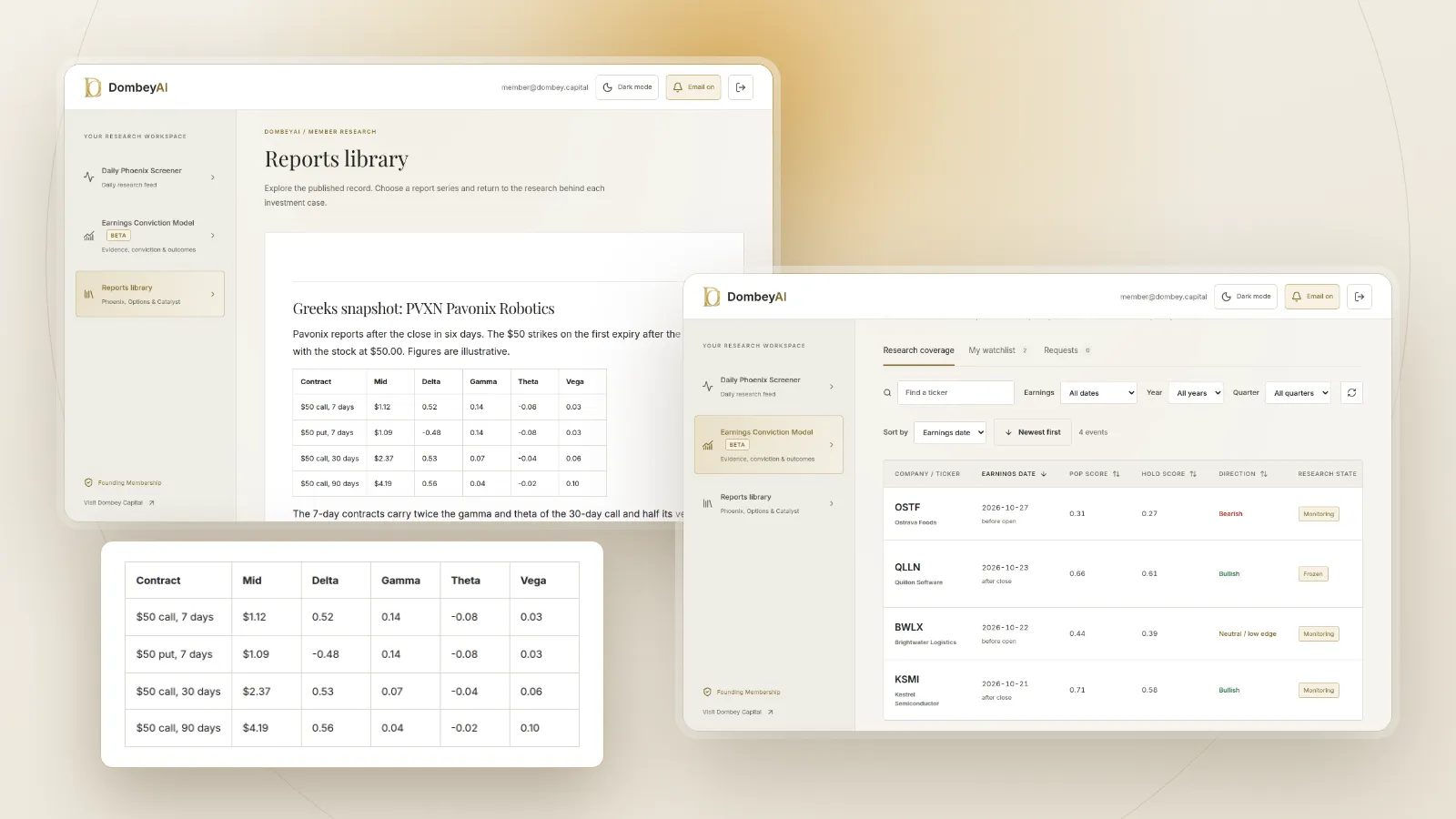
The same option can have a very different profile a week before an event and a day after it. In the model above, cutting time to expiry from 30 days to 7 roughly doubles gamma and theta and halves vega for the at-the-money call. Near-dated options become more sensitive to the stock and to the clock, and less sensitive to a change in volatility per point. The volatility change after an event, though, can be many points at once.
- If you hold a near-dated option into earnings, delta and gamma decide how much a large move helps, and vega decides how much the volatility drop takes away.
- If you sell options into an event, theta and the fall in implied volatility work in your favor, but negative gamma means a large gap can cost many times the premium collected.
- If you write calls against shares you own, delta shows how much upside you have given away, as our explainer on covered calls around catalysts covers.
- If a cash takeover is announced, implied volatility often collapses toward the deal terms and the greeks change with it; see what happens to options when a company is acquired.
Dombey's weekly Options Research looks at these exposures around dated catalysts; see the research archive.
Where this goes wrong
Treating the greeks as fixed. Every greek changes when the stock, time or implied volatility moves. The estimate from today's delta is only good for small moves over short periods.
Adding up greeks across different stocks. A portfolio delta that mixes a $10 stock and a $300 stock in share terms says little about dollar risk. Convert to dollar exposure before you combine positions.
Trusting greeks on thin contracts. On a contract with a wide bid-ask spread, the mid price is a guess, and so are the implied volatility and greeks built on it. Our explainer on options liquidity and wide spreads covers how to judge a quote.
Ignoring jumps. The greeks describe small, smooth changes. A stock that gaps 20% on a ruling or a deal break moves far outside the range where they are reliable.
Forgetting the model's assumptions. Dividends, early exercise, interest rates and the day-count method all change the output. Adjusted contracts after a corporate action can deliver something other than 100 shares, so check the terms before reading their greeks.
Reading the greeks as a forecast. They describe exposure, not direction. Delta tells you how much you gain or lose per dollar, not which way the stock will go. To see how far stocks actually moved on recent news, browse today's biggest stock moves.
The bottom line
The option greeks estimate how an option's price will respond to one change at a time: delta to the stock, gamma to delta itself, theta to the passing of a day and vega to implied volatility. They are model outputs that move with the market and vary between platforms, so read them as estimates. Around a dated catalyst, the balance between delta and gamma on one side and theta and vega on the other decides whether a position gains or loses. Options carry substantial risk, and this article is education, not a recommendation.