

Oct 16, 2026: a gap up at the open, then a slow fade
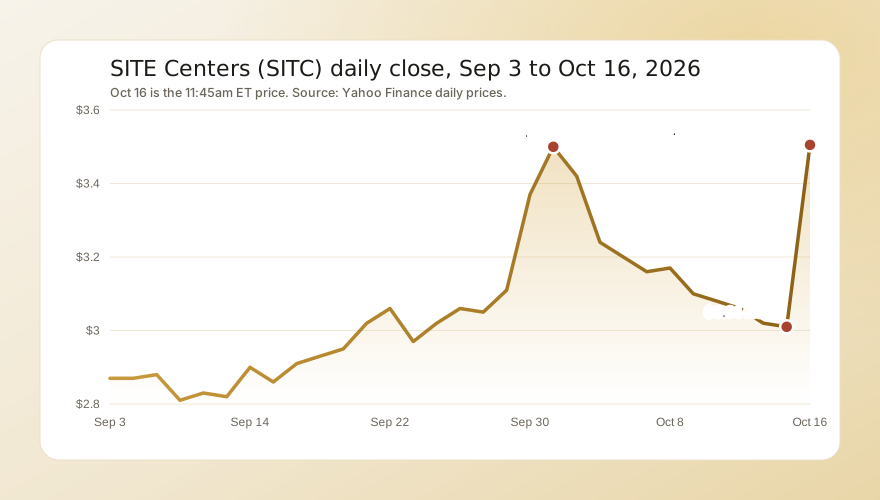
The news came after the close on Oct 15. Investing.com reported the shares rose as much as 20% in after-hours trading. Before the open on Oct 16, Yahoo Finance data show the stock trading mostly between $3.50 and $3.58, about 16% to 19% above the $3.01 close.
The stock opened at $3.59 and reached the day's high of $3.645 shortly after 10am. It then drifted lower, touched $3.45 around 11:20am, and recovered to $3.505 by 11:45am. Volume reached about 4.8 million shares by late morning, against an average of 1.15 million per FinViz.
What pushed it up:
- A payout nearly equal to the share price. The board declared $3.00 per common share, payable Nov 5 to holders of record on Oct 27.
- The last big uncertainty cleared. The company had been holding extra cash until its Dividend Trust Portfolio stake was resolved. That stake is now sold.
What held it back from rising further:
- The NYSE exit. The company said it plans to delist before trading opens on Dec 4 and has not arranged a listing on another exchange or a quotation venue.
Shopping center peers barely moved. At about the same time, Kimco was up 1.3%, Brixmor 1.1%, Regency 0.9% and Curbline Properties was flat, while the Real Estate Select Sector SPDR ETF (XLRE) was up 0.9%, per Yahoo Finance. The gap is company news, not the sector.
After the jump, RSI stood at 66, the shares sat 15.5% above their 50-day average and 27% below their 200-day average, and volume ran 3.0 times its 20-day average, per Yahoo Finance daily prices; the shares were 61% below their 52-week high of $8.95. Those prices are not adjusted for earlier special distributions, such as the $1.00 paid on July 31, so the longer comparisons overstate the decline.
What the $3.00 means against the share price
The payout is close to the whole value of the stock, and the math matters.
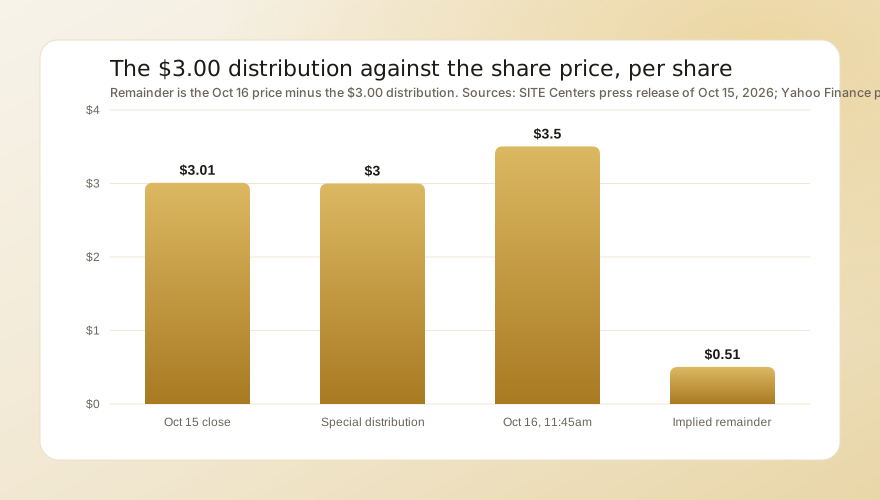
- Before the news, the stock closed at $3.01 on Oct 15. It was just above $3, so the market was pricing the whole company at about what the board has now declared in cash.
- At $3.505, a holder on the Oct 27 record date, or a new holder who takes the due bill, receives $3.00 on Nov 5. The other $0.505 is the market price of what is left: the remaining properties, the cash after the payout, and any later distributions, less wind-down costs.
- On Nov 6, the ex-dividend date, the shares should open roughly $3.00 lower. The last payout shows the pattern. After the $1.00 special dividend paid on July 31, the stock closed at $3.31 on Aug 3, the first trading day without it, down $0.97 from $4.28.
Because the payout is more than 25% of the share price, the NYSE told the company the shares will trade with due bills from the Oct 27 record date through the close on Nov 5. Anyone who parts with shares in that window gives up the $3.00 to the new holder. That is why the ex-dividend date falls after the payment date, not before the record date. Our guide to special dividends and their price effects covers how the drop on the ex-date works.
The cash, in numbers
The filings let us estimate what is left after the payout. This is our arithmetic, not a company figure.
| Item | Amount | Source |
|---|---|---|
| Unrestricted cash, June 30 | $238.9 million | 10-Q |
| Less $1.00 dividend paid July 31 | $52.7 million | 10-Q dividends payable |
| Plus July sales, Meadowmont Market and land | $11.1 million net | Q2 release |
| Plus Shoppes at Paradise Pointe | $8.4 million gross | Q2 release |
| Plus The Maxwell | $13.9 million net | Oct 1 release |
| Plus Dividend Trust Portfolio stake | $32.4 million net | Oct 15 release |
| Less $3.00 on 52,475,339 shares | $157.4 million | Oct 15 release, 10-Q share count |
That leaves about $95 million, or roughly $1.80 a share, before operating losses since June 30, $20.9 million of accounts payable and other liabilities and $9.4 million owed to Curbline at June 30, and the wind-down costs the company says will be significant. Even after those two liability lines, the figure is near $1.20 a share, more than twice the $0.50 the market implies. Any remaining properties would add to that, and the company has not put a value on them. For how to treat a figure like this, see net cash per share.
The $32.4 million was set months ago. On June 29 the company sent its joint venture partner a notice under the joint venture agreement that required the partner, by Aug 31, either to purchase SITE Centers' 20% stake for about $32.4 million or to hand over its own 80% for about $129.6 million, with a closing due by Oct 15. The Oct 15 sale for about $32.4 million matches the first option, and it closed on the deadline date. Our explainer on asset sales as catalysts covers why a sale like this can reset a stock.
What delisting means for holders
The company said it will notify the NYSE of a voluntary delisting because it expects the payout to push the share price and market value toward levels that would trigger an involuntary one. Its 10-Q sets out those levels: an average close below $1.00, or an average market value below $15 million, over 30 consecutive trading days. At about $0.50 after the payout, the price would be well under $1.00, and the market value would be about $26 million at that price.
- No exchange quote after Dec 4. The company expects delisting before trading opens on Dec 4, 2026, and has not arranged a listing on another national exchange or a quotation venue under Rule 15c2-11.
- Harder to trade. The 10-Q warns that once delisted, "shareholders may have difficulty trading their common shares on the secondary market."
- The claim stays. Delisting does not cancel the shares. Holders keep their claim on any later distributions from the wind-down.
Our guide to what a delisting means for shareholders covers the steps in more detail.
The case for the remainder
- Cash after the payout appears to exceed the price. By our arithmetic above, cash net of the reported liabilities is near $1.20 a share against a $0.50 implied remainder.
- The company has no debt. The 10-Q says it had no outstanding indebtedness at June 30, 2026.
- It keeps returning cash. It paid $1.00 on July 31 and declared $3.00 now, and the 10-Q says it expects to make distributions from future sales.
- The market is skeptical. FinViz shows short interest at 13.35% of the float and the stock at 0.65 times book value.
The risks
- Wind-down costs are open-ended. The 10-Q lists severance, bonuses on completion of the sales process, office lease exits, professional fees and a reserve for known and unknown claims.
- Legal expense. Environmental and tenant litigation cost $1.0 million in the second quarter, up from $0.4 million a year earlier.
- Liquidity after Dec 4. With no quote venue arranged, the price a holder can get may sit well below the value of the remaining assets. That gap is common in a liquidation play.
- Operating losses. Second-quarter Operating FFO was a loss of $4.6 million, and the leased rate fell to 82.5% at June 30 from 87.8% at the end of 2025 as properties were sold.
What comes next
- Oct 27: record date. Due bill trading begins.
- Nov 5: payment. The $3.00 is paid and the due bill period ends at the close.
- Nov 6: ex-dividend date. The first price of the remainder on its own. A price near $0.50 would confirm today's math.
- Third-quarter results, date not yet announced. The first balance sheet with the joint venture sold and the payout declared, and the clearest test of the cash estimate above.
- Dec 4: expected delisting. Watch for any word on a quotation venue and on whether the company keeps filing SEC reports.