

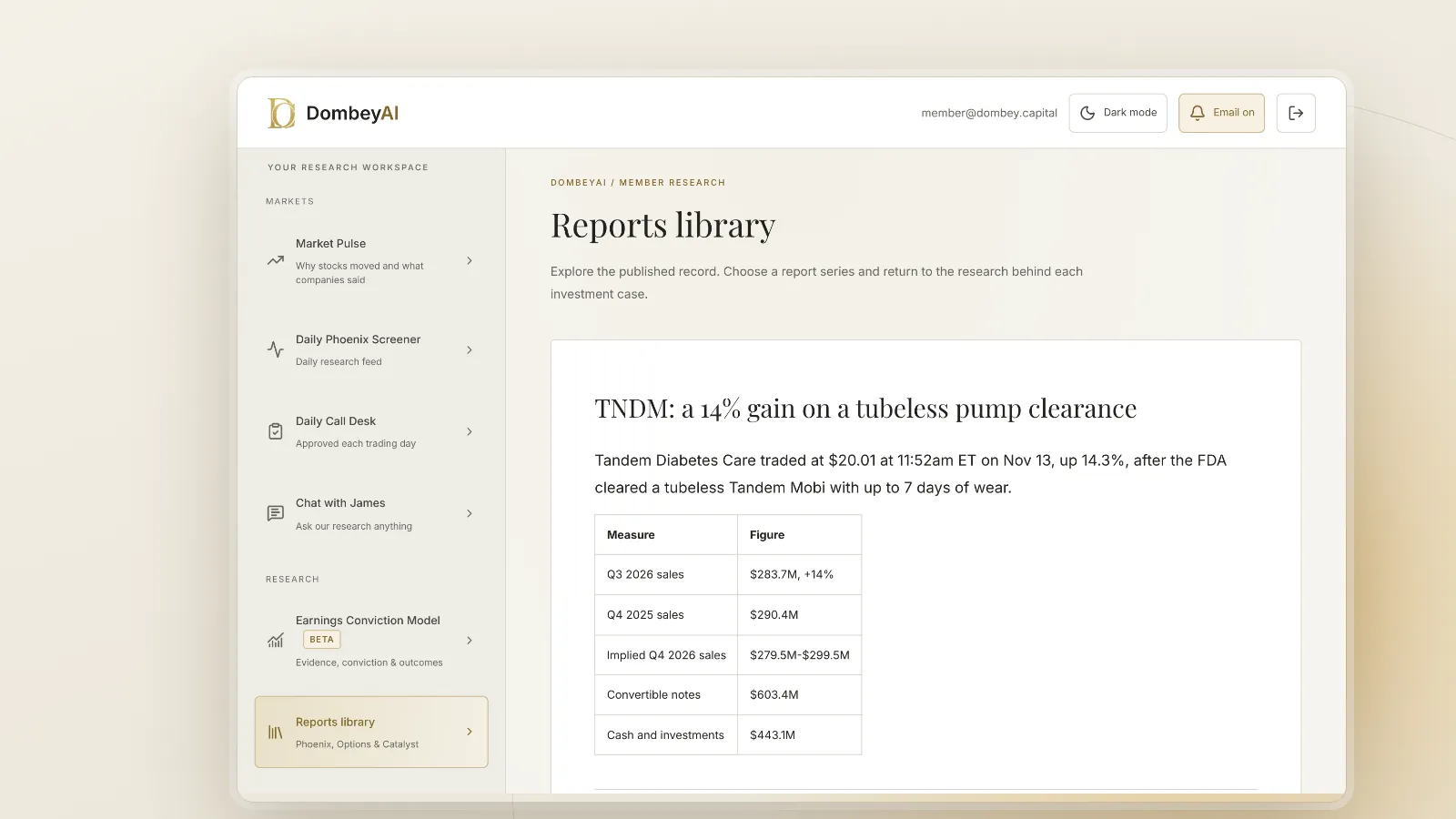
Nov 13, 2026: a 14% gain on a tubeless pump clearance
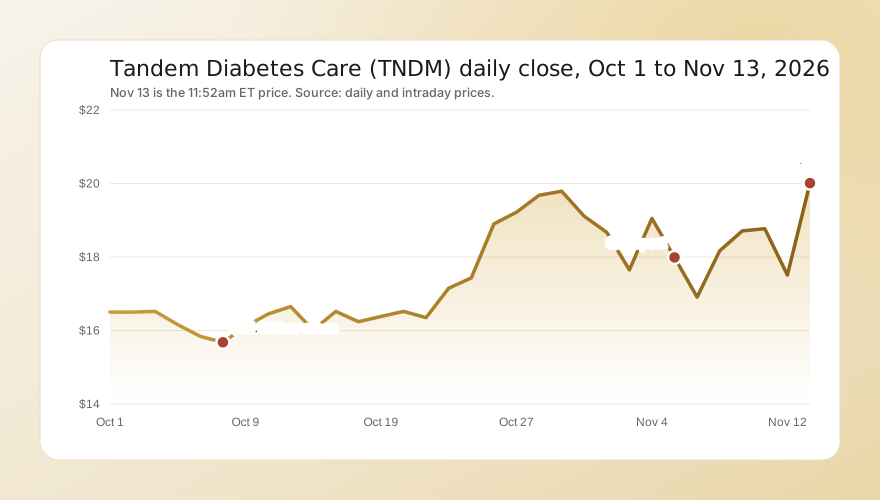
Tandem closed Nov 12 at $17.51. The FDA granted the clearance on Nov 12, and the company announced it at 8:30am on Nov 13 and filed an 8-K. Premarket trading, which stood at $17.70 at 8:30am, reached $20.00 by 8:35am. The stock opened at $19.00, set its session low of $18.53 in the first five minutes, and climbed through the morning to $20.12 at 11:45am. At 11:52am it was $20.01, up 14.3%.
What pushed it up:
- A tubeless option. A new tubeless cartridge and infusion set turn the existing Tandem Mobi pump into a tubeless device, with Control-IQ+ automated insulin delivery.
- Longer wear. The infusion set is cleared for up to seven days of wear, which means fewer site changes. The cartridge is cleared for three days of use, so users still refill or swap it more often than they move the site.
- A choice of mode. The pump is cleared for both tubeless and tubed use, which the company says makes it "the only pump that offers users the flexibility to choose the wear option."
What the filing did not include: pricing, reimbursement or any change to guidance. Our explainer on FDA decision dates covers how a device clearance differs from a drug approval as a catalyst.
The rest of diabetes devices moved little. At 11:52am:
| Stock or fund | Change from Nov 12 close |
|---|---|
| Tandem Diabetes Care (TNDM) | +14.3% |
| Insulet (PODD) | +1.2% |
| iShares U.S. Medical Devices ETF (IHI) | +1.0% |
| Dexcom (DXCM) | +0.9% |
Insulet, which sells the Omnipod tubeless pump, rose 1.2%. Our page on why Dexcom stock fell covers the sensor maker whose devices work with insulin pumps, and the rest of the session's movers are in today's biggest stock moves.
After the gain, RSI(14) stood at 60, the shares sat 15% above their 50-day average and 6% above their 200-day average, volume of 1.7 million shares by midday was 0.7 times the 20-day average, and the stock was 33% below its 52-week high of $29.65.
The numbers
Third-quarter results came on Nov 5:
| Measure | Q3 2025 | Q3 2026 |
|---|---|---|
| Worldwide sales | $249.3M | $283.7M |
| U.S. sales | $175.6M | $191.0M |
| International sales | $73.6M | $92.6M |
| Gross margin | 54% | 57% |
| Operating loss | ($22.9M) | ($2.4M) |
| Net loss | ($21.2M) | ($7.1M) |
| Adjusted EBITDA | $2.8M | $18.0M |
The company shipped about 33,000 pumps worldwide, nearly 23,000 of them in the U.S. Pharmacy sales made up 15% of U.S. sales, and pharmacy coverage reached about 50% of U.S. lives. Our guide on how to read an earnings release covers where the reaffirmed guide sits in a report like this one.
The bull case
Tandem is now close to breaking even. The operating loss fell to $2.4 million from $22.9 million, gross margin rose to 57%, and adjusted EBITDA reached 6% of sales. A pump that works with or without tubing could win users who want a tubeless pump without giving up the option of tubing, and longer wear means fewer supplies to buy and change. International sales are growing faster than U.S. sales. At about 1.9 times sales on enterprise value, the stock is not expensive if the tubeless launch lifts U.S. growth in 2027. The consensus price target of $23.19 is about 16% above the midday price.
The risks
- Timing. The launch is planned for the first half of 2027, so the fourth quarter and probably the first quarter of 2027 carry no tubeless sales.
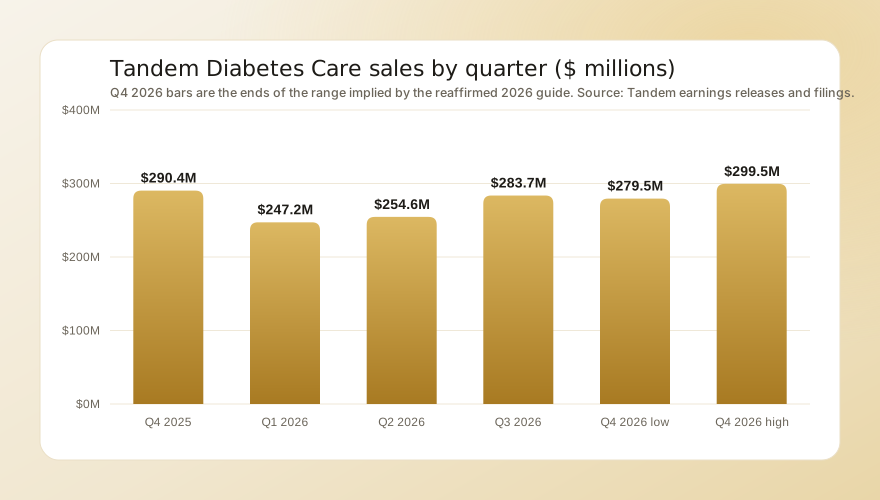
- A flat fourth quarter. The reaffirmed guide implies fourth-quarter sales of $279.5 million to $299.5 million against $290.4 million a year earlier.
- Debt. Convertible notes of $603.4 million exceed cash and short-term investments of $443.1 million. Our explainer on the debt maturity wall covers how to read that kind of balance sheet.
- Competition. Insulet's Omnipod is already sold as a tubeless pump, and U.S. sales growth of 9% trails international growth of 26%.
What comes next
- Fourth-quarter results, estimated for February 18, 2027. Watch sales against the implied $279.5 million to $299.5 million and the first 2027 guide.
- Launch details. Pricing, reimbursement and a firm launch date for the tubeless Mobi.
- Pharmacy coverage. Growth past 50% of U.S. lives would widen access to the pay-as-you-go model.