

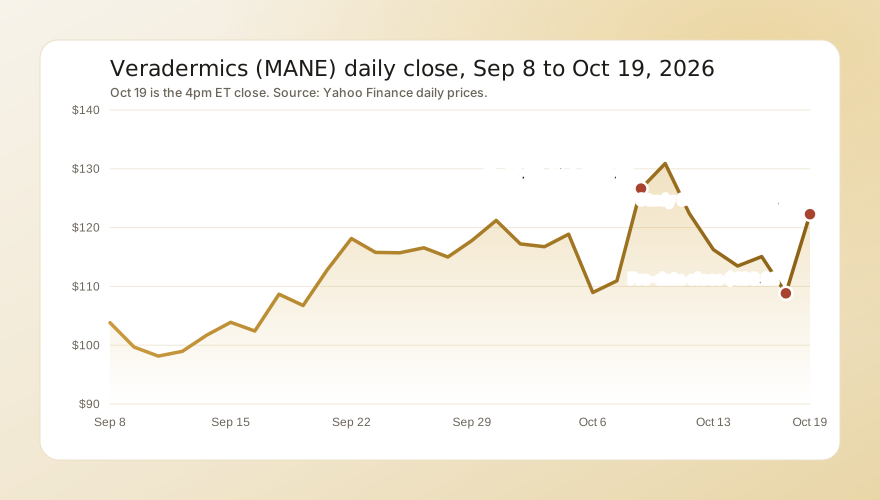
Oct 19, 2026: a premarket dip, then a steady climb to the close
The first premarket trade at 4:05am was $114.00. The company put out its press release at 7am, and the stock briefly traded as low as $104.11 in the 7am minutes before buyers stepped in. During the 8am conference call it climbed to $120.00, and the last premarket trade was $117.00. The 8-K with the release and the call slides was accepted by the SEC at 9:06am.
The shares opened at $115.34, 6.0% above Friday's close, and set their low of $113.55 in the first half hour. They then rose through the day to a high of $123.93 at about 3:35pm and closed at $122.28 on 1.46 million shares.
What pushed it up:
- Every endpoint hit, again. Both co-primary endpoints and all 17 secondary endpoints separated from placebo, MarketBeat reported from the call, and the p-values on the main measures were below 0.0001.
- Fast onset. The pill separated from placebo on hair count, patient ratings and investigator ratings at month 2, the earliest check.
- A clean heart readout. The company reported no cardiac adverse events of special interest and, per MarketBeat, no clinically meaningful changes in heart rate, blood pressure or ECGs. TIKR noted that more than half the men in Study 304 had high blood pressure going in.
The move was company news, not a sector rally. At the close:
| Stock or fund | Change |
|---|---|
| Veradermics (MANE) | +12.4% |
| Absci (ABSI) | +3.5% |
| Journey Medical (DERM) | +4.1% |
| SPDR S&P Biotech ETF (XBI) | +2.5% |
| iShares Biotechnology ETF (IBB) | +1.0% |
After the move, RSI(14) stood at 56, the shares sat 11.8% above their 50-day average (the stock has traded for under 200 sessions since its February IPO, so there is no 200-day figure), volume ran 1.6 times its 20-day average, and the price was 10.6% below the 52-week high of $136.72 set intraday on Oct 8. The stock rose 14.1% to $126.63 that day, then fell back to $108.82 by Friday. More of today's biggest stock moves are on our market page.
The results, in numbers
Study 304 enrolled 536 men at 45 U.S. sites that did not overlap with Study 302. They took VDPHL01 8.5 mg once daily, 8.5 mg twice daily, or placebo for six months. From the company's release:
| Measure at month 6 | Once daily | Twice daily | Placebo |
|---|---|---|---|
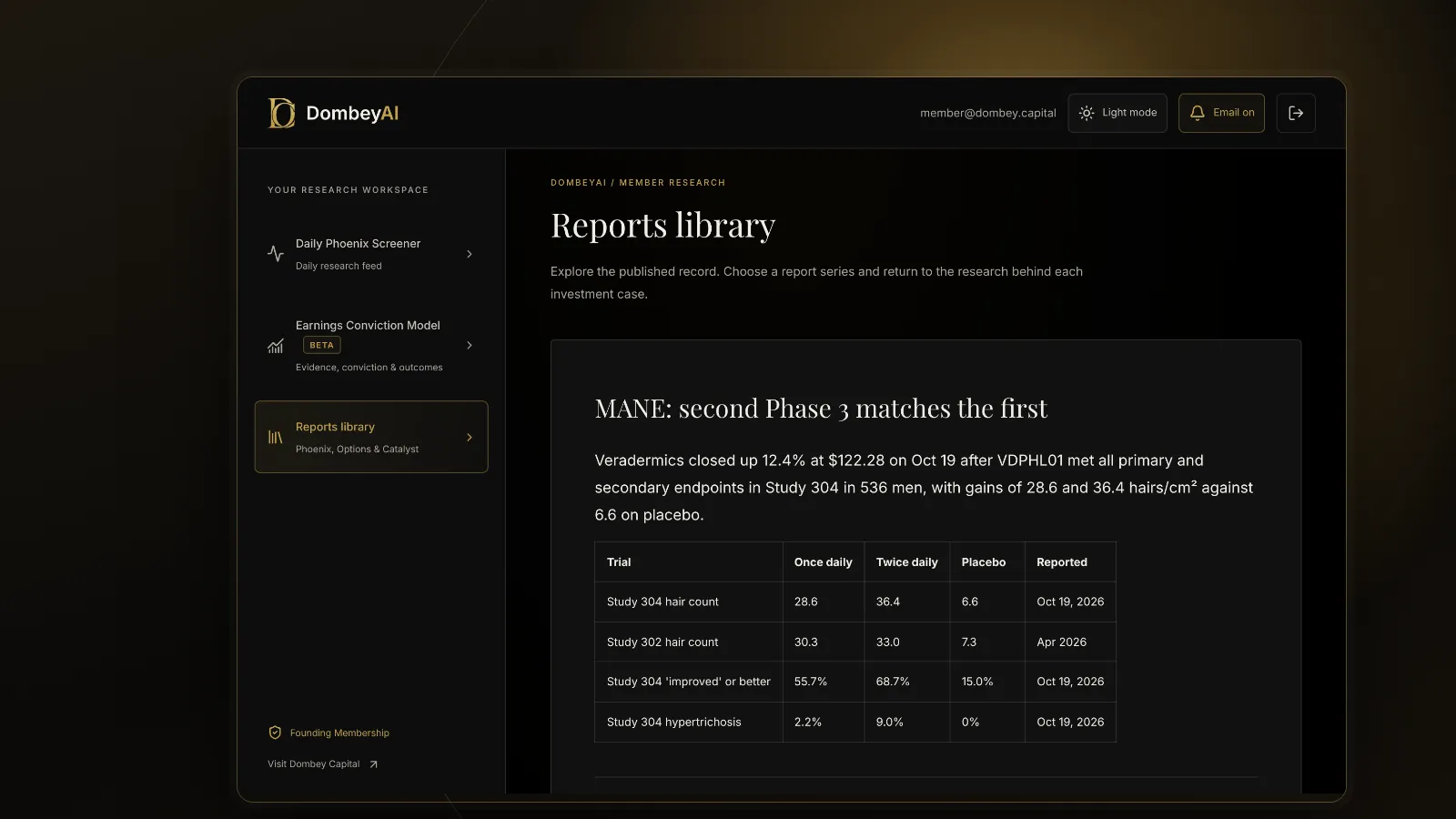
| Gain in non-vellus hair count (hairs/cm²) | 28.6 | 36.4 | 6.6 |
| Rated hair "improved" or "much improved" | 55.7% | 68.7% | 15.0% |
| Reported any improvement in coverage | 78.8% | 85.0% | 35.3% |
| Investigator saw improved coverage | 78.4% | 82.7% | n/a |
CEO Reid Waldman said the twice-daily gain was the largest six-month change reported in a placebo-controlled pattern hair loss study. An independent review of frontal scalp photos counted more than a third of once-daily patients and nearly half of twice-daily patients as responders, against 5% on placebo, MarketBeat reported.
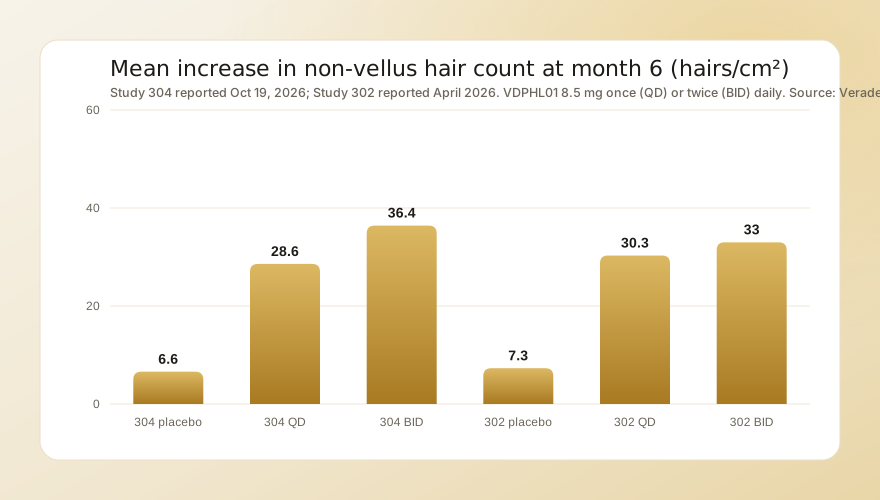
The chart shows why the market cared. One positive trial can be luck. Two that land this close together are harder to argue with, and Cantor Fitzgerald analyst Prakhar Agrawal called the new data "directionally better" than Study 302, BioPharma Dive reported.
The safety picture
| Side effect in Study 304 | Once daily | Twice daily | Placebo |
|---|---|---|---|
| Peripheral edema | 2.8% | 4.5% | 0.6% |
| Edema leading to discontinuation | 0% | 0.6% | 0% |
| Hypertrichosis | 2.2% | 9.0% | 0% |
| Hypertrichosis leading to discontinuation | 0% | 0.6% | 0% |
Across both trials, five of more than 700 treated patients stopped because of edema and one because of hypertrichosis, Waldman said on the call. These are the known side effects of minoxidil. The question for regulators and doctors is whether they stay this low over a full year.
The bull case
- The efficacy question looks settled. Two trials, two doses each, all endpoints met. Our explainer on regulatory approvals as catalysts covers why replication matters to the FDA.
- Cash. $819.9 million at June 30 against a second-quarter net loss of $23.5 million. Cash per share is $19.62. Our guide on estimating cash runway shows how to check the company's into-2030 estimate.
- Doctors sound willing. In a company survey of 198 dermatologists and primary care providers, nearly 90% rated the drug as positively differentiated and about two-thirds said they would use it first line if approved.
- Room to the targets. The average analyst target is $164.83, 34.8% above the close.
- Short sellers. 4.24 million shares, 14.2% of the float, were sold short, about 5.5 days of normal volume. Our explainer on short interest and squeeze risk covers why that matters after good news.
The risks
- Cheap generics. Agrawal wrote that some investors doubt the sales potential given how easy it is to get inexpensive generic minoxidil. Veradermics has to persuade doctors and patients its version is worth a premium price.
- Twelve-month safety. The six-month data are clean, but the Study 302 extension is the first look at a full year on the drug.
- The valuation already counts on approval. At $5.11 billion, the company trades at 6.27 times book value with no sales. A setback would hit a stock priced for success. Our framework for probability-weighted valuation of binary events is one way to weigh that.
- A share sale. The company raised money right after the Study 302 data in the spring, and TIKR's author wrote that he would not be surprised to see it happen again. A sale would add dilution.
- Timing of the filing. Management has not said whether it will file for men now or wait to file for men and women together after the 2027 women's data.
What comes next
- Twelve-month data from Study 302 Part B, expected by the end of 2026. Watch the cardiac events, edema and dropouts.
- The filing decision. A plan to file for men first would bring an FDA decision date sooner. Our page on how FDA decision dates work covers the review clock.
- Study 306 in 556 women, with topline data due in the first half of 2027.
- Any share offering, which would appear first as a prospectus filing. For another biotech that moved on Phase 3 data today, see our note on Disc Medicine.