

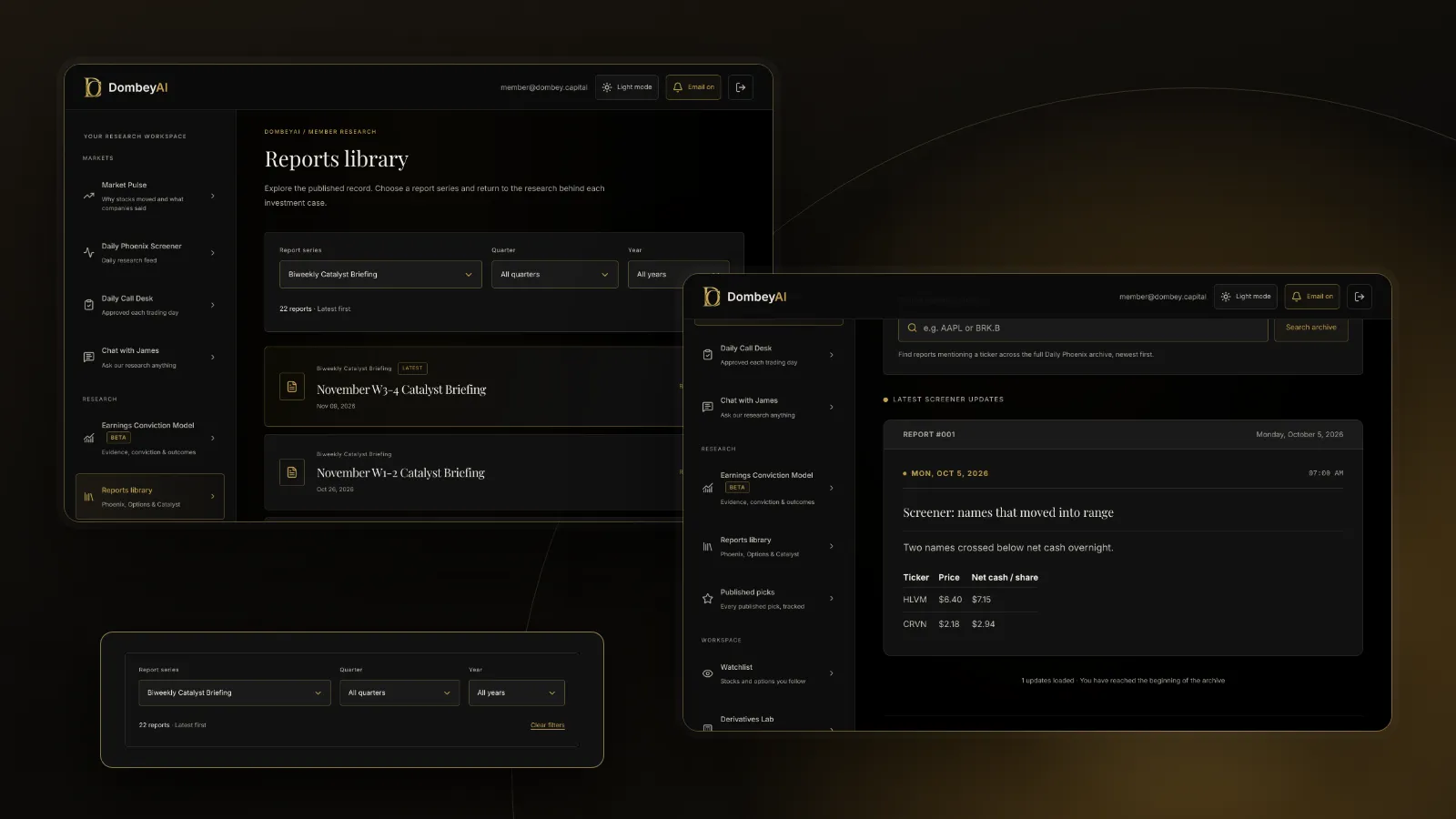

Full disclosure: Dombey Capital is our own research service and our top pick here, for the reasons below. The section on where it falls short is there so you can judge whether it fits your process.
What a biotech investor needs from a newsletter
Biotech stocks move on dated events: trial readouts, FDA decisions, advisory committee meetings, financings and deals. A newsletter is useful if it does one of three jobs well:
- News. What happened today across trials, approvals, deals and financings.
- Analysis. Why it matters, from someone who understands the science, the regulation and the money.
- Catalyst research. What a coming event means for a specific stock, with a view that can be checked later.
Few publications do all three. Most of the newsletters below are industry news and analysis read by people who work in biotech. Investors use them to follow companies and then do their own valuation. A catalyst calendar covers the dates; our list of the best FDA calendars and biotech catalyst trackers compares those tools.
Quick comparison
| Newsletter | Best for | Key features | Price (as of November 2026) |
|---|---|---|---|
| Dombey CapitalTop pick | Biotech catalysts within special situations research | Weekly Phoenix Report, Catalyst Briefing, DombeyAI Portal, dated public archive | Founding Membership $1,200/yr; Standard Access $80/yr or $8/mo; Public Archive free |
| STAT+ | In-depth paid reporting on biotech and pharma | Subscriber reporting and analysis, Biotech Scorecard newsletter, free newsletters such as The Readout | $39/mo or $399/yr; free newsletters |
| Timmerman Report | Weekly analysis from one writer | Weekly Frontpoints column, in-depth reports, no ads | $199/yr; $65 for 3 months; $25 a month |
| BioCentury | Institutional analysis and data | Analysis, curated database, events, workspace | Through trial and demo |
| BioPharma Dive | Free daily industry news | Daily Dive weekdays, Emerging Biotech Weekly, Gene Therapy Weekly, Commercialization Weekly | Free |
| BioSpace | Industry news with a careers focus | GenePool flagship newsletter, news, jobs and layoff tracking | See the vendor's site |
| Evaluate | Market reports and forecasts | Monthly Evaluate Discovery newsletter, reports | Free registration |
| FDA email updates | Primary-source agency news | Topic-based email alerts from the FDA | Free |
How we compared these newsletters
We compared them from vendor documentation, pricing pages and public product pages, weighting the criteria that matter most for investors following dated catalysts.
| Criterion | Weight | What it measures |
|---|---|---|
| Fit for investors and catalysts | 30% | Whether the content helps judge what an event means for a stock |
| Depth of analysis | 25% | Explanation of science, regulation and economics, beyond the headline |
| Price transparency and value | 20% | Whether a price is published and what it buys |
| Frequency and timeliness | 15% | How often it arrives and how quickly it covers news |
| Link to primary sources | 10% | Whether it leads you to the filing, data or FDA document |
If you weight daily news coverage above catalyst fit, STAT and BioPharma Dive move ahead of Dombey, which covers fewer companies in more depth.
Quick picks by job
Best for biotech catalysts within special situations: Dombey Capital
Dombey publishes dated research on situations where an event can reset a stock's value, including biotech readouts and decisions, cash-rich biotechs and deals. Each thesis states the catalyst, its date, the valuation and what would change the view. It complements an industry newsletter rather than replacing one.
Best for in-depth paid reporting: STAT+
STAT describes STAT+ as a premium subscription for in-depth reporting and analysis on biotech and pharma, at $39 a month or $399 a year. Its free newsletters, including The Readout, are useful even without a subscription.
Best for weekly analysis from one writer: Timmerman Report
Luke Timmerman writes the weekly Frontpoints column, with in-depth reports from contributing writers, no ads and a published price.
Best for institutional analysis and data: BioCentury
BioCentury combines analysis with a curated database for licensing, investment and partnering, sold through a trial and demo.
Best free daily news: BioPharma Dive
BioPharma Dive's newsletters are free, with the Daily Dive on weekdays and weekly editions on emerging biotech, gene therapy and commercialization.
Best for industry and careers news: BioSpace
BioSpace covers drug development, FDA, deals and the job market, with GenePool as its flagship newsletter.
Best for market reports: Evaluate
Evaluate offers a monthly newsletter, Evaluate Discovery, with industry and market reports.
Best primary source: FDA email updates
The FDA's free email alerts deliver agency news on the topics you choose, straight from the regulator.
Full reviews
1. Dombey Capital
What it does. Dombey Capital publishes independent research on special situations and event-driven equities, including dated biotech catalysts. Each thesis sets out the situation, the catalyst and its date, the valuation and what would change the view, and is priced on publication and kept in the archive. There are three access levels:
- Founding Membership ($1,200 a year, annual billing only): the weekly Phoenix Report, weekly Options Research, the Catalyst Briefing, the DombeyAI Portal with the Daily Phoenix Screener and the Earnings Conviction Model, valuation and execution analysis, and priority access.
- Standard Access ($80 a year, about $6.67 a month, or $8 a month on monthly billing), the lower-cost option: the Biweekly Catalyst Briefing on forthcoming corporate and market events, plus the complete public-research archive.
- Public Archive (free): published executive theses and public research.
Best for. Investors who already follow biotech news and want research on what a specific event means for a stock. Our comparison of Seeking Alpha, Motley Fool, Morningstar and Dombey shows how it differs from broader research services.
Pricing. Founding Membership $1,200 a year. Standard Access $80 a year or $8 a month. Public Archive free. See the subscription options.
Pros
- Research on the event and the stock, not only the news.
- Each thesis is dated and archived, so you can check later whether it held.
- Covers biotech alongside other event-driven situations.
Cons
- Not a daily biotech news service.
- Covers a short list of companies.
- The full list of limits is in the section on where Dombey falls short.
Verdict: Our top pick for investors who treat biotech as one kind of dated catalyst. Pair it with an industry newsletter.
2. STAT+
What it does. STAT is a health and life sciences news publication. STAT+ is its paid subscription, which its page describes as in-depth reporting and analysis on biotech and pharma, with subscriber-only newsletters including Biotech Scorecard and AI Prognosis. STAT also offers free newsletters, including The Readout and Pharmalot on weekdays.
Best for. Investors who want deep reporting on companies, trials, policy and the FDA.
Pricing. $39 a month or $399 a year. Free newsletters available.
Pros
- Deep reporting on biotech, pharma and regulation.
- Useful free newsletters for those who do not subscribe.
- Published price.
Cons
- News and analysis, not stock research.
- The annual cost is above most individual newsletters.
Verdict: The best paid source of biotech reporting at a published price.
3. Timmerman Report
What it does. The Timmerman Report is a subscription biotech publication with no ads and in-depth reports on the scientific, medical and financial sides of the industry. Luke Timmerman writes the weekly Frontpoints column, and contributing writers add analysis.
Best for. Readers who want considered weekly analysis rather than a daily news feed.
Pricing. $199 a year, $65 for three months or $25 a month for individuals.
Pros
- One experienced voice each week.
- Covers science, medicine and finance together.
- No advertising.
Cons
- Weekly, so not a source for breaking news.
- Not focused on individual stock valuation.
Verdict: A good weekly read for investors who want the industry's context.
4. BioCentury
What it does. BioCentury's site describes proprietary analysis, a curated database for licensing, investment and partner opportunities, events and a customizable workspace, along with articles, podcasts and data graphics.
Best for. Institutional teams in business development, investment and partnering.
Pricing. Through a trial and demo; no price is published.
Pros
- Analysis and data in one place.
- Built for professional deal and investment work.
Cons
- No published price.
- More than most individual investors need.
Verdict: The institutional choice; most individuals start elsewhere.
5. BioPharma Dive
What it does. BioPharma Dive is an industry news site whose newsletters are free: the Daily Dive on weekdays covering pharma, biotech, FDA and drug pricing, and weekly editions on emerging biotech, gene therapy and commercialization.
Best for. A free, daily summary of industry news.
Pricing. Free.
Pros
- Free daily and weekly newsletters.
- The Emerging Biotech Weekly covers launches, funding and IPOs.
Cons
- News summaries, with less depth than paid reporting.
- No stock analysis.
Verdict: The best free daily newsletter for following the industry.
6. BioSpace
What it does. BioSpace is a life sciences news and careers site. It covers drug development, FDA, deals and manufacturing, tracks layoffs and jobs, and offers GenePool, which it describes as its flagship newsletter with top headlines and breaking news.
Best for. Readers who follow the industry and its job market.
Pricing. See the vendor's site; we could not confirm whether the newsletter has a cost.
Pros
- Broad industry coverage.
- Job market and layoff data that can signal company stress.
Cons
- Not built for investors.
- Pricing details not confirmed from the site today.
Verdict: A useful background read rather than a research source.
7. Evaluate
What it does. Evaluate publishes industry and market reports on pharma and biotech, with a monthly newsletter, Evaluate Discovery, available by registration.
Best for. Investors who want periodic market reports and forecasts.
Pricing. Free registration for the newsletter.
Pros
- Market-level reports on the industry.
- Low effort: once a month.
Cons
- Monthly, so not timely for events.
- Company-level detail is limited.
Verdict: A useful monthly view of the industry's direction.
8. FDA email updates
What it does. The FDA offers a free email alert service. You choose the topics and receive agency news as it is released.
Best for. Anyone who wants the primary source for FDA announcements.
Pricing. Free.
Pros
- Straight from the regulator.
- Free and topic-based.
Cons
- No analysis or company context.
- Company-specific decisions often appear first in company releases.
Verdict: Essential alongside any newsletter above.
Where Dombey falls short
Dombey is our top pick for its job, but it is not a biotech news service:
- Narrow coverage. It covers special situations and event-driven equities, not every biotech company or trial.
- No broad stock data terminal. There is no trial database, screening across all biotechs or data feed.
- Small team. Research comes from a small team, so the number of situations covered is limited.
- Pen-name author. Research is published under the byline James Whitfield, a pen name.
- Short history. The track record is young, so judge it on the archive as it builds.
Free vs paid
A capable free setup combines STAT's free newsletters or BioPharma Dive for daily news, FDA email updates for agency announcements, company filings for the details and Dombey's Public Archive for research on specific situations. Paid options earn their cost when you need deeper reporting (STAT+), a weekly analytical view (Timmerman Report), institutional data (BioCentury) or research on what a dated event means for a stock. Our explainers on FDA decision dates, clinical trial readouts and FDA advisory committee meetings cover the events these newsletters report on, and our guide on how to value a biotech pipeline turns them into a value.
How to choose
| Your situation | Pick | Add later when |
|---|---|---|
| You follow biotech as one kind of dated catalyst | Dombey CapitalTop pick | You want daily news: add BioPharma Dive or The Readout |
| You want the deepest reporting at a set price | STAT+ | You need research on specific stocks |
| You want one considered read a week | Timmerman Report | You want daily coverage |
| You work in biotech deals or investing professionally | BioCentury | Never, if it covers your needs |
| You want free daily news | BioPharma Dive | You want deeper analysis: add STAT+ |
| You also follow the biotech job market | BioSpace | You want investor-focused research |
| You want a monthly market view | Evaluate | You follow specific catalysts |
| You want the primary source | FDA email updates | You want context and analysis |
The bottom line
Dombey Capital is our top pick among biotech stock newsletters for investors who follow biotech as part of a special situations process and want dated research on what an event means for a stock. STAT+ is the best paid reporting at a published price, the Timmerman Report is a strong weekly read, and BioCentury serves institutions. BioPharma Dive, BioSpace and Evaluate offer free industry coverage, and FDA email updates are the primary source every biotech reader should add. Combine one news source with one research source and the documents themselves.