

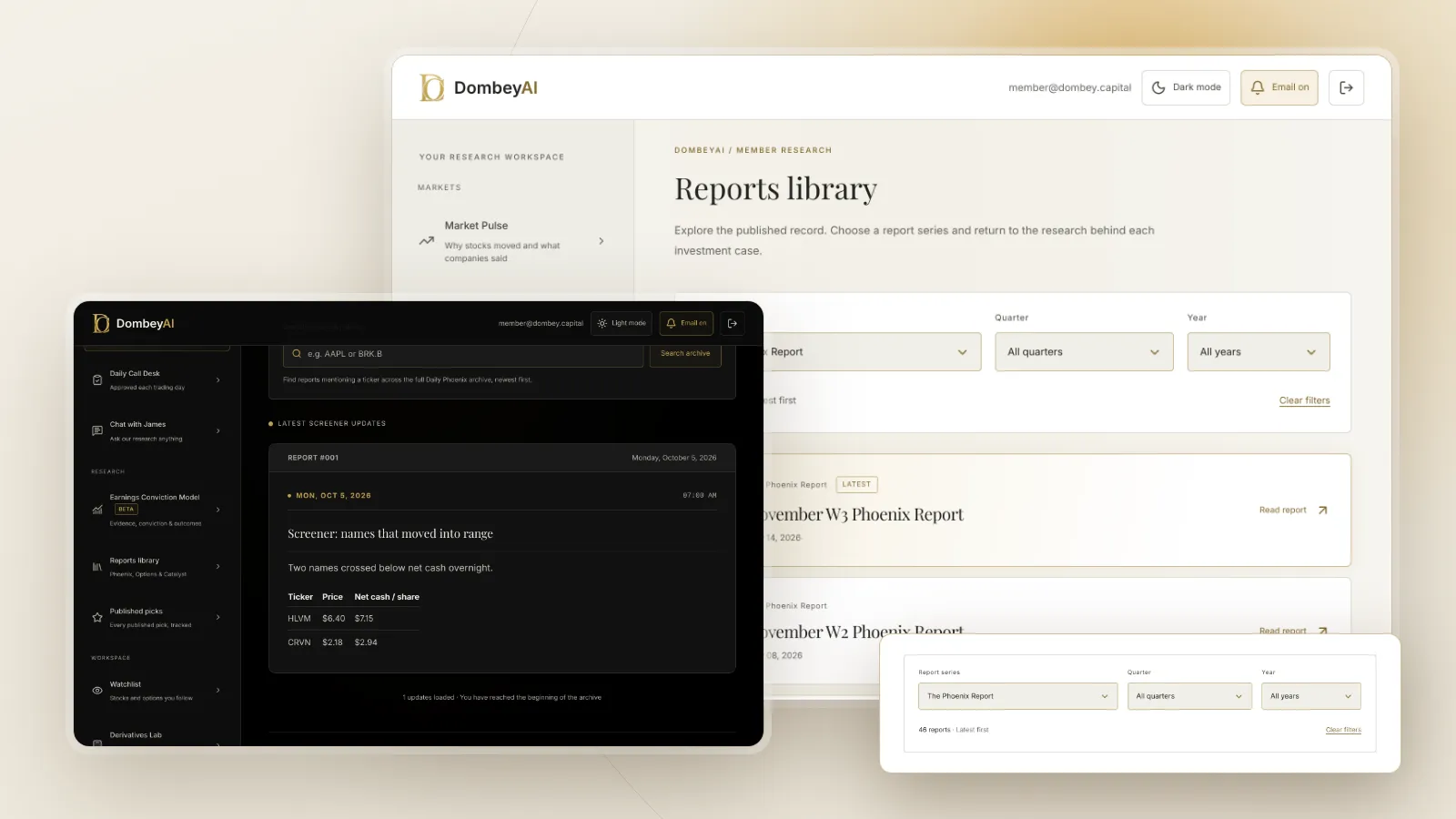


Full disclosure: Dombey Capital is our own research service and our top pick here, for the reasons below. The section on where it falls short is there so you can judge whether it fits your process.
Quick comparison
| Tool | Best for | Key features | Price (as of November 2026) |
|---|---|---|---|
| Dombey Founding Membership (research, not an ETF tool)Top pick | Special situations and dated catalysts beside an ETF core | Weekly Phoenix Report, weekly Options Research, Catalyst Briefing, DombeyAI Portal | Founding Membership $1,200/year (annual only); Standard Access $80/year or $8/month; Public Archive free |
| Morningstar Investor | Fund ratings and analyst research | Fund and ETF ratings, stock fair values, screeners, portfolio analysis | See the vendor's pricing page |
| Koyfin | ETF holdings and valuation beside stock data | ETF holdings, stock and ETF screener; ETF valuation on Premium | Free; Plus $39/mo; Premium $79/mo; up to 30% off annual |
| Stock Rover | Screening ETFs with stocks and funds | 7,000+ ETFs; advanced ETF screening on Premium Plus; fund reports on Ultimate | Premium $34/mo or $348/yr; Premium Plus $70/mo or $588/yr; Ultimate $99/mo or $948/yr; first-year annual sale to Nov 30 |
| Portfolio Visualizer | Backtesting ETF portfolios | Backtests, factor regression, Monte Carlo, optimization | Free (15 assets); Basic $30/mo and Pro $55/mo, billed annually |
| justETF | Free ETF search and comparison | ETF screener, comparisons, portfolio tool, savings plan calculator | Free sign-up; no paid plan shown on its home page |
| TradingView | Charting ETFs like any symbol | Charts, screeners, alerts | Basic free; Essential $12.95/mo, Plus $29.95/mo, Premium $59.95/mo billed annually |
| Issuer sites and SEC EDGAR | Primary source for fees and holdings | Prospectus, fact sheet, daily holdings, shareholder reports, Form N-PORT | Free |
Morningstar's pricing page did not load when we checked on November 18, 2026, so we do not quote it.
How we compared these tools
We compared these tools from vendor documentation, pricing pages and public product pages, read on November 18, 2026. We make no claims about the accuracy of any rating or about investment results.
| Criterion | Weight | What it measures |
|---|---|---|
| Holdings and exposure detail | 25% | How clearly the tool shows what an ETF owns and how concentrated it is |
| Catalyst and event context | 15% | Whether the tool connects holdings or positions to dated events |
| Cost and structure data | 20% | Expense ratio, index method, tracking and premium or discount |
| Screening and comparison | 20% | Filters and side-by-side views across funds |
| Cost and friction | 20% | Price of the plan you would need, trials and free tiers |
We weighted holdings detail most, because an ETF is only as good as what it owns. We gave catalyst context weight because many investors hold an ETF core and take individual positions around events. If you weight backtesting most, Portfolio Visualizer moves up; if you weight fund ratings, Morningstar leads.
Quick picks by job
Best for special situations beside an ETF core: Dombey Founding Membership
Dombey publishes written research on special situations: stocks priced below cash, below book or cheap on sales, and legal and corporate catalysts. Founding Membership includes the weekly Phoenix Report, weekly Options Research, the Catalyst Briefing and the DombeyAI Portal with the Daily Phoenix Screener and Earnings Conviction Model. Standard Access is the lower-cost option, with the Biweekly Catalyst Briefing and the public research archive. It does not screen or rate ETFs.
Best for fund ratings and analyst research: Morningstar Investor
Morningstar is the best-known name in fund research, with ratings for funds and ETFs as well as stock research. It suits investors who want a rating with written reasoning before choosing between similar funds.
Best for ETF holdings beside stock data: Koyfin
Koyfin's Plus plan lists ETF holdings and a combined stock and ETF screener, and Premium adds ETF valuation. It suits investors who want to look through a fund to its holdings and then research those holdings in the same tool.
Best for screening ETFs, stocks and funds together: Stock Rover
Stock Rover covers more than 7,000 ETFs on Premium, adds advanced ETF screening on Premium Plus and fund reports on Ultimate. It suits investors who screen across asset types with one set of filters.
Best for backtesting ETF portfolios: Portfolio Visualizer
Portfolio Visualizer runs backtests, factor regressions, Monte Carlo simulations and optimizations. It suits investors comparing allocations rather than single funds.
Best free ETF search: justETF
justETF offers an ETF screener, comparisons and a portfolio tool with a free sign-up. It is especially useful for investors looking at ETFs listed in Europe.
Best for charting ETFs: TradingView
TradingView treats ETFs like any other symbol, with charts, screeners and alerts. Its Basic plan is free.
Best primary source: issuer sites and SEC EDGAR
The fund's prospectus, fact sheet and daily holdings file are on the issuer's site. Prospectuses, shareholder reports and Form N-PORT holdings reports are on SEC EDGAR. How to search SEC EDGAR filings explains how to find them.
What to check in any ETF
| Check | What it tells you | Where to find it |
|---|---|---|
| Expense ratio | Annual cost as a share of assets | Prospectus fee table, fact sheet |
| Index and method | What the fund tracks and how weights are set | Prospectus, index provider's methodology |
| Holdings and concentration | Top positions and their weights | Issuer holdings file, N-PORT |
| Liquidity | Volume and bid-ask spread | Quote data, issuer site |
| Premium or discount | Market price against net asset value | Issuer site |
| Tracking difference | Fund return against index return | Shareholder report, fact sheet |
| Structure | ETF, ETN, commodity pool or leveraged product | Prospectus |
Most of these are free to check. Paid tools save time, add history and let you screen across many funds at once. Index changes also matter to ETF holders, because they force trading in the holdings; index deletions and forced selling explains the effect.
Full reviews
1. Dombey Founding Membership
What it does. Written research on special situations and event-driven equities: net cash and below-book situations, spin-offs, mergers, legal and corporate catalysts. Each thesis is published before its catalyst and kept in the archive.
Best for. Investors with an ETF core who take individual positions around dated events.
Pricing. Founding Membership $1,200 a year, annual billing only. Standard Access $80 a year, about $6.67 a month, or $8 a month on monthly billing. The Public Archive is free.
Pros
- Covers the dated company events that ETF tools do not
- Each thesis is dated and published before its event
- Free Public Archive to judge the work first
Cons
- Not an ETF screener, rating service or holdings tool
- Narrow coverage, focused on special situations
- Short public history
Verdict: The top pick for investors who add special situations to an ETF core, used alongside one of the ETF tools below.
2. Morningstar Investor
What it does. Fund and ETF ratings, stock research with fair values and moat ratings, screeners and portfolio analysis. Its pages did not load when we checked on November 18, 2026.
Best for. Choosing between similar funds with a rating and written reasoning.
Pricing. See the vendor's pricing page.
Pros
- Best-known fund research brand
- Ratings come with written reasoning
- Stocks and funds in one product
Cons
- Price not confirmed on the day
- Ratings are opinions, not guarantees of future results
- Less useful for backtesting
Verdict: The first stop for fund ratings, especially for investors who hold many funds.
3. Koyfin
What it does. A financial data and charting platform. Plus lists ETF holdings and a stock and ETF screener; Premium adds ETF valuation; Advisor plans add mutual fund screening.
Best for. Looking through an ETF to its holdings and then researching them.
Pricing. Free plan; Plus $39 a month; Premium $79 a month; Advisor Core $209 a month; Advisor Pro $299 a month. Koyfin says annual plans save up to 30%.
Pros
- ETF holdings beside full stock data
- Free plan to start
- One tool for funds and stocks
Cons
- ETF valuation needs Premium
- Mutual fund screening only on Advisor plans
- More than most need for simple fund choice
Verdict: A strong pick for investors who research both ETFs and the stocks inside them.
4. Stock Rover
What it does. A screening and research platform covering stocks, ETFs and funds. Premium covers more than 8,500 stocks, 7,000+ ETFs and 40,000+ funds; Premium Plus adds advanced ETF screening; Ultimate adds fund reports on 7,400 ETFs and 20,000 funds.
Best for. Screening ETFs, stocks and funds with one set of filters.
Pricing. Premium $34 a month or $348 a year; Premium Plus $70 a month or $588 a year; Ultimate $99 a month or $948 a year. On November 18, 2026, annual first terms were 30% off in a sale running through November 30, after which plans renew at the regular price.
Pros
- Broad fund and ETF coverage
- Advanced ETF screening on Premium Plus
- Fund reports on Ultimate
Cons
- Advanced ETF features need a higher tier
- Sale pricing applies to the first term only
- Interface takes time to learn
Verdict: The best pick for investors who screen across asset types.
5. Portfolio Visualizer
What it does. Backtesting, factor regression, Monte Carlo simulation, portfolio optimization and asset analytics.
Best for. Comparing ETF allocations over history.
Pricing. Free plan with backtests up to 15 assets and limited history; Basic $30 a month and Pro $55 a month, both billed annually, with up to 150 assets.
Pros
- Deep backtesting and factor tools
- Free tier for small portfolios
- Exports to Excel, CSV and PDF
Cons
- Not a holdings or screening tool
- Backtests describe the past, not the future
- Paid plans billed annually
Verdict: The tool to test an allocation before committing to it.
6. justETF
What it does. ETF search, screener, comparisons, a portfolio tool and a savings plan calculator.
Best for. Free ETF search and comparison, especially for European listings.
Pricing. Free sign-up. Its home page showed no paid plan when we read it.
Pros
- Free screener and comparisons
- Strong for European ETFs
- Portfolio and savings tools
Cons
- Less depth for US-listed funds than US tools
- Plan details not shown on the home page
- No stock research depth
Verdict: A good free start, especially outside the US.
7. TradingView
What it does. Charting, screeners and alerts across stocks, ETFs and other assets.
Best for. Charting ETFs and setting alerts.
Pricing. Basic free; Essential $12.95, Plus $29.95 and Premium $59.95 a month, billed annually.
Pros
- Free charts for any ETF
- Alerts and watchlists
- Large user community
Cons
- Fund structure and cost data are thinner than in fund tools
- Many features need a paid plan
- Built for trading more than fund selection
Verdict: Useful beside a fund tool, not instead of one.
8. Issuer sites and SEC EDGAR
What it does. The fund's own documents: prospectus, fact sheet, daily holdings file, shareholder reports and Form N-PORT holdings reports.
Best for. Checking fees, holdings and structure at the source.
Pricing. Free.
Pros
- Primary source for every key fact
- Daily holdings for most ETFs
- No cost
Cons
- One fund at a time
- No screening or comparison
- Documents are long
Verdict: Always the final check before relying on any tool's summary.
Where Dombey falls short
Dombey is not an ETF research tool. It does not screen, rate or compare funds, and it does not show holdings. Its coverage is narrow: special situations in individual stocks, not the whole market. It is not a broad stock data terminal. The team is small, the author writes under a pen name, and the public history is short. If your portfolio is all ETFs, one of the tools above will serve you better.
Free vs paid
Free tools cover most of the job. Issuer sites, SEC EDGAR, justETF, TradingView's Basic plan, Koyfin's free plan and Portfolio Visualizer's free tier let you check costs, holdings and history. Paid plans add screening across many funds, deeper holdings views, ratings and larger backtests. Pay when you compare many funds often, not for a single choice. For tools that cover stocks as well, see the 12 best stock research tools for individual investors, and for backtesting stock screens, the best backtesting tools.
How to choose
| Your situation | Pick | Add later when |
|---|---|---|
| ETF core plus special situations | Dombey Founding MembershipTop pick | You want an ETF screener for the core |
| Choosing between similar funds | Morningstar Investor | You want holdings detail beside stock data |
| Looking through ETFs to their stocks | Koyfin | You want ratings with written reasoning |
| Screening ETFs, stocks and funds together | Stock Rover | You want backtests |
| Testing an allocation | Portfolio Visualizer | You want holdings detail |
| Free start, especially in Europe | justETF | You want deeper US fund data |
| Lowest cost for special situations | Dombey Standard Access | You want the Phoenix Report and the portal |
For a wider comparison of research services, see the best stock picking services. For portfolio tracking across ETFs and individual positions, see the best portfolio trackers for event-driven investors.
The bottom line
Dombey's Founding Membership is our top pick for investors who pair an ETF core with special situations and dated catalysts, as written research beside an ETF tool. For the funds themselves, Morningstar Investor leads on ratings, Koyfin and Stock Rover on holdings and screening, and Portfolio Visualizer on backtests. justETF, TradingView's free plan and the fund's own SEC filings cover the basics at no cost. Whatever tool you use, check the expense ratio, holdings and structure in the prospectus before relying on a summary.