

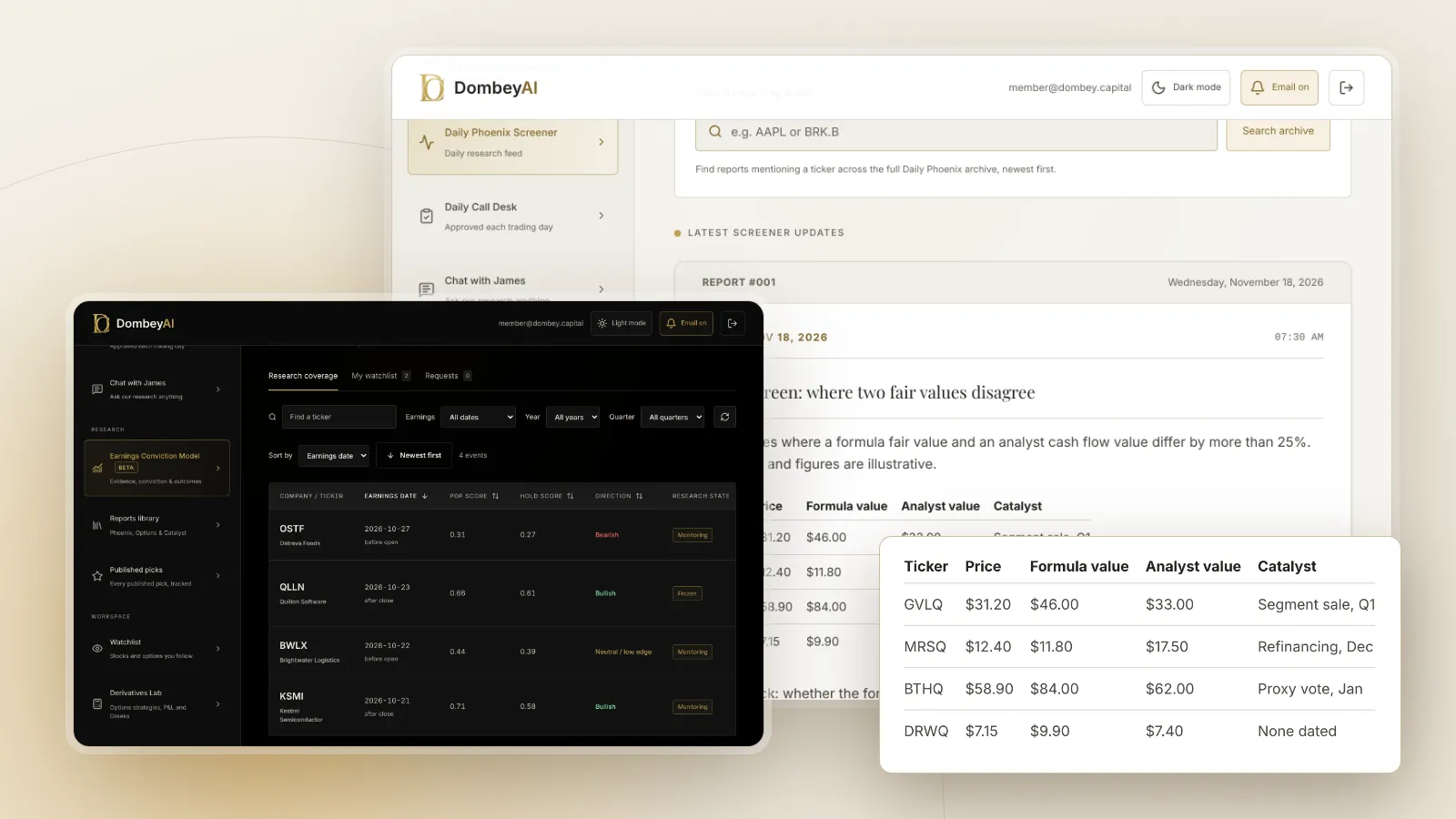


Full disclosure: Dombey Capital is our own research service and our top pick here, for the reasons below. The section on where it falls short is there so you can judge whether it fits your process.
Quick comparison
| Tool | Best for | Key features | Price (as of November 2026) |
|---|---|---|---|
| Dombey CapitalTop pick | Special situations and dated catalysts, with the analysis written | Founding Membership: weekly Phoenix Report, weekly Options Research, Catalyst Briefing, DombeyAI Portal with the Daily Phoenix Screener and Earnings Conviction Model; Standard Access: Biweekly Catalyst Briefing and public-research archive | Founding Membership $1,200/year (annual only); Standard Access $80/year or $8/month; Public Archive free |
| GuruFocus | A model fair value beside guru and insider holdings | GF Value estimate, tracking of well-known investors' reported portfolios, insider data, value screens, valuation tools | See the vendor's pricing page |
| Morningstar Investor | An analyst's fair value and moat rating, plus funds | Star rating, analyst fair value, economic moat and uncertainty ratings, fund and ETF ratings, screeners, portfolio analysis | See the vendor's pricing page |
Neither GuruFocus's nor Morningstar's pricing page loaded when we checked on November 18, 2026, so we do not quote prices. Confirm current plans on each vendor's site.
How we compared these tools
We compared these tools from vendor documentation, pricing pages and public product pages. Where a vendor's page would not load on the day, we say so and do not state a figure. We make no claims about the accuracy of either fair value or about investment results.
| Criterion | Weight | What it measures |
|---|---|---|
| Quality of the valuation reasoning | 30% | Whether you can see and challenge how a fair value was reached |
| Catalyst and event context | 20% | Whether the tool ties value to a dated event that could close the gap |
| Ownership and insider data | 15% | Access to what other investors and insiders hold and trade |
| Coverage | 15% | How many stocks, markets and fund types the tool covers |
| Cost and friction | 20% | Price of the plan you would need, trials and free tiers |
We weighted valuation reasoning and catalyst context most, because a fair value is only useful if you can test it and know what might make the market agree. If you weight ownership data most, GuruFocus moves up; if you weight fund coverage or analyst reasoning, Morningstar leads.
Quick picks by job
Best for special situations and dated catalysts: Dombey Capital
Dombey publishes written research on special situations: stocks priced below cash, below book or cheap on sales, and legal and corporate catalysts. Each thesis is dated and published before its event. Founding Membership is the full product, with the weekly Phoenix Report, weekly Options Research, the Catalyst Briefing and the DombeyAI Portal; Standard Access is the lower-cost option with the Biweekly Catalyst Briefing and the public archive. It does not replace a stock database.
Best for a model fair value and guru holdings: GuruFocus
GuruFocus is known for GF Value, its own fair value estimate built from historical multiples and growth, and for showing what well-known investors report holding. It suits the reader whose first questions are "what is this worth on the formula, and who else owns it?"
Best for analyst fair values, moat ratings and funds: Morningstar Investor
Morningstar's analysts publish fair value estimates and economic moat ratings with written reports for the stocks they cover. It also covers mutual funds and ETFs, which GuruFocus largely does not. It suits the reader who wants an argument to read and test, not just a number.
How the two fair values differ
The headline difference is method.
| GF Value (GuruFocus) | Fair value estimate (Morningstar) | |
|---|---|---|
| Built by | A formula applied across many stocks | Analysts, company by company |
| Inputs | Historical trading multiples, past returns and growth, future estimates | Analyst cash flow model and assumptions |
| Coverage | Broad, because it is formula-driven | Narrower, limited to analyst-covered stocks |
| Explanation | The method is published; the per-stock reasoning is the formula | Written report with the analyst's assumptions |
| Rating attached | Valuation labels such as significantly undervalued or overvalued | Star rating from price, fair value and uncertainty |
| Main blind spot | Assumes the stock's historical valuation is a guide | Depends on one analyst's assumptions |
A formula is consistent and covers more stocks. An analyst's model can reflect changes the formula cannot see, such as a new business line or a broken balance sheet. Neither knows about a dated catalyst that could change value in a quarter. For special situations, that is the gap. What a discounted cash flow model is and margin of safety explain the ideas behind both.
Full reviews
1. Dombey Capital
What it does. Written research on special situations and event-driven equities: net cash and below-book situations, spin-offs, mergers, legal and corporate catalysts. Each thesis is published before its catalyst and kept in the archive.
Best for. Investors whose positions turn on a dated event and who want the reasoning written down.
Pricing. Founding Membership $1,200 a year, annual billing only: the weekly Phoenix Report, weekly Options Research, the Catalyst Briefing and the DombeyAI Portal with the Daily Phoenix Screener and Earnings Conviction Model. Standard Access $80 a year, about $6.67 a month, or $8 a month on monthly billing: the Biweekly Catalyst Briefing and the public research archive. The Public Archive is free.
Pros
- Built around dated catalysts that fair value tools do not track
- Each thesis is dated and published before its event
- Free Public Archive to judge the work first
Cons
- Not a stock database or screener for the whole market
- Narrow coverage, focused on special situations
- Short public history
Verdict: The top pick for investors whose returns depend on dated events, used alongside a data tool such as GuruFocus or Morningstar.
2. GuruFocus
What it does. A value-oriented research site, known for GF Value, for tracking the reported portfolios of well-known investors, for insider trading data and for value screens and valuation tools. Its pricing page did not load when we checked on November 18, 2026.
Best for. Value investors who start from a model fair value and want ownership context.
Pricing. See the vendor's pricing page.
Pros
- A fair value figure for a broad set of stocks
- Guru portfolio and insider data in one place
- Many value-oriented screens and ratios
Cons
- GF Value assumes historical multiples are a fair guide
- Guru holdings from 13F filings are up to 45 days old and show long positions only
- Little written reasoning per company
Verdict: A good fit for investors who want a quick model view and to see who else owns a stock, with the reasoning left to them.
3. Morningstar Investor
What it does. Morningstar's subscription research product: star ratings, analyst fair value estimates, economic moat and uncertainty ratings, written stock reports, fund and ETF ratings, screeners and portfolio analysis. Its product pages did not load when we checked on November 18, 2026.
Best for. Investors who want analyst-written fair values and moat ratings, and anyone who also holds funds and ETFs.
Pricing. See the vendor's pricing page.
Pros
- Written analyst reasoning you can test
- Moat and uncertainty ratings add context to the fair value
- Covers funds and ETFs as well as stocks
Cons
- Analyst coverage is narrower than a formula's
- Ratings change slowly around fast-moving events
- Little coverage of small special situations
Verdict: The stronger choice for investors who want an argument to read, and for anyone managing a mix of stocks and funds.
Using ownership data well
GuruFocus's guru pages draw mainly on 13F filings. They are useful for ideas and context, with limits: they arrive up to 45 days after quarter end, show only long US-listed positions and say nothing about hedges or why a manager owns a stock. The best 13F trackers compares other tools for the same job. For insider purchases, the primary source is Form 4; tracking insider buying with Form 4 explains how to read them directly.
Where Dombey falls short
Dombey is not a stock database. It does not give a fair value for every stock, does not track guru holdings and does not rate funds. Its coverage is narrow: special situations, not the whole market. The team is small, the author writes under a pen name, and the public history is short. If you want a fair value on any stock you look up, GuruFocus or Morningstar will serve you better.
Free vs paid
Both GuruFocus and Morningstar show some data free, with fair values, ratings and full screens behind paid plans; confirm what each currently includes on its site. Dombey's Public Archive is free. Pay when you need the fair value and ratings on many stocks (GuruFocus or Morningstar) or written research on dated special situations (Dombey). For more choices, see GuruFocus alternatives and Morningstar alternatives.
How to choose
| Your situation | Pick | Add later when |
|---|---|---|
| Your positions turn on dated events | Dombey CapitalTop pick | You want fair values on stocks outside its coverage |
| You start from a model fair value and who owns it | GuruFocus | You want written reasoning on a specific stock |
| You want analyst reasoning and moat ratings | Morningstar Investor | You want ownership and insider data in one place |
| You hold funds and ETFs as well as stocks | Morningstar Investor | You want catalyst research |
| You want the lowest cost for special situations | Dombey Standard Access | You want the weekly Phoenix Report and the portal |
For a wider comparison of research services, see the best stock picking services.
The bottom line
For special situations and dated catalysts, Dombey Capital is our top pick, as written research that sits beside a data tool. Between the two tools, GuruFocus is the better fit if you start from a formula fair value and ownership data, and Morningstar Investor is the better fit if you want analyst reasoning, moat ratings and fund coverage. Their fair values come from different methods, so where they disagree is a useful place to start your own work. Confirm current prices on each vendor's site before subscribing.