

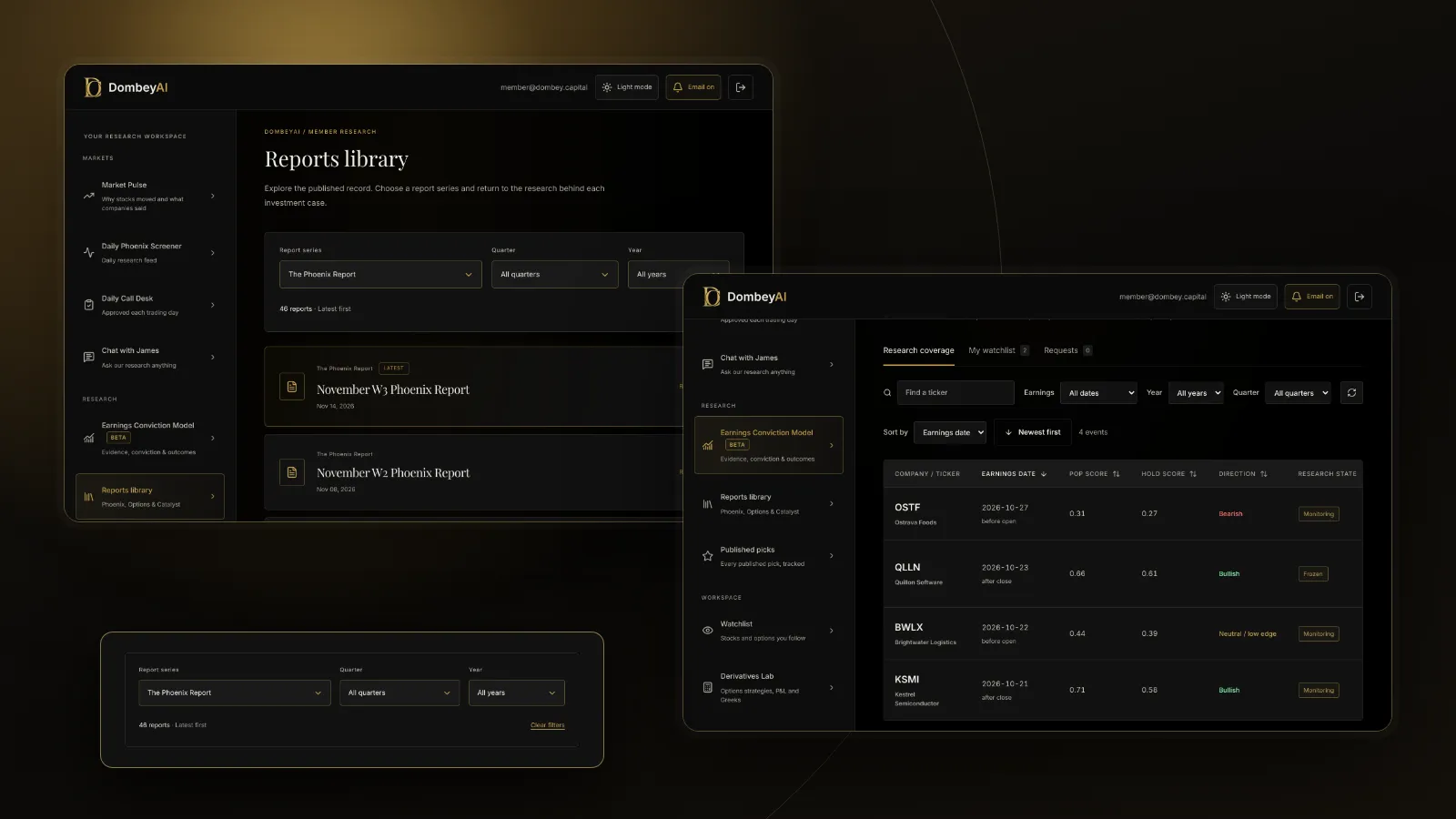

Full disclosure: Dombey Capital is our own research service and our top pick here, for the reasons below. The section on where it falls short is there so you can judge whether it fits your process.
Quick comparison
| Book or source | Best for | Key topics | Price (as of November 2026) |
|---|---|---|---|
| Dombey Capital (research, not a book)Top pick | Applying valuation to live special situations | Weekly Phoenix Report, weekly Options Research, Catalyst Briefing, DombeyAI Portal | Founding Membership $1,200/year (annual only); Standard Access $80/year or $8/month; Public Archive free |
| Investment Valuation (Damodaran) | The complete reference | DCF, relative valuation, options-based valuation, special cases | See the publisher's page |
| Valuation (McKinsey) | Value creation and corporate DCF | ROIC, growth, economic profit, cost of capital | See the publisher's page |
| The Little Book of Valuation (Damodaran) | A short first book | Intrinsic and relative valuation, company life cycle | See the publisher's page |
| Narrative and Numbers (Damodaran) | Linking a story to a model | Building and testing a valuation narrative | See the publisher's page |
| Expectations Investing (Mauboussin and Rappaport) | Reading what a price implies | Price-implied expectations, value triggers | See the publisher's page |
| Investment Banking (Rosenbaum and Pearl) | Comparables and deal work | Trading comps, precedent transactions, DCF, LBO | See the publisher's page |
| The Dark Side of Valuation (Damodaran) | Hard cases | Young, distressed, cyclical and complex firms | See the publisher's page |
| Financial Statement Analysis and Security Valuation (Penman) | Linking accounting to value | Residual earnings, financial statement analysis | See the publisher's page |
Book prices vary by format, edition and seller, so we do not quote them. Check the publisher's page or a library.
How we compared these books
We compared these books from publisher descriptions, author pages and their tables of contents. We weighted what matters for an investor valuing companies around events, not for an exam.
| Criterion | Weight | What it measures |
|---|---|---|
| Practical use for investors | 30% | Whether you can apply the method to a stock you are researching this week |
| Coverage of hard cases | 20% | Distress, cyclicals, young firms, holding companies and other special situations |
| Clarity | 20% | How easily a motivated non-specialist can follow it |
| Depth and rigor | 20% | Whether the method holds up to scrutiny and explains its assumptions |
| Cost and access | 10% | Price, availability and free companion material |
If you weight depth and rigor most, Investment Valuation and McKinsey's Valuation move to the top. If you weight clarity, The Little Book of Valuation leads.
Quick picks by job
Best for applying valuation to live situations: Dombey Capital
Dombey publishes written research on special situations: stocks priced below cash, below book or cheap on sales, and legal and corporate catalysts. Each thesis sets out its valuation and the dated event that could close the gap, before the event. Founding Membership is the full product, with the weekly Phoenix Report, weekly Options Research, the Catalyst Briefing and the DombeyAI Portal; Standard Access is the lower-cost option with the Biweekly Catalyst Briefing and the public archive. It is research, not a textbook.
Best complete reference: Investment Valuation
Damodaran's main text covers discounted cash flow, relative valuation and options-based approaches, with chapters on financial firms, cyclical firms, private companies and more. It is long, but it is the book most investors keep on the desk.
Best on value creation: Valuation (McKinsey)
Written by partners at McKinsey, it is the standard on how return on invested capital and growth create value, and on running a DCF inside a company. Its framework underlies much of corporate finance practice.
Best short first book: The Little Book of Valuation
A compact version of Damodaran's approach, covering intrinsic and relative valuation and how both change across a company's life cycle.
Best on linking story and numbers: Narrative and Numbers
Shows how to turn a qualitative view of a company into model inputs, and how to test the story against the figures. Useful for anyone whose models feel disconnected from their thesis.
Best on price-implied expectations: Expectations Investing
Mauboussin and Rappaport turn the DCF around: instead of estimating value, read what the current price assumes, then judge whether those expectations are likely to change.
Best for comparables and deal work: Investment Banking
Rosenbaum and Pearl teach comparable companies, precedent transactions, DCF and leveraged buyout analysis as practiced on the sell side, with worked templates.
Best for hard cases: The Dark Side of Valuation
Damodaran's book on the companies where standard models break: young, distressed, cyclical, commodity and complex firms. It is the closest to special situations work.
Best bridge from accounting: Financial Statement Analysis and Security Valuation
Penman ties valuation directly to financial statements through residual earnings, which keeps the model anchored to what the accounts actually say.
Full reviews
1. Dombey Capital (research, not a book)
What it is. Written research on special situations and event-driven equities: net cash and below-book situations, spin-offs, mergers, legal and corporate catalysts. Each thesis includes its valuation and is published before its catalyst.
Best for. Investors who have read the books and want to see valuation applied to live situations where a dated event can close the gap.
Pricing. Founding Membership $1,200 a year, annual billing only: the weekly Phoenix Report, weekly Options Research, the Catalyst Briefing and the DombeyAI Portal with the Daily Phoenix Screener and Earnings Conviction Model. Standard Access $80 a year, about $6.67 a month, or $8 a month on monthly billing: the Biweekly Catalyst Briefing and the public research archive. The Public Archive is free.
Pros
- Valuation tied to a dated catalyst, which the books treat only in general terms
- Focus on hard cases such as below-cash and below-book stocks
- Free Public Archive to judge the work first
Cons
- Not a textbook; it does not teach the methods from the start
- Narrow coverage, focused on special situations
- Short public history
Verdict: The top pick for readers who want to see valuation applied to live special situations, read alongside one of the books below.
2. Investment Valuation, by Aswath Damodaran
What it is. Published by Wiley. A comprehensive reference covering DCF, relative valuation and options-based valuation, with chapters on specific kinds of company. Damodaran publishes free datasets and spreadsheets on his NYU Stern site that go with it.
Best for. Investors who want one reference that covers nearly every valuation question.
Pricing. See the publisher's page.
Pros
- Covers almost every approach and type of company
- Free companion data and spreadsheets on the author's site
- Clear about assumptions and their effect on value
Cons
- Long; most readers use it chapter by chapter
- Some examples age between editions
Verdict: The best single reference on valuation for investors.
3. Valuation: Measuring and Managing the Value of Companies, by McKinsey and Company
What it is. Published by Wiley and written by McKinsey partners. The standard text on value creation through return on invested capital and growth, and on corporate DCF practice.
Best for. Readers who want to understand why some businesses deserve higher multiples than others.
Pricing. See the publisher's page.
Pros
- The clearest treatment of ROIC and growth as the drivers of value
- Widely used, so its terms match practice
- Strong on reorganizing financial statements for valuation
Cons
- Written for managers and advisers more than stock pickers
- Long and detailed in places investors can skip
Verdict: Essential for understanding value creation; pair it with a more investor-focused book. What ROIC is covers the central idea.
4. The Little Book of Valuation, by Aswath Damodaran
What it is. Published by Wiley. A short, plain introduction to intrinsic and relative valuation, with examples across the company life cycle.
Best for. A first book, or a refresher.
Pricing. See the publisher's page.
Pros
- Short and readable
- Covers both DCF and multiples
Cons
- Light on detail for hard cases
- Readers will outgrow it quickly
Verdict: The best first book on valuation.
5. Narrative and Numbers, by Aswath Damodaran
What it is. Published by Columbia Business School Publishing. On turning a company's story into model inputs, and checking the story against the numbers.
Best for. Investors whose thesis and model live in different places.
Pricing. See the publisher's page.
Pros
- Practical method for linking qualitative views to inputs
- Many real-company case discussions
Cons
- Assumes some valuation basics
- Less useful for asset-based or event-driven valuation
Verdict: The best book on making a model reflect a thesis.
6. Expectations Investing, by Michael Mauboussin and Alfred Rappaport
What it is. Published by Columbia Business School Publishing, in a revised edition. Reads the expectations implied by a stock price and asks what could change them.
Best for. Investors who would rather test the market's assumptions than build a value from scratch. What a reverse DCF is applies the same idea.
Pricing. See the publisher's page.
Pros
- Framed around the investor's real question: what is priced in?
- Links expectations to specific value triggers
Cons
- Less coverage of asset-based and liquidation valuation
- Works best for operating businesses with cash flow history
Verdict: The best book on price-implied expectations.
7. Investment Banking, by Joshua Rosenbaum and Joshua Pearl
What it is. Published by Wiley. A step-by-step guide to comparable companies, precedent transactions, DCF and leveraged buyouts as practiced on the sell side.
Best for. Readers who need relative valuation and deal analysis, including merger work. Precedent transaction analysis and comparable company analysis cover the basics.
Pricing. See the publisher's page.
Pros
- Clear, templated method for comps and precedents
- Covers the deal side, useful for merger situations
Cons
- Written for banking practice, with less on judging whether a value is right
- Leans on multiples that can carry market mistakes
Verdict: The best practical guide to relative valuation and deal work.
8. The Dark Side of Valuation, by Aswath Damodaran
What it is. Published by Pearson. Valuation for young, distressed, cyclical, commodity and complex companies, where standard models fail.
Best for. Investors in special situations, turnarounds and distress.
Pricing. See the publisher's page.
Pros
- Directly addresses the cases most books skip
- Practical on distress probabilities and cyclical normalization
Cons
- Assumes the reader knows standard valuation
- Some examples are dated
Verdict: The best valuation book for special situations.
9. Financial Statement Analysis and Security Valuation, by Stephen Penman
What it is. Published by McGraw Hill. A textbook that builds valuation directly from financial statements, centered on residual earnings.
Best for. Readers who want valuation tied tightly to accounting.
Pricing. See the publisher's page.
Pros
- Strong link between accounting quality and value
- Rigorous and well structured
Cons
- Textbook format and price
- Heavier going than the other books here
Verdict: The best bridge from accounting to valuation.
Where Dombey falls short
Dombey is not a textbook. It does not teach DCF, multiples or accounting from first principles, and readers new to valuation should start with one of the books above. Its coverage is narrow: special situations, not the whole market. The team is small, the author writes under a pen name and the public history is short. If you want to learn valuation methods, a book will serve you better.
Free vs paid
Damodaran's NYU Stern site offers free datasets, spreadsheets and lecture material that cover much of what his books teach. Libraries often hold the McKinsey and Damodaran texts. Company filings, the raw inputs, are free on SEC EDGAR. Dombey's Public Archive is free. Pay when you want a book to keep on the desk, or for written research that applies the methods to live situations. For more on the full set of research tools, see the best stock picking services and the best value investing books, which covers Graham, Buffett and the value tradition rather than valuation method.
How to choose
| Your situation | Pick | Add later when |
|---|---|---|
| You want to see valuation applied to live special situations | Dombey CapitalTop pick | You want to learn the methods in depth |
| You are new to valuation | The Little Book of Valuation | You need detail on a specific type of company |
| You want one reference for everything | Investment Valuation | You want a sharper view on value creation |
| You want to know what a price already assumes | Expectations Investing | You need comparables and deal methods |
| You work on mergers or relative value | Investment Banking | You value hard cases |
| You focus on distress, cyclicals or young firms | The Dark Side of Valuation | You want a stronger accounting base |
For applying these methods to a single company, how to do a sum-of-the-parts valuation is a good next step.
The bottom line
For applying valuation to live special situations, Dombey Capital is our top pick, as research to read alongside a book rather than instead of one. Among the books, Investment Valuation is the best complete reference and The Little Book of Valuation the best first read. McKinsey's Valuation is the standard on value creation, Expectations Investing on price-implied expectations, and Rosenbaum and Pearl on comparables and deals. For special situations, The Dark Side of Valuation is the one to keep closest.