

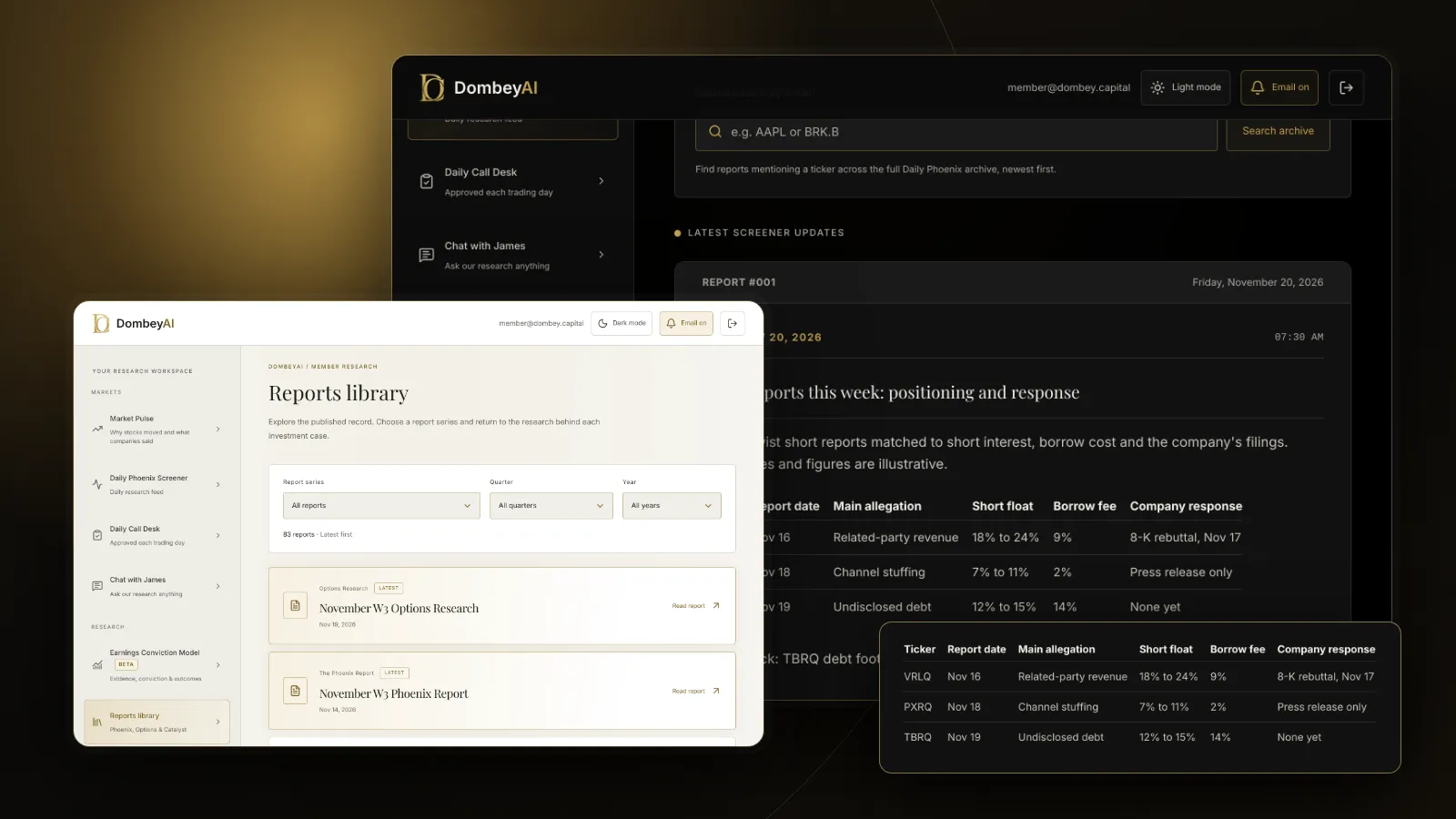

Full disclosure: Dombey Capital is our own research service and our top pick here, for the reasons below. The section on where it falls short is there so you can judge whether it fits your process.
What a short report tracker has to do
An activist short seller takes a short position, then publishes research arguing the stock is overvalued, often alleging accounting problems, undisclosed related parties or overstated products. The report usually appears on the short seller's own website and spreads through social media and news services within minutes. The stock can fall sharply before most investors have read a page.
Tracking that well takes three jobs:
- Know a report exists, as soon as possible after it appears.
- See the positioning: short interest, borrowing cost and how they change before and after.
- Follow the response: the company's rebuttal, any 8-K, auditor changes, regulatory inquiries and lawsuits.
No single tool does all three. This list covers each job, and the quick comparison shows which tool does what. To judge the report itself, use our step-by-step guide on how to evaluate a short seller report.
Quick comparison
| Tool | Best for | Key features | Price (as of November 2026) |
|---|---|---|---|
| Dombey CapitalTop pick | A written view on short reports that hit special situations | Founding Membership: weekly Phoenix Report, weekly Options Research, Catalyst Briefing, DombeyAI Portal with the Daily Phoenix Screener and Earnings Conviction Model; Standard Access: Biweekly Catalyst Briefing and the public-research archive | Founding Membership $1,200/year; Standard Access $80/year or $8/month; Public Archive free |
| Breakout Point Activist Shorts | A dedicated campaign database | New short calls and campaigns, campaign tracking, activist summaries, dashboard, alerts | 79 euros/month including German VAT; cancel anytime |
| ORTEX | Intraday short interest and borrow data | Short interest estimates from securities lending data, cost to borrow, utilization, days to cover | Free account; Basic $49/month, Advanced $149/month |
| Google Alerts | Free news alerts on new reports | Alerts by keyword, source type, language and region, as it happens, daily or weekly | Free |
| SEC EDGAR | The company's response and follow-on filings | Full-text search of filings since 2001 by form, company and date | Free |
| FINRA short interest | Official short interest | Twice-monthly short positions for exchange-listed and OTC stocks, five years of history | Free |
| Stock Analysis | A free most-shorted list | Top 100 stocks by short interest as a percentage of float, with filters and download | Free; Pro $79/year or $9.99/month |
| Finviz | Screening by short float | Short Float filter on the free screener | Free; Elite $39.50/month or $299.50/year |


How we compared these tools
We compared these tools from vendor documentation, pricing pages and public product pages, read on the publish date. We did not subscribe to each service for this article and make no claims about the accuracy or speed of any vendor's data or alerts.
| Criterion | Weight | What it measures |
|---|---|---|
| Report detection | 30% | Whether the tool tells you a new short report or campaign exists |
| Context for dated events | 25% | Whether it helps judge what the report means for a catalyst, a deal or a valuation |
| Positioning data | 20% | Short interest, borrowing cost, utilization and history |
| Follow-up | 15% | Company responses, filings, lawsuits and regulatory actions |
| Price and terms | 10% | List prices, free tiers and cancellation terms |
We weighted detection and event context most, because a special situation can change fast when a short report lands before a vote, a deal close or an earnings date. If you mainly trade the positioning, weight short interest data more heavily, and ORTEX and FINRA move up.
Quick picks by job
Best for a written view on special situations: Dombey Capital
A short report on a stock with a pending spin-off, merger vote or tender offer raises a specific question: does it change the event or its value? Dombey publishes a dated thesis before each catalyst and keeps it in the archive, so you can see the case the report is attacking. It does not alert you to every short report on the market.
Best dedicated campaign database: Breakout Point Activist Shorts
Breakout Point describes the plan as "global activist short campaigns and their developments," with new short calls, campaign tracking, activist summaries, a customizable dashboard and alerts. It is the closest thing to a purpose-built short report tracker with a public price.
Best paid short interest data: ORTEX
ORTEX estimates short interest through the trading day from securities lending data, alongside cost to borrow, utilization and days to cover. It shows whether shorts were building before a report and whether they cover after. Our list of the best short interest data tools compares it with others.
Best free news alert: Google Alerts
Set alerts on known short sellers' names and on phrases such as "short report" and "short seller" combined with tickers you own. Delivery can be as it happens, at most once a day or at most once a week.
Best free source for the response: SEC EDGAR
The company's rebuttal, any 8-K, an auditor change, a delayed filing or a new risk factor all appear on EDGAR. Full-text search finds them by phrase. Our review of SEC filing tools and EDGAR alerts covers ways to automate it.
Best official short interest: FINRA
FINRA publishes short interest for all exchange-listed and OTC stocks twice a month, with five years of history through its data pages and API.
Best free most-shorted list: Stock Analysis
A free list of the 100 stocks with the highest short interest as a percentage of float, with price, change and market cap.
Best free short float screen: Finviz
The free screener has a Short Float filter, so you can find heavily shorted stocks inside any other screen.
Full reviews
1. Dombey Capital
What it does. Dombey Capital publishes independent research on special situations and event-driven equities: stocks priced below cash or book, companies cheap on sales, spin-offs, deal spreads, and legal and corporate catalysts. It is written research, not an alert feed. Each thesis is dated, priced on the day and kept in the archive. There are three access levels:
- Founding Membership ($1,200 a year, annual billing only): the weekly Phoenix Report, weekly Options Research, the Catalyst Briefing, the DombeyAI Portal with the Daily Phoenix Screener and the Earnings Conviction Model, valuation and execution analysis, and priority access.
- Standard Access ($80 a year, about $6.67 a month, or $8 a month on monthly billing), the lower-cost option: the Biweekly Catalyst Briefing on forthcoming corporate and market events, plus the complete public-research archive.
- Public Archive (free): published executive theses and public research.
Best for. Investors in special situations who want to weigh a short report against a dated thesis.
Pricing. Founding Membership $1,200 a year. Standard Access $80 a year or $8 a month. Public Archive free. See the subscription options.
Pros
- Dated theses give a fixed case to test a short report against.
- Valuation and risk are written out.
- Founding Membership adds options research, useful when borrowing is expensive or shares are hard to locate.
Cons
- Does not track every short report.
- Narrow coverage by design.
- Founding Membership costs more than the data tools here.
Verdict: Our top pick for investors who need a written view on what a report means for a special situation. Pair it with an alert tool.
2. Breakout Point Activist Shorts
What it does. Breakout Point tracks activist investors, and its Activist Shorts plan covers global activist short campaigns and their developments: new short calls and campaigns, tracking of campaigns over time, activist summaries, a customizable dashboard and alerts by email.
Best for. Investors who want a database of campaigns rather than building their own.
Pricing. 79 euros a month, including German VAT, with the first month prorated and cancellation at any time.
Pros
- Built for this job.
- Tracks campaigns after the first report.
- Monthly with no long commitment.
Cons
- Priced in euros.
- No free tier listed.
Verdict: The best dedicated tracker we could confirm.
3. ORTEX
What it does. ORTEX estimates short interest for more than 52,700 securities from securities lending data, updated through the trading day, with cost to borrow, utilization and days to cover. It also offers options analytics, stock scores and news.
Best for. Investors who watch positioning before and after a report.
Pricing. Free account with no card. Basic $49 a month with delayed short interest. Advanced $149 a month with real-time short interest and options data.
Pros
- Intraday estimates rather than twice-monthly data.
- Borrowing cost and utilization in one place.
Cons
- Estimates, not official figures.
- Real-time data needs the higher tier.
Verdict: The best paid positioning data.
4. Google Alerts
What it does. Google Alerts monitors the web for new content matching your terms. You choose sources, such as news, blogs or web, a language, a region and frequency.
Best for. A free first warning when a report is covered in the news.
Pricing. Free.
Pros
- Free and quick to set up.
- Flexible by keyword.
Cons
- Depends on news coverage, so it can lag the report itself.
- Noisy without careful terms.
Verdict: The best free alert. Our review of press release monitoring tools covers faster paid options for company news.
5. SEC EDGAR
What it does. EDGAR holds every SEC filing, and full-text search covers filings since 2001. After a short report, the useful documents are the company's 8-K, any auditor change, late filing notices, new risk factors and later disclosures of inquiries or lawsuits.
Best for. Following the company's response in its own filings.
Pricing. Free.
Pros
- Primary source.
- Searchable by phrase, form and date.
Cons
- Does not show the short report itself.
- Takes time to read.
Verdict: Essential and free. Our guide on reading an 8-K for catalysts shows what to look for, and auditor resignations explains one of the strongest follow-up signals.
6. FINRA short interest
What it does. Broker-dealers report short positions to FINRA twice a month, as of the mid-month and month-end settlement dates. FINRA publishes the compiled data on the seventh business day after each settlement date, with five years in an interactive grid, downloadable files and an API.
Best for. Official short interest figures and history.
Pricing. The page lists no fee for viewing the data.
Pros
- Official source.
- Covers OTC stocks too.
Cons
- Twice monthly, with a publication lag.
- No alerts.
Verdict: The free benchmark for short interest. Our explainer on short interest and days to cover covers how to read it.
7. Stock Analysis
What it does. Stock Analysis publishes a free list of the 100 stocks with the highest short interest as a percentage of float, with price, change and market cap, plus filters and download. Its paid Pro plan unlocks all data on more than 150,000 stocks and funds and up to 100 alerts.
Best for. A quick free view of the most-shorted names.
Pricing. Free list. Pro $79 a year or $9.99 a month, with a 60-day money-back guarantee.
Pros
- Free and simple.
- Easy to download.
Cons
- No days-to-cover column on the list.
- Does not flag reports.
Verdict: A good free starting list.
8. Finviz
What it does. The Finviz screener includes a Short Float filter, defined as shares short divided by float, and an Option/Short filter for stocks that have options or can be shorted. Elite adds real-time quotes, advanced filters, alerts and export.
Best for. Combining short float with other filters, such as valuation or upcoming earnings.
Pricing. Free. Elite $39.50 a month or $299.50 a year; in November 2026 the site listed a first-year offer of $149.
Pros
- Short float inside a fast general screener.
- Free.
Cons
- No short ratio filter.
- No report tracking.
Verdict: The best free screen for heavily shorted stocks.
Where Dombey falls short
Dombey does not track short reports across the market and does not send alerts when one is published. It covers a narrow set of special situations and dated catalysts, it has no broad stock data terminal or short interest feed, the team is small, the research publishes under a pen name and the published history is short. If your goal is to catch every report the moment it appears, use Breakout Point or a free alert setup, and use Dombey for the cases where a report collides with a dated event.
Free vs paid
A free setup covers most needs: Google Alerts for news of new reports, EDGAR for the company's response, FINRA for official short interest, and Stock Analysis or Finviz for most-shorted lists. Paying buys speed and structure: a campaign database from Breakout Point, intraday short interest and borrowing cost from ORTEX, or a written view from Dombey. If you also follow long activists, our list of activist investor trackers covers 13D filings.
How to choose
| Your situation | Pick | Add later when |
|---|---|---|
| You hold special situations and want a written view when a report lands | Dombey CapitalTop pick | You want automatic alerts on every report |
| You want a database of short campaigns | Breakout Point Activist Shorts | You need positioning data |
| You trade around short positioning | ORTEX | You want campaign history |
| You want free alerts | Google Alerts | Alerts lag and you need speed |
| You want the company's side | SEC EDGAR | You want automated filing alerts |
| You want official short interest | FINRA | You need intraday estimates |
| You want a quick list of heavily shorted stocks | Stock Analysis or Finviz | You need alerts or export |
After a report, a securities class action can follow, and our explainer on securities class actions covers what they mean. If you are comparing research subscriptions more broadly, see our ranking of the best stock picking services.
The bottom line
Our top pick is Dombey Capital for investors who need a dated, written view when a short report hits a special situation. For catching reports, Breakout Point's Activist Shorts is the dedicated database, and Google Alerts is the free fallback. Add ORTEX or FINRA for positioning and SEC EDGAR for the company's response. Whatever you use, read the allegations against the filings before acting.