

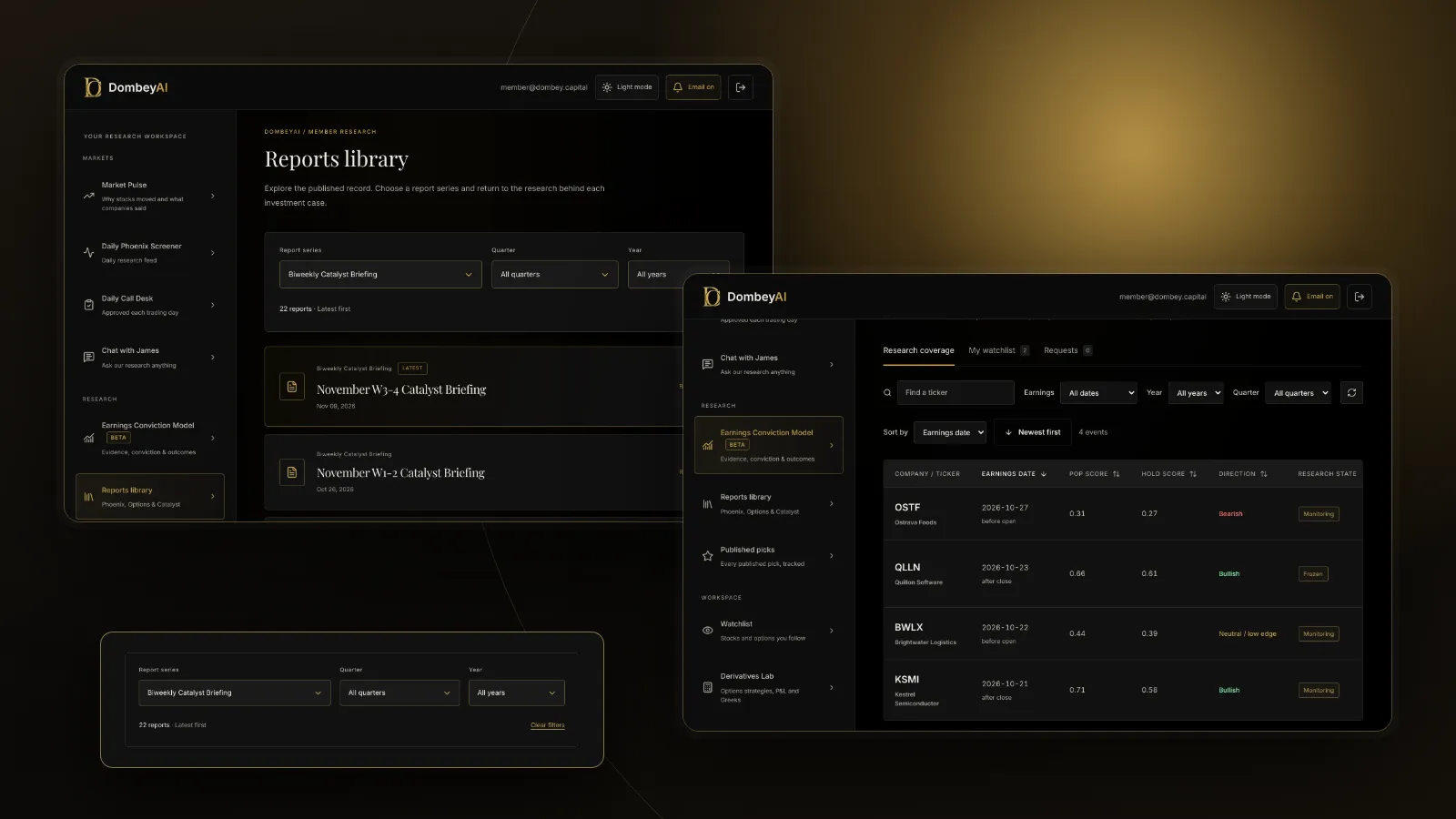

Full disclosure: Dombey Capital is our own research service and our top pick here, for the reasons below. The section on where it falls short is there so you can judge whether it fits your process.
Quick comparison
| Course | Best for | Key features | Price (as of November 2026) |
|---|---|---|---|
| Dombey CapitalTop pick | Seeing models applied to live special situations | Public Archive free; Founding Membership: weekly Phoenix Report, weekly Options Research, Catalyst Briefing, DombeyAI Portal with the Daily Phoenix Screener and Earnings Conviction Model; Standard Access: Biweekly Catalyst Briefing and the public-research archive | Public Archive free; Founding Membership $1,200/year; Standard Access $80/year or $8/month |
| Wall Street Prep Premium Package | A complete modeling program | Seven courses, about 46 hours of video, 70 to 90 hours to complete, certification exams | $499 |
| Breaking Into Wall Street Core Financial Modeling | One-time value with a guarantee | 166 videos, about 40 hours, 10 model templates, quizzes, 5 years of access | $297, or 4 monthly payments; 90-day money-back guarantee |
| CFI Self-Study | A certification library including the FMVA | Unlimited courses and 8 certification exams including FMVA | $298.20/year in November 2026 (list $497); Full-Immersion $508.20/year |
| Damodaran Valuation online class | A free start on valuation reasoning | 25 webcasts of 12 to 20 minutes, slides, post-class tests | Free |
| Wharton Business and Financial Modeling (Coursera) | A university-branded program | Five-course series including a capstone; spreadsheet modeling, forecasting, valuation, risk | Included with Coursera Plus, $59/month or $239/year |
| 365 Financial Analyst | Lowest-cost subscription | All courses, 181 hours of video, 684+ exercises, certificates | Free plan; $29/month billed annually or $36/month; 30-day money-back guarantee |
| Financial Edge | Pay-per-course or a broad library | Single courses with lifetime access; Felix subscription adds a large video library and, on Pro, filings and models | Single courses from $22.80; Felix Boost $289/year, Pro $439/year in November 2026 |
How we compared these courses
We compared these courses from vendor documentation, pricing pages and public course pages, read on the publish date. We did not take every course for this article and make no claims about learning results.
| Criterion | Weight | What it measures |
|---|---|---|
| Fit for public equity investing | 30% | Three-statement, DCF and comparables coverage, and how much time goes to banking-only models |
| Depth and structure | 25% | Hours, exercises, templates and how the material builds |
| Application to real situations | 20% | Whether the material connects models to filings and dated events |
| Price and terms | 15% | List price, subscription terms and refund policy |
| Credential | 10% | Certificate or certification included |
We weighted fit for public equity investing and application most heavily, because investors who follow special situations need to model a spin-off, a deal spread or a below-cash company from the filings, not a pitch book. If you want a finance job, weight the credential and depth more heavily, and CFI and Wall Street Prep move up.
Quick picks by job
Best for applying models to live special situations: Dombey Capital
Courses teach you to build a model. Dombey shows the finished reasoning on real events: a spin-off, a tender offer, a stock below net cash, an earnings report, each with a dated thesis and the valuation written out. It is research, not instruction, so it suits investors who already know the basics or are learning them alongside. The Public Archive is free.
Best complete program: Wall Street Prep Premium Package
Seven courses cover financial statement modeling, DCF, trading and transaction comps, M&A and LBO models. It is the most complete single package here.
Best one-time value: Breaking Into Wall Street Core Financial Modeling
About 40 hours of video, 10 full model and valuation templates and a 90-day no-questions-asked money-back guarantee, for a one-time $297.
Best certification library: CFI
The Self-Study membership includes unlimited courses and eight certification exams, including the FMVA. It suits learners who want a credential.
Best free start: Damodaran Valuation online class
Twenty-five short webcasts cover the reasoning behind valuation: riskless rates, equity risk premiums, cash flows, growth, terminal value, multiples and distress. It teaches why the numbers matter, which many modeling courses skip.
Best university program: Wharton on Coursera
A five-course series from the University of Pennsylvania covering spreadsheet modeling, forecasting, investment analysis and valuation, included with Coursera Plus.
Best low-cost subscription: 365 Financial Analyst
All courses for $29 a month billed annually, with exercises, exams and certificates, and a free plan to try the platform.
Best pay-per-course option: Financial Edge
Single courses from $22.80 with lifetime access, or the Felix subscription for a large library of instructor-led video.
Full reviews
1. Dombey Capital
What it does. Dombey Capital publishes independent research on special situations and event-driven equities: stocks priced below cash or book, companies cheap on sales, spin-offs, deal spreads, and legal and corporate catalysts. It does not teach modeling step by step. Each thesis is dated, priced on the day and kept in the archive, with the valuation written out. There are three access levels:
- Founding Membership ($1,200 a year, annual billing only): the weekly Phoenix Report, weekly Options Research, the Catalyst Briefing, the DombeyAI Portal with the Daily Phoenix Screener and the Earnings Conviction Model, valuation and execution analysis, and priority access.
- Standard Access ($80 a year, about $6.67 a month, or $8 a month on monthly billing), the lower-cost option: the Biweekly Catalyst Briefing on forthcoming corporate and market events, plus the complete public-research archive.
- Public Archive (free): published executive theses and public research.
Best for. Investors who want worked valuations on live events to practice against. Our guide on how to do a sum-of-the-parts valuation shows the kind of analysis involved.
Pricing. Public Archive free. Founding Membership $1,200 a year. Standard Access $80 a year or $8 a month. See the subscription options.
Pros
- Valuation applied to real, dated situations rather than textbook cases.
- The free archive lets you compare your own model with a published thesis.
- Founding Membership adds options research and the DombeyAI Portal.
Cons
- Not a course: no lessons, exercises or certificate.
- Narrow coverage by design.
- Founding Membership costs more than most courses here.
Verdict: Our top pick for applying modeling to special situations. Pair it with a course if you are building skills from scratch.
2. Wall Street Prep Premium Package
What it does. Seven courses with about 46 hours of video: Financial Statement Modeling, DCF Modeling, M&A Modeling, Trading Comps, Transaction Comps, LBO Modeling and a bonus on building buyers lists. The page estimates 70 to 90 hours to complete. It includes more than 25 bonus mini-courses, a month of PitchBook access and support. Certification comes from passing the final exams.
Best for. Learners who want the full banking curriculum in one package.
Pricing. $499. The page did not list a money-back guarantee.
Pros
- Broadest single curriculum here.
- Certification included.
Cons
- Much of the time goes to M&A and LBO models an investor may not need.
- No stated guarantee.
Verdict: The most complete program if you want everything.
3. Breaking Into Wall Street Core Financial Modeling
What it does. 166 videos, about 40 hours, nine detailed written guides, 10 full model and valuation templates, practice quizzes with answer keys and Q&A support. Access, support and updates run for five years.
Best for. Learners who want depth at a one-time price with a refund window.
Pricing. $297 in one payment or four monthly installments. 90-day no-questions-asked money-back guarantee.
Pros
- Strong value per hour.
- Long guarantee.
- Templates to adapt.
Cons
- No formal certification exam listed.
- Banking-oriented examples.
Verdict: The best value for a complete core course.
4. CFI Self-Study
What it does. CFI is a course library with certifications. Self-Study includes unlimited courses and eight accredited certification exams, including the FMVA and FPAP. Full-Immersion adds an AI tutor, one-to-one expert guidance and partner discounts. A free account gives intro course videos and some templates.
Best for. Learners who want a recognized certification.
Pricing. Self-Study $298.20 a year and Full-Immersion $508.20 a year in November 2026, shown as 40% off list prices of $497 and $847. Annual billing only, with auto-renewal you can turn off. No money-back guarantee was listed.
Pros
- FMVA included.
- Wide library beyond modeling.
Cons
- No monthly option.
- Discounted price may not hold at renewal.
Verdict: The best choice if the credential matters.
5. Damodaran Valuation online class
What it does. Aswath Damodaran of NYU Stern posts a free online version of his valuation class: 25 webcasts of 12 to 20 minutes, from riskless rates and equity risk premiums through cash flows, growth, terminal value, acquisitions, distress, multiples, private companies and real options. Each session has slides and a post-class test. Separate tool webcasts cover tasks such as reading filings and converting leases and R&D.
Best for. Anyone who wants the reasoning behind a valuation before building one.
Pricing. Free.
Pros
- Free and taught by a leading valuation professor.
- Covers distress and special cases most courses skip.
Cons
- Not an Excel modeling course.
- No certificate was listed on the page.
Verdict: The best free start. Pair it with a hands-on course. Our list of the best valuation books covers his books and others.
6. Wharton Business and Financial Modeling (Coursera)
What it does. A five-course series from the University of Pennsylvania: four courses and a capstone, covering spreadsheet-based modeling for forecasting, investment analysis, company valuation and risk management.
Best for. Learners who want a university-branded program at a low monthly cost.
Pricing. Included with Coursera Plus at $59 a month after a 7-day free trial, or $239 a year with a 14-day refund window. Financial aid is available.
Pros
- University program at a low price.
- Broad modeling foundations.
Cons
- Less focus on public company valuation than banking courses.
- Pace and length vary; the page gives different estimates.
Verdict: A good structured option if you already use Coursera.
7. 365 Financial Analyst
What it does. A subscription platform where every plan unlocks all its finance courses. Premium lists 181 hours of video, 684+ exercises, exams, certificates and career tracks.
Best for. Learners on a budget who want breadth.
Pricing. Free plan to try the platform. Premium $29 a month billed annually or $36 a month billed monthly. 30-day money-back guarantee.
Pros
- Lowest-cost paid subscription here.
- Many exercises.
Cons
- Breadth over depth.
- Certificates carry less weight than the FMVA.
Verdict: The best low-cost subscription.
8. Financial Edge
What it does. Financial Edge sells single online finance courses with lifetime access and instructor support, and the Felix subscription. Felix Boost lists 326+ hours of instructor-led learning across thousands of videos; Felix Pro adds company filings for over 7,000 companies, market data and ready-made sector and transaction models.
Best for. Learners who want one specific course, or a library with models attached.
Pricing. Single courses from $22.80. Felix Boost $289 a year and Pro $439 a year in November 2026, shown as discounts from $549 and $849.
Pros
- Buy only the course you need.
- Pro includes filings and sector models.
Cons
- The catalog takes time to navigate.
- Subscription prices shown as sale prices.
Verdict: The best pay-per-course option.
Where Dombey falls short
Dombey is not a course. It has no lessons, exercises, templates or certificate, and it will not teach Excel or the mechanics of a three-statement model. Coverage is limited to special situations and dated catalysts, the team is small, the research publishes under a pen name and the published history is short. If you need to learn modeling from the ground up, take a course first and use Dombey's archive to practice on real cases.
Free vs paid
You can learn a great deal free. Damodaran's class covers valuation reasoning, 365 Financial Analyst and CFI have free entry points, and Coursera lets you look at course content before subscribing. Our guide on how to build a simple financial model and explainers on the discounted cash flow model and comparable company analysis are free too. Paying buys structure, templates, exercises and a credential. For investors, the best spend is usually one complete course, then practice on filings.
How to choose
| Your situation | Pick | Add later when |
|---|---|---|
| You want to apply models to special situations | Dombey CapitalTop pick | You need to build models yourself, then add a course |
| You want the full banking curriculum | Wall Street Prep | You want a credential, then consider CFI |
| You want depth at a one-time price | Breaking Into Wall Street | You need M&A and LBO depth |
| You want a certification | CFI Self-Study | You want one-to-one guidance |
| You want to start free | Damodaran's class | You are ready to build models in Excel |
| You prefer a university program | Wharton on Coursera | You need public-company valuation depth |
| You are on a tight budget | 365 Financial Analyst | You want deeper modeling |
| You need one specific skill | Financial Edge | You want a library with models |
If you are choosing among research subscriptions rather than courses, our ranking of the best stock picking services compares them, and our list of investing courses for special situations covers value and event-driven programs beyond modeling. A model is only as good as its inputs, so pair any course with our guide to reading the footnotes in a 10-K.
The bottom line
Our top pick is Dombey Capital for investors who want modeling applied to live special situations with dated catalysts, with a free archive to start. To learn the skills, take Damodaran's free class first, then Wall Street Prep for the complete curriculum or Breaking Into Wall Street for value with a guarantee. Choose CFI if you want the FMVA, and 365 Financial Analyst or Financial Edge if budget comes first. Whatever you pick, practice on real filings.