

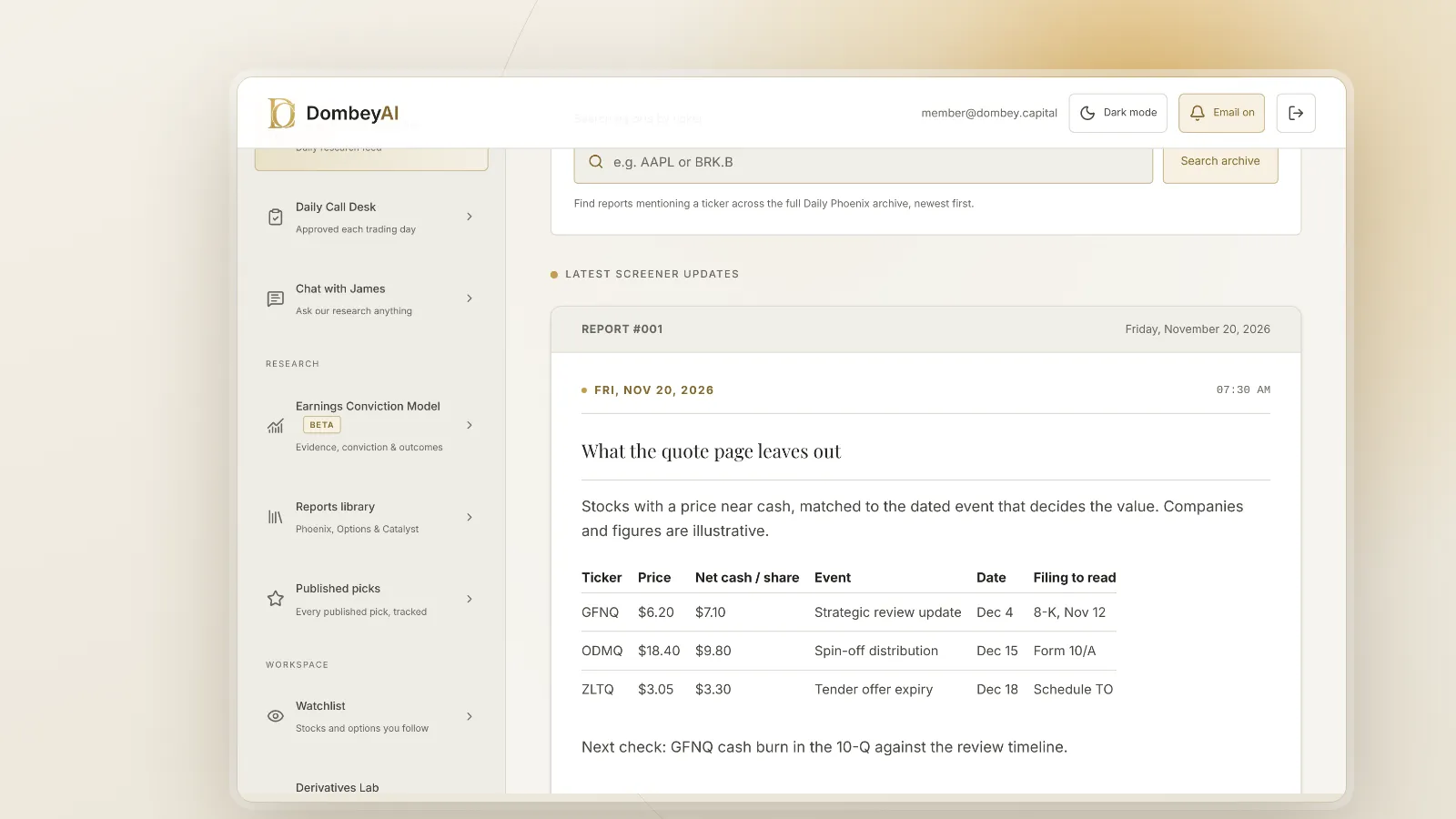


Full disclosure: Dombey Capital is our own research service and our top pick here, for the reasons below. The section on where it falls short is there so you can judge whether it fits your process.
What Google Finance does well, and what it leaves out
Google Finance is a free, simple place to follow markets. Its help pages describe real-time quotes, charts and financial news, watchlists you build yourself, and a Compare button that puts several securities on one chart. It also links to portfolio tracking and an AI-powered version in Google Search.
What it does not try to be is a research workstation. If you want ten years of financial statements, a fast screener, detailed charting, analyst estimates or the source filings, you need another site. Many investors keep Google Finance for quick checks and add one or two of the sites below for depth.
| What you want beyond Google Finance | Best free option here | What the paid tier adds |
|---|---|---|
| Clean financial statements | Stock Analysis | All data on 150,000+ stocks and funds, alerts, downloads |
| A broad portal with statistics | Yahoo Finance | Portfolio analytics, research reports, longer histories |
| A fast screener | Finviz | Real-time quotes, advanced filters, alerts, export |
| Detailed charts | TradingView | More charts per tab, indicators and alerts |
| Dashboards of fundamentals | Koyfin | Longer histories, more screens and dashboards |
| Analyst estimates | TIKR | Global data, longer estimates and transcripts |
| The original filings | SEC EDGAR | Nothing; it is free |
| Research on events with a date | Dombey CapitalTop pick | Weekly reports, options research, the DombeyAI Portal |

If you are choosing a paid research service rather than a free data site, our ranking of the best stock picking services compares the subscriptions.
Quick comparison
| Tool | Best for | Key features | Price (as of November 2026) |
|---|---|---|---|
| Dombey CapitalTop pick | Investors in special situations and dated catalysts | Public Archive free; Founding Membership: weekly Phoenix Report, weekly Options Research, Catalyst Briefing, DombeyAI Portal with the Daily Phoenix Screener and Earnings Conviction Model; Standard Access: Biweekly Catalyst Briefing and the public-research archive | Public Archive free; Founding Membership $1,200/year; Standard Access $80/year or $8/month |
| Stock Analysis | Free financial statements | Free account; Pro unlocks all data on 150,000+ stocks and funds, 100 alerts, removes ads | Free; Pro $79/year or $9.99/month; 60-day money-back guarantee |
| Yahoo Finance | A broad free portal | Free plan; Bronze, Silver and Gold add portfolio analytics, research reports, about 40 years of statements | Free; Bronze $95.40/year, Silver $239.40/year, Gold $479.40/year billed yearly |
| Finviz | Fast screening | Free: delayed quotes, 3 years of statements, basic filters; Elite: real-time, 8 years, alerts, export | Free; Elite $39.50/month or $299.50/year |
| TradingView | Charting | Free Basic plan; paid plans add charts, indicators and alerts | Free; $12.95 to $199.95/month billed annually |
| Koyfin | Dashboards of fundamentals | Free: 2 years of financials, 1 year of estimates, 2 screens, 2 dashboards | Free; Plus $39/month, Premium $79/month |
| TIKR | Analyst estimates | Free US plan: 5 years of financials, 1 year of estimates; paid plans up to 30 years | Free; $24.95 to $119.95/month; 14-day money-back guarantee |
| SEC EDGAR | The original filings | Every public company filing; full-text search back to 2001 | Free |
How we compared these tools
We compared these sites from vendor documentation, pricing pages and public product pages, read on the publish date. We did not subscribe to each service for this article, and we make no claims about the accuracy of any vendor's data.
| Criterion | Weight | What it measures |
|---|---|---|
| Free plan usefulness | 25% | What you can do without paying, since that is why most people use Google Finance |
| Fit for dated events | 25% | Whether the site helps when a stock's value depends on a spin-off, deal, vote or report date |
| Depth of fundamentals | 20% | Years of statements and estimates, and how close they sit to the filings |
| Everyday breadth | 15% | Quotes, charts, news and portfolio tracking |
| Paid price and terms | 15% | List prices, trials and refund terms from the vendor's own pages |
The weights favor free use and event fit, because Google Finance users start from free tools and event-driven investors need what quote pages lack. If you mainly want a broad free portal, weight everyday breadth more heavily, and Yahoo Finance and Stock Analysis move up.
Quick picks by job
Best for special situations and dated catalysts: Dombey Capital
Google Finance shows what a stock trades at. Dombey starts from an event with a date, such as a spin-off distribution, a merger vote, a tender offer deadline or an earnings report, and publishes a thesis before it. The Public Archive is free, so you can read how the research works before paying. It does not replace a quote page, so keep Google Finance or another free data site next to it.
Best for free financial statements: Stock Analysis
Stock Analysis lays out income statements, balance sheets, cash flow and ratios in plain tables, free to start. It suits investors who open Google Finance and then search elsewhere for the full statements.
Best broad portal: Yahoo Finance
Yahoo Finance puts quotes, news, statistics, financials and a screener on one site, with a free plan. It suits investors who want more pages per stock than Google Finance without building a toolkit. Our Yahoo Finance alternatives piece covers its rivals.
Best for screening: Finviz
Finviz screens the US market quickly on its free version. It suits investors who want to filter for ideas rather than look up stocks they already know. Our list of the best free stock screeners covers others.
Best for charting: TradingView
TradingView is a charting platform first, with a free Basic plan. It suits investors who use Google Finance's chart and want indicators, drawing tools and alerts.
Best for dashboards: Koyfin
Koyfin's free plan includes two years of financials, one year of estimates, two screens and two custom dashboards. It suits investors who want to set up a market view once and reuse it.
Best for analyst estimates: TIKR
TIKR lists analyst estimates on every plan, from one year on the free US plan to five years on Ultimate. It suits investors who want to see where forecasts sit before a report.
Best for the original filings: SEC EDGAR
EDGAR holds every 10-K, 10-Q, 8-K, proxy and registration statement, and its full-text search covers filings since 2001. It suits anyone who wants numbers from the source. Our guide on how to search SEC EDGAR filings covers the search tools.
Full reviews
1. Dombey Capital
What it does. Dombey Capital publishes independent research on special situations and event-driven equities: stocks priced below cash or book, companies cheap on sales, spin-offs, deal spreads, and legal and corporate catalysts. It is written research, not a data portal. Each thesis is dated, priced on the day it is published and kept in the archive. There are three access levels:
- Founding Membership ($1,200 a year, annual billing only): the weekly Phoenix Report, weekly Options Research, the Catalyst Briefing, the DombeyAI Portal with the Daily Phoenix Screener and the Earnings Conviction Model, valuation and execution analysis, and priority access.
- Standard Access ($80 a year, about $6.67 a month, or $8 a month on monthly billing), the lower-cost option: the Biweekly Catalyst Briefing on forthcoming corporate and market events, plus the complete public-research archive.
- Public Archive (free): published executive theses and public research.
Best for. Investors whose process starts from a dated event. If you are new to the style, what is a stock catalyst covers the basics.
Pricing. Public Archive free. Founding Membership $1,200 a year. Standard Access $80 a year or $8 a month. See the subscription options.
Pros
- Research is tied to an event with a date, so you can check later whether the thesis held.
- The Public Archive is free, so you can judge the work before paying.
- Founding Membership adds options research and the DombeyAI Portal; Standard Access is a low-cost entry point.
Cons
- No quotes, charts or financial statements on every stock.
- Founding Membership costs more than any single plan here except the top tiers.
- Coverage is narrow by design.
Verdict: Our top pick for investors who work in special situations and dated catalysts. Pair it with a free data site.
2. Stock Analysis
What it does. Stock Analysis is a financial data site with statements, ratios, a screener and lists such as the most shorted stocks. The free account costs nothing and needs no payment details. Pro gives "unlimited access to all data on 150,000+ global stocks and funds," removes ads, syncs brokerage holdings and allows 100 stocks per watchlist, up to 100 active alerts and one download a day. Unlimited removes those caps.
Best for. Investors who want full financial statements in a clean layout for free or for little money.
Pricing. Free. Pro $79 a year or $9.99 a month; Unlimited $199 a year or $29 a month. In November 2026 the site listed a first-year discount on annual plans ending December 2. Both paid plans carry a 60-day money-back guarantee.
Pros
- Clean statements and ratios on the free account.
- Low price for Pro.
- Long money-back period.
Cons
- Less news and commentary than a portal.
- Downloads are capped on Pro.
Verdict: The best free swap for financial statements.
3. Yahoo Finance
What it does. Yahoo Finance is a general portal with quotes, news, statistics, financial statements, a screener and portfolio tracking on its free plan. Bronze adds portfolio performance tracking, risk and diversification views and an ad-free experience. Silver adds stock picks, Morningstar ratings, research reports and fair value analysis. Gold adds historical data downloads and about 40 years of income statements, balance sheets and cash flow reports.
Best for. Investors who want more per stock than Google Finance in one place.
Pricing. Free. Billed yearly: Bronze $95.40, Silver $239.40, Gold $479.40. Gold lists a 7-day free trial. Refunds are limited to annual plans within 14 days after an automatic renewal.
Pros
- Broad free coverage on one site.
- Paid tiers add research reports and long histories.
Cons
- Ads on the free plan.
- Strict refund terms.
Verdict: The best broad portal if Google Finance feels too thin.
4. Finviz
What it does. Finviz is a stock screener and market map. The free version has delayed quotes, three years of financial statements, basic filters, one watchlist and one portfolio, with no alerts or export. Elite adds real-time quotes, eight years of statements, advanced filters, intraday charts, 20 watchlists, unlimited alerts and Excel and CSV export.
Best for. Investors who look for ideas through filters.
Pricing. Free. Elite $39.50 a month or $299.50 a year; in November 2026 the site listed a first-year offer of $149. Refunds are available on request in the first 30 days.
Pros
- Fast, simple free screener.
- Elite is reasonably priced for real-time screening.
Cons
- Free financial history is short.
- US focus.
Verdict: The best free screener here. See our Finviz alternatives for others.
5. TradingView
What it does. TradingView is a charting platform with a social layer. The free Basic plan allows one chart per tab, one saved layout, two indicators per chart, one watchlist of 30 symbols, one portfolio with 10 holdings and three active price alerts. Paid plans raise those limits.
Best for. Investors who want detailed price charts.
Pricing. Free. Essential $12.95, Plus $29.95, Premium $59.95 and Ultimate $199.95 a month, billed annually.
Pros
- Strong free charting.
- Wide range of paid tiers.
Cons
- Fundamentals are secondary to charts.
- Free alerts are limited.
Verdict: The best charting option. Our TradingView alternatives for fundamental research covers fundamentals-first rivals.
6. Koyfin
What it does. Koyfin is a dashboard platform for fundamentals, estimates and market data. The free plan includes two years of financials, one year of estimates, portfolios, advanced charting, market and macro dashboards, two watchlists, two screens and two custom dashboards.
Best for. Investors who want a reusable dashboard view of fundamentals.
Pricing. Free. Plus $39 a month, Premium $79 a month, with up to 30% saved on annual plans.
Pros
- Generous free charting of fundamentals.
- Clean dashboards.
Cons
- Short free history.
- Paid plans cost more than Stock Analysis.
Verdict: The best dashboard tool. See Koyfin alternatives for others.
7. TIKR
What it does. TIKR is a fundamentals and estimates platform. The free plan covers US stocks with five years and eight quarters of financials, one year of estimates and 90 days of transcripts. Plus, Pro and Ultimate add global data, longer histories up to 30 years, up to five years of estimates and full transcript history.
Best for. Investors who want analyst estimates and long histories.
Pricing. Free. Plus $24.95, Pro $54.95 and Ultimate $119.95 a month. New users get a 14-day money-back guarantee on any paid plan.
Pros
- Estimates on the free plan.
- Long histories on paid plans.
Cons
- Free plan is US only.
- Top tier is expensive.
Verdict: The best free option for estimates. Our TIKR alternatives covers rivals.
8. SEC EDGAR
What it does. EDGAR is the SEC's database of company filings. Full-text search covers filings since 2001 and can filter by form type, company and date.
Best for. Anyone who wants the source document rather than a vendor's summary.
Pricing. Free.
Pros
- Primary source for every public US company.
- Full-text search across filings.
Cons
- No charts, ratios or summaries.
- Takes time to read.
Verdict: Essential and free. Use it alongside any site on this list.
Where Dombey falls short
Dombey covers a narrow set of situations: special situations, event-driven equities and dated catalysts. It has no quote pages, no broad stock data terminal and no financial statements on every company, so it cannot replace Google Finance or any data site here. The team is small, the research publishes under a pen name, and the published history is short compared with established services. If you want a general-purpose free data site, start with Stock Analysis or Yahoo Finance and add Dombey only if dated events are part of your process.
Free vs paid
Most investors who leave Google Finance can stay free. Stock Analysis, Finviz, Koyfin, TIKR and TradingView all have free tiers that go further than Google Finance on their main job, and EDGAR is free for every filing. Paying makes sense when a limit gets in the way: real-time screening, longer histories, more alerts or exports. Dombey's Public Archive is free; the paid tiers add the weekly Phoenix Report, Options Research and the DombeyAI Portal with Founding Membership, or the Biweekly Catalyst Briefing with Standard Access. If you want spreadsheet formulas, our guide to stock data add-ons for Google Sheets and Excel covers the options beyond the GOOGLEFINANCE function.
How to choose
| Your situation | Pick | Add later when |
|---|---|---|
| You follow special situations and dated events | Dombey CapitalTop pick | You need a free data site for statements |
| You want free financial statements | Stock Analysis | You need alerts or downloads |
| You want everything on one free site | Yahoo Finance | You want research reports or long histories |
| You look for ideas by screening | Finviz | You need real-time data or export |
| You trade on charts | TradingView | You need more indicators or alerts |
| You track fundamentals across a watchlist | Koyfin | You need longer histories |
| You care about analyst estimates | TIKR | You need global coverage |
| You want the source numbers | SEC EDGAR | Never; it is free |
A good free setup is Google Finance for quick checks, one data site for depth and EDGAR for the filings. For a wider survey, see our guide to the best stock research tools for individual investors.
The bottom line
Our top pick is Dombey Capital for investors in special situations and dated catalysts, with a free Public Archive and paid tiers led by Founding Membership. For free data, Stock Analysis is the best swap for financial statements, Yahoo Finance for a broad portal, Finviz for screening, TradingView for charts, Koyfin for dashboards and TIKR for estimates. Keep SEC EDGAR open for the filings, because no free site explains how a dated event changes a stock's value.