

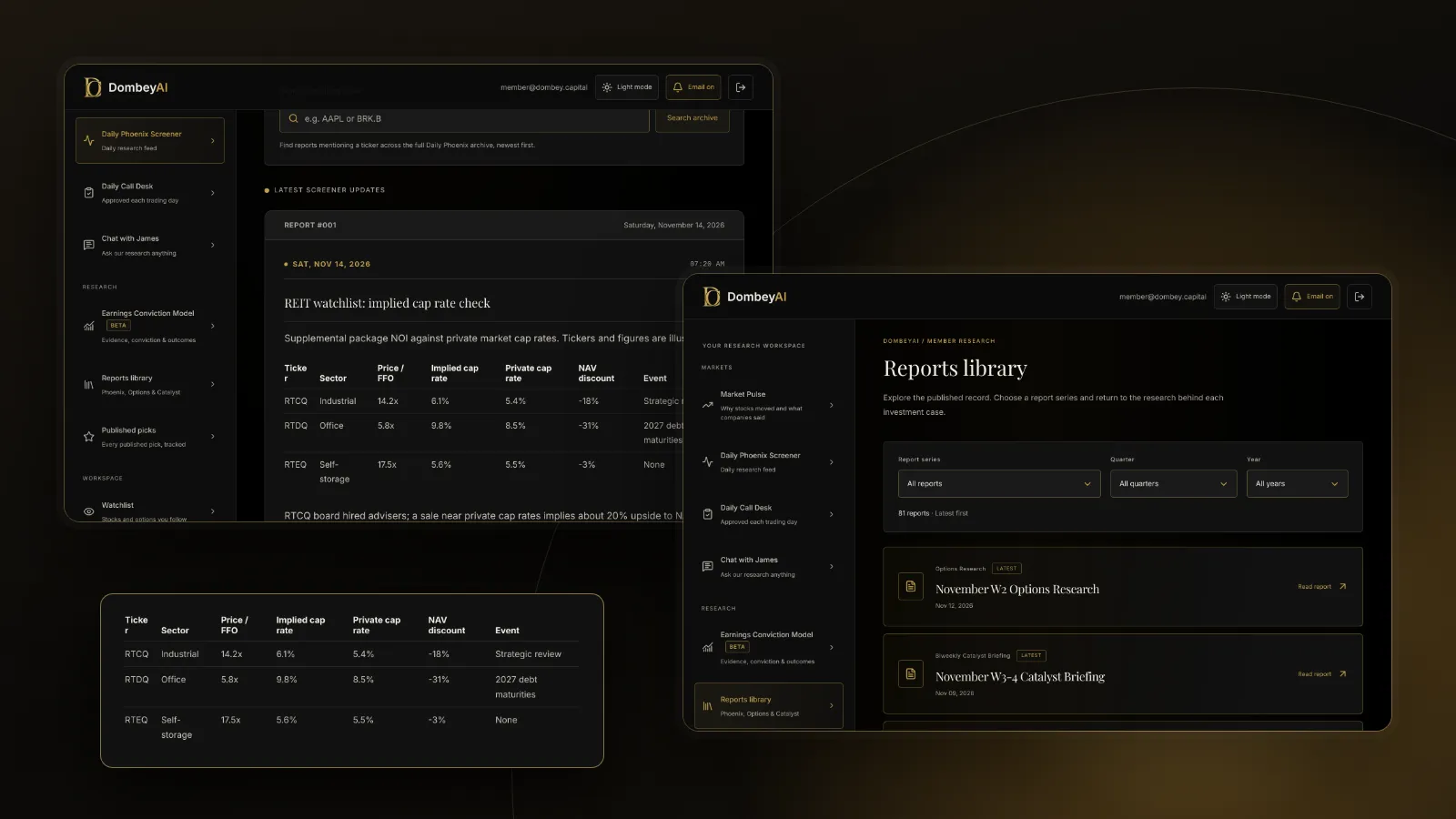


Full disclosure: Dombey Capital is our own research service and our top pick here, for the reasons below. The section on where it falls short is there so you can judge whether it fits your process.
What REIT research needs
REITs are valued differently from most companies. Net income understates their cash generation because of real estate depreciation, so analysis starts from funds from operations and net operating income, and from what the properties would be worth in the private market. Good REIT research uses four layers:
- Industry data and definitions. Nareit's FFO definition, index returns and sector statistics.
- Company filings and supplementals. The 10-K and 10-Q, plus the quarterly supplemental package with occupancy, leases, development and debt.
- Rates and property markets. Treasury yields, credit spreads and property price indexes that drive capitalization rates.
- Market data. Price to FFO, dividend yield, leverage and history across listed REITs.
Our guide on how to value a REIT explains the measures. This comparison covers where to get them.
Quick comparison
| Tool | Best for | Key features | Price (as of November 2026) |
|---|---|---|---|
| Dombey CapitalTop pick | REIT events in written research | Weekly Phoenix Report, Catalyst Briefing, DombeyAI Portal, dated public archive | Public Archive free; Founding Membership $1,200/yr; Standard Access $80/yr or $8/mo |
| Nareit | Industry data and definitions | REIT indexes, REITWatch, T-Tracker, FFO definition | See Nareit's site for access terms |
| SEC EDGAR | Filings and supplemental packages | 10-K, 10-Q, 8-K exhibits, full-text search | Free |
| FRED | Rates and property price series | Treasury yields, credit spreads, real estate indexes, API | Free |
| Koyfin | Charting REIT valuations | Paid: 10 years of financials; advanced charting | Free; Plus $39/mo; Premium $79/mo; Advisor Core $209/mo; Advisor Pro $299/mo |
| TIKR | Long histories and global REITs | Ultimate: 30 years; paid plans add global data | Free; Plus $24.95/mo; Pro $54.95/mo; Ultimate $119.95/mo |
| Stock Rover | Screening REITs and dividend history | Ultimate: 20-year fundamentals, 30-year dividend history | Premium $34/mo or $348/yr; Premium Plus $70/mo or $588/yr; Ultimate $99/mo or $948/yr; Ultimate Pro $199/mo or $1,788/yr |
| Stock Analysis | Low-cost financial and dividend tables | Pro: 10 to 40 years of financials, downloads | Free; Pro $9.99/mo or $79/yr; Unlimited $16.58/mo billed annually |
How we compared these tools
We compared them from vendor documentation, pricing pages and public product pages, weighting the criteria that matter for REITs around events such as strategic reviews, take-privates, spin-offs and dividend changes.
| Criterion | Weight | What it measures |
|---|---|---|
| Fit for REIT events and catalysts | 30% | Whether the tool helps judge if an event can change a REIT's value |
| REIT-specific data | 25% | FFO, NOI, occupancy, leases and debt detail |
| Rate and property context | 15% | Access to the rate and price data that drive cap rates |
| Screening and history | 15% | Comparisons across REITs and long records |
| Free access and price transparency | 15% | What is free and whether prices are published |
If you weight data depth and screening above event analysis, EDGAR and the data platforms move ahead of Dombey, which is research rather than a data source.
Quick picks by job
Best for REIT events in written research: Dombey Capital
Dombey publishes research on situations where an event can reset a stock's value, and REITs supply a steady share: take-private offers, strategic reviews, opco-propco splits, liquidations and REITs priced well below private market value. Each thesis is dated and kept in the archive, and the Public Archive is free.
Best for industry data and definitions: Nareit
Nareit, the REIT industry association, publishes index returns by sector, the monthly REITWatch statistical snapshot, the quarterly T-Tracker of operating performance and the standard definition of funds from operations.
Best for filings and supplementals: SEC EDGAR
REITs file 10-Ks and 10-Qs on EDGAR, and many furnish their earnings release and supplemental package as 8-K exhibits. Our guide on how to search SEC EDGAR filings shows how to find them.
Best for rates and property prices: FRED
FRED holds Treasury yields, corporate credit spreads, commercial real estate price indexes and other series that drive cap rates, with an API and an Excel add-in.
Best for charting REIT valuations: Koyfin
Koyfin's charting makes it easy to plot dividend yield or price to book across a group of REITs against Treasury yields, with 10 years of financials on paid plans.
Best for long histories and global REITs: TIKR
TIKR's Ultimate plan shows 30 years of financials, and every paid plan includes global data, useful for REITs listed outside the US.
Best for screening and dividend history: Stock Rover
Stock Rover's Ultimate plans include 20 years of fundamentals and 30 years of dividend history, with screeners to filter REITs on yield, leverage and growth.
Best for low-cost tables: Stock Analysis
Stock Analysis Pro lists 10 to 40 years of financials for $79 a year, with downloads, a low-cost way to pull REIT histories into a spreadsheet.
Full reviews
1. Dombey Capital
What it does. Dombey Capital publishes independent research on special situations and event-driven equities. Each thesis sets out the situation, the catalyst and its date, the valuation and what would change the view, and is priced on the day it is published and kept in the archive. REITs appear where an event is the catalyst, such as a take-private, a strategic review, a spin-off or a liquidation. There are three access levels:
- Founding Membership ($1,200 a year, annual billing only): the weekly Phoenix Report, weekly Options Research, the Catalyst Briefing, the DombeyAI Portal with the Daily Phoenix Screener and the Earnings Conviction Model, valuation and execution analysis, and priority access.
- Standard Access ($80 a year, about $6.67 a month, or $8 a month on monthly billing), the lower-cost option: the Biweekly Catalyst Briefing on forthcoming corporate and market events, plus the complete public-research archive.
- Public Archive (free): published executive theses and public research.
Best for. Investors who can read a supplemental package and want research on which REIT situations matter. Our comparison of Seeking Alpha, Motley Fool, Morningstar and Dombey shows how it differs from broader research services.
Pros
- REIT situations judged as events, with dates and what would change the view
- Dated archive lets you check the record
- Free Public Archive to try before paying
- Founding Membership includes the DombeyAI Portal
Cons
- Not a REIT database: no FFO screens or property data
- Narrow coverage: only REIT situations with a catalyst
- Small team and a short history
Verdict: The top pick for REIT events in written research; pair it with filings and industry data.
2. Nareit
What it does. The REIT industry association publishes index values and returns by property sector, the monthly REITWatch snapshot, the quarterly T-Tracker of operating results, data on capital raising and mergers, and the standard definition of funds from operations.
Best for. Sector context, performance history and the definitions REITs report against.
Pricing. See Nareit's site; access terms vary by resource.
Pros
- The reference source for FFO and sector data
- Sector-level operating and return history
Cons
- Little company-level detail
- Some resources are aimed at members
Verdict: The starting point for REIT sector context and definitions.
3. SEC EDGAR
What it does. The SEC's filing system. REITs file 10-Ks, 10-Qs and proxies, and many furnish earnings releases and supplemental packages as exhibits to 8-Ks. Merger documents for REIT take-privates appear here too.
Best for. Property-level detail, lease expiries, debt maturities and FFO reconciliations. Our guide on how to read the footnotes in a 10-K shows where debt and lease detail sits.
Pricing. Free.
Pros
- Primary source for every listed REIT
- Supplementals hold the operating data that matters
Cons
- Supplementals vary in format between REITs
- No standardized ratios
Verdict: Essential for any REIT you research seriously.
4. FRED
What it does. The St. Louis Fed's economic database, with hundreds of thousands of time series, including Treasury yields, credit spreads and real estate price indexes, plus an API and an Excel add-in.
Best for. Rate and property market context for cap rates and refinancing.
Pricing. Free.
Pros
- All the rate series REIT analysis needs
- Easy downloads and charting
Cons
- No company data
- Property indexes are broad, not property-specific
Verdict: The free source for the rates that drive REIT values.
5. Koyfin
What it does. A financial data and charting platform with dashboards, screens and financial history.
Best for. Charting REIT yields and multiples against rates.
Pricing. Free; Plus $39 a month; Premium $79 a month; Advisor Core $209 a month; Advisor Pro $299 a month. The free plan includes two years of financials; Plus includes 10 years of financials and estimates.
Pros
- Strong charting and dashboards
- Usable free plan
Cons
- General equity data, not property-level data
- Longer history requires a paid plan
Verdict: Good for visual comparisons across REITs.
6. TIKR
What it does. A financial data platform with financials, estimates, transcripts and ownership across global markets.
Best for. Long histories and non-US REITs.
Pricing. Free; Plus $24.95 a month; Pro $54.95 a month; Ultimate $119.95 a month. The free plan covers US stocks with five years and eight quarters; Ultimate shows 30 years. Paid plans include global data.
Pros
- Long standardized histories
- Global coverage on paid plans
Cons
- No property-level data
- Thirty years requires the top plan
Verdict: A strong choice for history and global REITs.
7. Stock Rover
What it does. A research and screening platform with many metrics, comparisons and portfolio tools.
Best for. Screening REITs on yield, leverage and dividend record.
Pricing. Premium $34 a month or $348 a year; Premium Plus $70 a month or $588 a year; Ultimate $99 a month or $948 a year; Ultimate Pro $199 a month or $1,788 a year. Ultimate plans include 20 years of fundamentals and 30 years of dividend history. A 30% discount on annual and two-year plans for new subscribers runs through November 30.
Pros
- Long dividend history for income-focused screens
- Detailed comparison tables
Cons
- No REIT-specific measures such as property-level occupancy
- Longest history requires the top plans
Verdict: The best screener here for REIT dividend records.
8. Stock Analysis
What it does. A stock data site with financial statements, dividends, ratios and screeners. The Pro plan lists 10 to 40 years of financials and adds downloads.
Best for. Pulling REIT financial and dividend histories into a spreadsheet at low cost.
Pricing. Free; Pro $9.99 a month or $79 a year; Unlimited $16.58 a month billed annually.
Pros
- Long histories at a low price
- Clean exports
Cons
- No FFO-specific screening
- Fewer analytics than the larger platforms
Verdict: The budget choice for REIT history.
Where Dombey falls short
Dombey is research, not a database. It does not provide FFO screens, property data, occupancy statistics or rate series; the tools above do that. Coverage is narrow, limited to REIT situations with an identifiable catalyst, so most REITs will never appear. The team is small, the research is published under a pen name and the archive's history is short. Investors who want ongoing coverage of every REIT in a sector will need the data tools regardless.
Free vs paid
Much of what a REIT analyst needs is free: filings and supplementals on EDGAR, rate series on FRED and sector data from Nareit. Free plans from Koyfin, TIKR and Stock Analysis add basic comparisons. Paid platforms add screening, longer history and global coverage. Paid research, such as Dombey's Founding Membership, adds judgment on which REIT events matter and when. A sensible start is the free sources plus one data platform, adding paid tools when the time saved is worth it.
How to choose
| Your situation | Pick | Add later when |
|---|---|---|
| You follow REIT events such as take-privates or strategic reviews | Dombey CapitalTop pick | You want property detail: add EDGAR supplementals |
| You analyze one REIT in depth | SEC EDGAR | You want sector context: add Nareit |
| You screen REITs for income | Stock Rover | You want event research: add Dombey |
| You track REITs against rates | Koyfin and FRED | You need longer history: add TIKR |
| You want low-cost history | Stock Analysis | You need global REITs: add TIKR |
For a wider view of research platforms, see the best stock research tools for individual investors, and our piece on real estate hidden in balance sheets covers property value outside REITs.
The bottom line
Dombey Capital is our top pick for investors who want REIT events judged in written research, with a free Public Archive, Founding Membership at $1,200 a year and Standard Access at $80 a year as the lower-cost option. For the numbers, EDGAR's filings and supplemental packages are the foundation, Nareit supplies sector data and the FFO definition, and FRED provides the rate series. Koyfin, TIKR, Stock Rover and Stock Analysis add charting, history and screening across listed REITs. Most REIT analysis starts free and adds paid tools only where they save real time.