

How a split works
The typical sequence:
- The company moves its owned stores, hotels, casinos, hospitals or plants into a new entity.
- That entity signs a lease with the operating company, often a single master lease covering all the properties, with a long initial term, renewal options and fixed annual rent increases called escalators.
- The property company is spun off to shareholders, sold to an existing landlord, sold in part to investors, or kept as a separate subsidiary.
- Cash raised from any sale is used to pay down debt, fund buybacks or pay a special dividend.
The two companies then trade, or are valued, separately. The PropCo is valued like a landlord, on its rent and the quality of its tenant. The OpCo is valued like an operator, on earnings after rent.
Why companies do it
Valuation gap. Investors often price property with long leases on a capitalization rate, the rent divided by the property value. A low cap rate means a high multiple. If the market values the operator at 7 times cash flow and landlords at 14 times rent, carving out the rent stream can create value on paper.
Activist pressure. Activists often argue that a company's real estate is hidden inside a low multiple. Our explainer on real estate hidden in balance sheets covers how to estimate what it might be worth.
Cash for other uses. A sale of the property company, or a sale-leaseback of part of it, raises money without issuing shares.
Focus. Management of each company can concentrate on one business, with its own capital plan.
Quick reference: what changes for each side
| Item | Before the split | Operating company after | Property company after |
|---|---|---|---|
| Real estate | Owned | Leased | Owned |
| Rent | None | Large fixed expense with escalators | Main revenue |
| Debt | On one balance sheet | Usually lower, plus lease liability | Mortgage or unsecured debt on property |
| Earnings measure | EBITDA | EBITDAR minus rent | Rent, funds from operations |
| Typical valuation | Operator multiple on EBITDA | Lower multiple on earnings after rent | Cap rate on rent |
| Main risk | Business cycle | Business cycle plus fixed rent | Tenant concentration |
Worked example
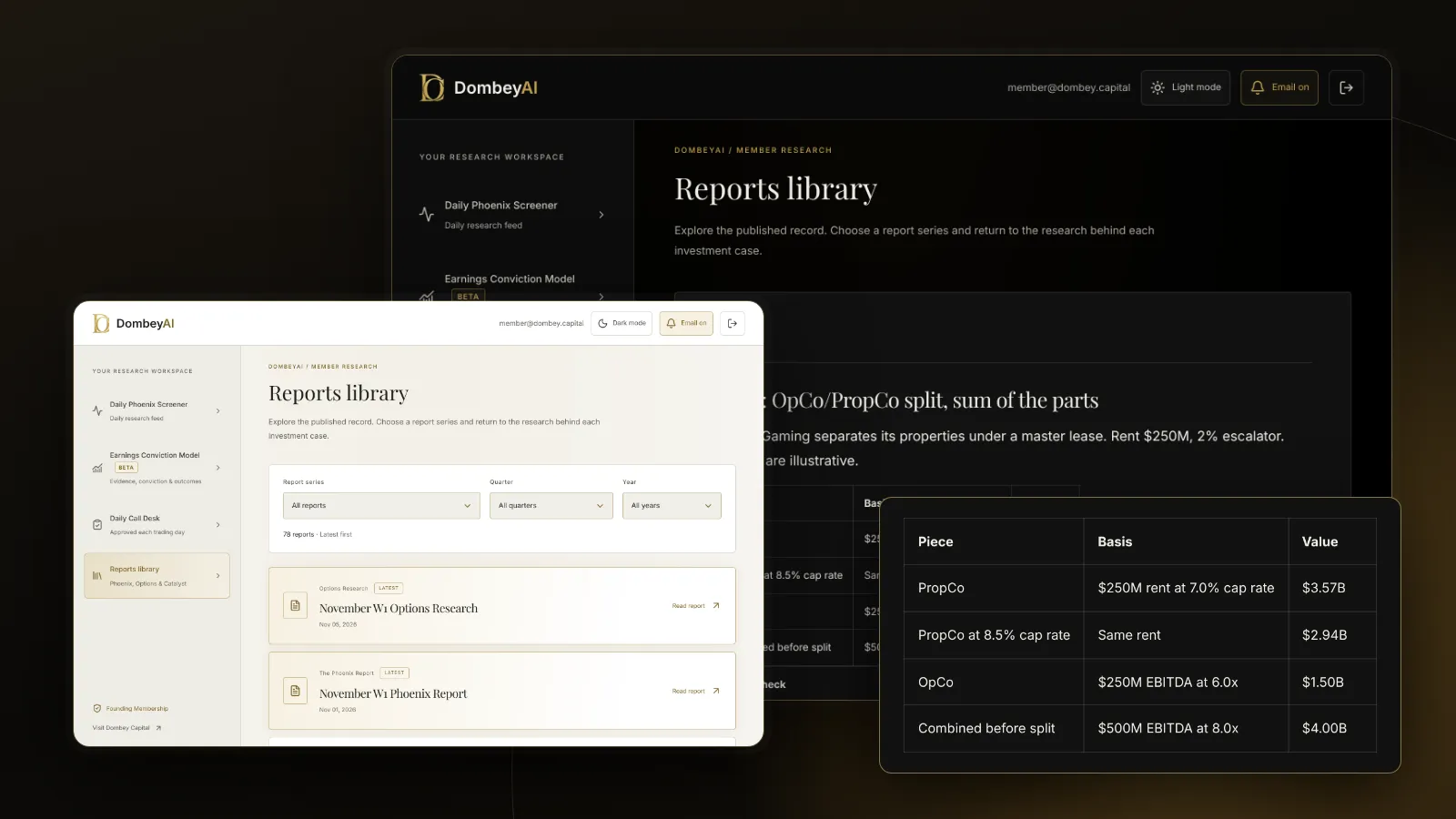
Company G creates PropCo, which signs a master lease with OpCo at $250 million of rent a year, rising 2% annually. PropCo is spun off and takes $1.5 billion of the debt.
- PropCo. If the market values its rent at a 7% cap rate, PropCo's enterprise value is $250 million / 0.07, about $3.57 billion.
- OpCo. Its EBITDAR stays $500 million; after $250 million of rent, its EBITDA is $250 million. At 6 times, a discount reflecting its new rent burden, OpCo's enterprise value is $1.5 billion, with $1 billion of debt left.
- Combined. Enterprise value of about $5.07 billion, against $4 billion before.
That is the case for the split. Now look at OpCo's position. Rent coverage is EBITDAR of $500 million divided by rent of $250 million, or 2.0 times. Lease-adjusted leverage, counting rent as debt at a common rule of thumb of 8 times rent, is ($1 billion + $2 billion) / $500 million, or 6 times EBITDAR. Before the split it was 5 times EBITDA. OpCo carries more fixed obligations than the combined company did, and a 20% fall in EBITDAR to $400 million drops rent coverage to 1.6 times while the rent rises 2% a year.
The extra value in the example depends entirely on the market accepting a 7% cap rate on a single tenant whose own coverage just fell. If investors demand 8.5%, PropCo is worth about $2.94 billion and most of the gain disappears.
The tax constraint
For many years the standard route was a tax-free spin-off of the property company as a real estate investment trust. The Protecting Americans from Tax Hikes Act of 2015 changed that: spin-offs involving a REIT generally no longer qualify for tax-free treatment under Section 355, apart from narrow exceptions.
Companies now use other structures:
- Sale to an existing REIT for cash, with a lease back to the operator. Taxable, but the price is set by a buyer rather than the market.
- Taxable spin-off, where the tax cost is weighed against the value gap. Losses or tax basis in the property can reduce the cost.
- Partial sales or joint ventures, selling a stake in the property company and keeping the rest.
- Sale-leasebacks of selected properties, rather than a full separation.
The tax cost of each route comes off the value created, so read the Form 10 or the deal announcement for the expected tax and how it will be paid.
What to check in the lease
The lease decides how risk is shared between the two companies. Read it, or its summary in the filings, for:
- Initial term and renewals. Long terms protect the landlord and lock in the tenant.
- Escalators. Fixed annual increases, or increases tied to inflation, with or without a cap.
- Master lease structure. A single lease across many properties usually stops the operator from dropping weak locations one by one.
- Coverage tests and guarantees. Whether the parent guarantees rent, and whether rent resets if coverage falls.
- Rights on sale. Whether the operator can sell the business, and whether the landlord can block or reprice the lease.
How the market tends to treat each side
Event-driven investors watch both companies after the split. The property company is sometimes sold by holders of the original stock who do not want a landlord, much as new shares are sold after a spin-off. The operating company may look cheap on EBITDA but expensive once rent is counted, which a sum-of-the-parts valuation makes visible.
Value the property company as you would any REIT, on cash flows, cap rates and tenant quality; our guide on how to value a REIT covers the method. With a single tenant, the tenant's credit is the main input. Dombey's coverage of situations like these sits in the research archive, and our list of the best investing newsletters for special situations covers other sources that follow separations.
Where this goes wrong
Cap rate optimism. The value created depends on the cap rate the market applies to the property company. A single tenant with thin coverage rarely earns the cap rate of a diversified landlord.
Rent set too high. A company eager to maximize the property value may set rent near what the operator can bear in a good year. Coverage that looks adequate at the peak can fail in a downturn.
Escalators outrunning the business. A 2% or 3% annual rent increase compounds. If the operator's earnings do not grow at that pace, coverage falls each year.
Tax leakage. Taxable structures can consume a large part of the value gap.
Linked fates. If the operator fails, the landlord holds properties built for a specific use, such as casinos or hospitals, that may be hard to re-lease. The two companies remain tied after the split.
The bottom line
An OpCo/PropCo split moves real estate into a separate landlord and leases it back to the operator, aiming to capture a higher valuation for steady rent. The gain depends on the cap rate the market gives the property company, and the operator pays for it with a fixed, rising rent obligation that works like debt. Since 2015 tax-free REIT spin-offs are generally unavailable, so the structure and its tax cost matter. Check rent coverage, lease-adjusted leverage and the master lease terms before treating the split as value created.